
6 Safe Steps UK Couples Can Take to Start Swinging With Consent
6 Safe Steps UK Couples Can Take to Start Swinging With Consent
Swinging for couples means two committed partners consensually engaging in sexual activity with other people together, as a shared social and sexual choice rather than a secret or a fix for problems at home. It works when both of you are genuinely enthusiastic, your communication is already solid, and you’ve agreed on boundaries in advance. If either partner feels pressured, start with a conversation, not an event, and agree on a stop word before you do anything else.
TL;DR:
- Soft swap is recommended for beginners because it limits risk while still allowing testing comfort levels before progressing to full swap.
- Establish clear boundaries and a stop word before engaging in any swinging activity to ensure mutual safety and consent during encounters.
- Use verified platforms that combine AI screening and mutual-interest messaging to reduce profiles’ fake or pressured interactions before meeting in person.
- Swinging works best for stable couples who genuinely want a shared recreational experience and should not be used to fix underlying relationship issues.
- Regular STI testing, condom use, and respecting digital privacy are essential for safety, with community guidelines emphasizing consent and boundary enforcement.
Table of Contents
- What Swinging for Couples Actually Involves
- Soft Swap, Full Swap, and Other Terms You’ll Hear
- What Rules Should Couples Set Before Swinging?
- How Do You Start Swinging as a Couple?
- Staying Safe: Sexual Health, Testing, and Privacy
- How Do You Handle Jealousy and Emotional Fallout?
- Where Do Couples Meet Others in the Lifestyle?
- How Verification Systems Reduce Risk for New Couples
- A Balanced Note for Couples Still Deciding
- Getting Started Safely With SwingersUK
- Sources
What Swinging for Couples Actually Involves
Swinging is a sexual practice where partners in a committed relationship consensually engage in sexual activity with other adults, and the emphasis sits on mutual consent, transparency, and doing this together rather than separately, according to the foundational definition on Wikipedia). That last part is what separates it from other forms of consensual non-monogamy people often lump together.
Three pillars hold the whole thing up. Consent means every person involved, including partners outside your relationship, agrees freely and can withdraw at any point. Transparency means your partner knows what’s happening, when, and with whom. Togetherness means you experience this as a shared activity between you and your partner, not as two parallel, disconnected pursuits.
Polyamory typically involves ongoing emotional relationships with multiple people, often with the goal of building lasting romantic bonds outside the primary couple. Open relationships give each partner independent freedom to date or sleep with others, sometimes without the other’s direct involvement. Swinging is narrower and, for many couples, less complicated to manage precisely because it’s usually recreational and couple-centered rather than relationship-building with outside partners.
Couples give varied reasons for trying it. Some want novelty and adventure without risking their emotional bond elsewhere. Some are curious about group dynamics or watching their partner with someone else. Others are drawn to the couples lifestyle community itself, the friendships, the shared secret, the social calendar of events. None of these motives is more legitimate than another, but naming yours honestly with your partner matters more than the activity itself.
Soft Swap, Full Swap, and Other Terms You’ll Hear
Walk into any lifestyle conversation and you’ll hit a wall of shorthand fast. Here’s what the core terms actually mean:
- Soft swap: partners engage in activities like kissing, touching, or oral sex with others, but intercourse stays reserved for the primary couple.
- Full swap: partners have penetrative intercourse with other people, with the couple’s full agreement.
- Same-room play: both couples are in the same space, sometimes engaging together, sometimes watching.
- Separate-room play: couples split into different rooms or spaces, reconnecting afterward.
- Stag/vixen: a couple where the woman is the primary draw for social attention and the man supports or participates depending on arrangement.
- Unicorn: an partnered woman who joins couples, a role that’s in high demand and worth extra respect given how often single women get treated as an afterthought.
Soft swap tends to be the natural on-ramp for new couples because it limits risk while still testing how you both feel watching or being watched. Full swap usually comes later, once trust in the arrangement itself is established. Many beginner guides recommend exactly this staged approach, starting social and light before anything more happens, according to SwingsSpace’s beginner’s guide. Reading up on the difference between soft and full swap before your first event saves you from having a confusing negotiation in the moment.
What Rules Should Couples Set Before Swinging?
Boundaries set in a calm kitchen conversation hold up far better than ones improvised at 11 p.m. at a party. Work through these before your first outing:
- Decide your act list. Write down what’s in bounds (kissing, touching, oral, full intercourse) and what’s off the table entirely.
- Set kissing and intimacy rules. Some couples reserve mouth kissing for each other only; others don’t. Neither answer is wrong, but agree on it beforehand.
- Talk through repeat encounters. Is meeting the same couple twice fine, or does that start to feel like something more than swinging to either of you?
- Set an alcohol limit. Decide how much drinking is acceptable before play, since impaired judgment is where most regretted decisions happen.
- Agree on your stop word. Pick a word that means “stop this now, no explanation needed” and make sure you’d both actually use it.
A useful boundary sounds specific: “We kiss each other only,” or “No solo play, we stay in the same room,” or “We check in with each other every twenty minutes at events.” Vague boundaries like “let’s just see how it feels” tend to fall apart under real pressure.
Etiquette at events follows similar logic. Ask before touching, respect a “no” without pushback, arrive clean and well presented, and accept rejection gracefully since consent can be withdrawn at any moment without justification, a standard reputable clubs and communities enforce consistently.
Pro Tip: Write your boundaries down somewhere you can both reference later. Memory gets fuzzy in the moment, but a shared note removes the “wait, did we agree to that?” argument before it starts.
Red flags to walk away from: anyone who pressures you to go further than agreed, hosts who don’t enforce consent norms, or a partner who seems to negotiate boundaries differently depending on who’s watching.
How Do You Start Swinging as a Couple?
Before touching a single event listing, check the health of your relationship itself. Swinging works best as an addition to a relationship that’s already stable, not a repair job for one that’s struggling, and if you’re carrying unresolved resentment or trust issues, a few sessions with a therapist first will serve you better than a party will.
- Get clear on your individual “why.” Write down separately why you want this, then compare notes. Mismatched motives surface problems early.
- Have the real conversation. Use open questions: “What excites you about this?” “What would make you uncomfortable?” “What’s completely off limits?”
- Start social, not sexual. Attend a lifestyle meet-and-greet or club social night with zero pressure to play. Many couples spend several visits just observing and learning norms before doing anything else, a pattern echoed across beginner guidance.
- Try same-room play first. Being in the same space as another couple, even without full participation, tells you a lot about how you’ll actually feel versus how you imagined you’d feel.
- Attempt a soft swap before considering full swap. Lower stakes, easier to process, easier to stop midway.
- Build a first-event checklist. Confirm your stop word, agree on a check-in rhythm, bring your own condoms, and decide your exit plan before you arrive.
Our beginner’s guide to the lifestyle walks through this pacing in more depth if you want a longer runway before your first outing.
Staying Safe: Sexual Health, Testing, and Privacy
Swinging carries the same STI risk as any sexual contact with new partners, no more mysterious and no less real, which means safer-sex practices matter every time, not just the first few times.
- Use condoms consistently for intercourse and consider barriers like dental dams for oral contact.
- Get a baseline STI test before you start, then retest on a regular cadence (many clinics recommend every three to six months for people with multiple partners).
- Confidential testing is available through sexual health clinics and many general practitioners, so there’s no need to guess your status.
- Discuss contraception separately from STI prevention. They solve different problems.
- Protect your digital footprint: never share identifiable photos without explicit consent, be cautious about what personal details appear on profiles, and assume anything sent digitally could eventually be seen by someone else.
Statistic Callout: Community guides consistently flag consent and clear boundary-setting, not condom use alone, as the factor most strongly tied to couples having positive experiences in the lifestyle, according to Ravoke’s guide to ethical non-monogamy. Safer sex protects your body. Clear consent protects your relationship.
How Do You Handle Jealousy and Emotional Fallout?
Jealousy shows up even in couples who were certain they’d be fine. That’s normal, not a sign you’ve made a mistake, and pretending you won’t feel anything sets you up for a harder crash when you do.
- Name the feeling out loud rather than swallowing it. “I felt a flash of jealousy watching that” is a fact, not a confession of failure.
- Build a debrief into your routine after every encounter. What felt good? What didn’t? Anything to adjust next time?
- Practice aftercare deliberately. Reconnection time, physical closeness, and an honest conversation reduce post-encounter anxiety and reinforce your bond as aftercare rituals are shown to do.
- Pause the lifestyle entirely if resentment starts building instead of fading after debriefs. That’s a signal worth taking seriously, not pushing through.
- Consider couples counseling if jealousy feels disproportionate or keeps resurfacing after multiple honest conversations.
Pro Tip: Schedule your debrief for the next morning, not immediately after. Emotions right after an encounter run hot; a few hours of sleep gives you both clearer language for what you actually felt.
Swinging tends to strengthen communication and intimacy for couples who already had a solid foundation. It rarely fixes a relationship that was struggling before you started, a distinction worth sitting with honestly before you begin.
Where Do Couples Meet Others in the Lifestyle?
Meeting channels range from low-key to full-scale, and each has a different atmosphere worth knowing before you show up.
- Meet-and-greets are casual, clothed, conversation-first events designed for exactly the observation phase mentioned earlier.
- Private parties run smaller and more intimate, often hosted by established members of the swinger community.
- Clubs offer structured environments with house rules, often including designated play areas and social-only zones.
- Large events draw bigger crowds and a wider range of experience levels, from total newcomers to seasoned regulars.
Vet any host or event the way you’d vet anything else that matters: check reviews, confirm ID verification policies, and notice whether the venue actually enforces its stated consent rules or just posts them for show. Reputable clubs and organized communities enforce these standards closely, and many attendees observe for months before ever playing, a pattern that holds up across established beginner resources. Online communities have become the more common starting point simply because you can vet people before ever meeting in person, which brings its own advantages worth understanding on the platform side of things.
How Verification Systems Reduce Risk for New Couples
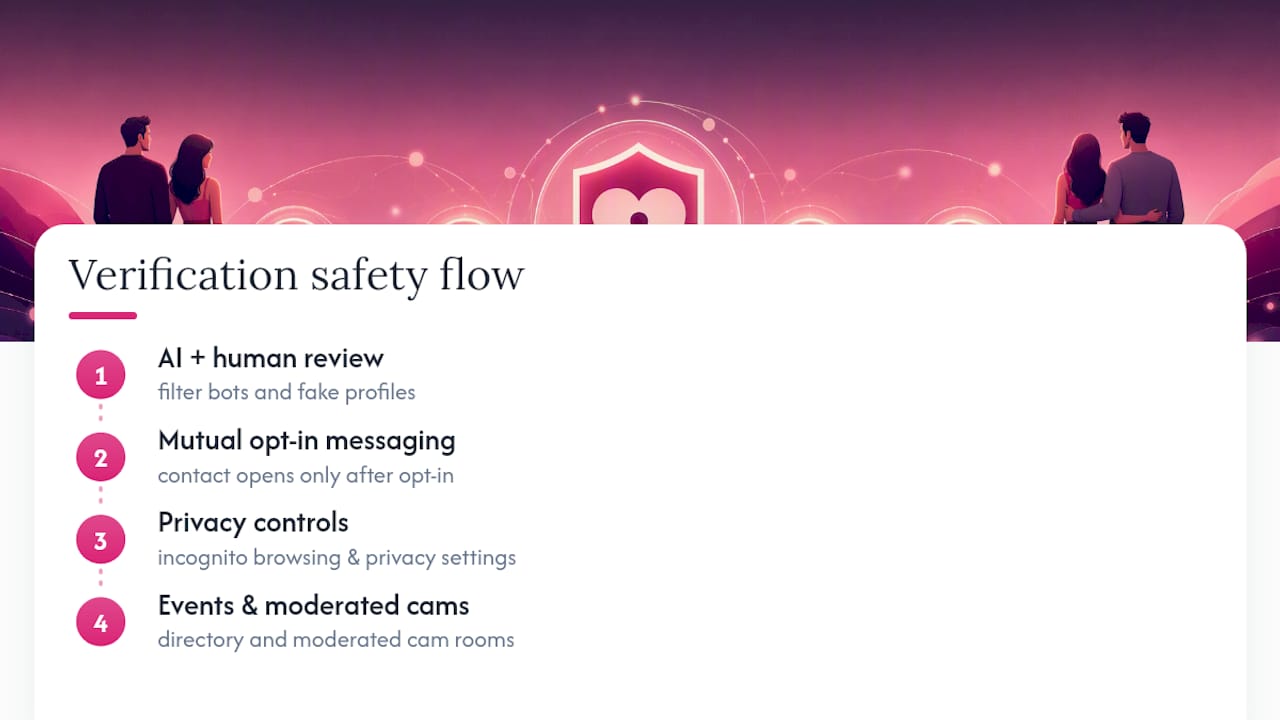
Fake profiles and pressure tactics are the two things that sour most people’s first experience with online swinger community platforms, and verification exists specifically to solve both. Combining AI screening with human review filters out bots and fabricated profiles before they ever reach your inbox, which matters more than most newcomers expect until they’ve dealt with the alternative.
Mutual-interest messaging systems, where both parties have to express interest before contact opens, remove the pressure dynamic entirely. Nobody’s fielding unwanted messages, and nobody’s guessing whether their interest is welcome. Paired with an event directory, moderated cam rooms, and privacy controls like incognito browsing, this kind of infrastructure turns the etiquette principles covered earlier, consent checks, respectful boundaries, no pressure, into something the platform itself enforces rather than something you have to police alone.
A Balanced Note for Couples Still Deciding
Uncertainty at this stage is normal, and if you’re still unsure after reading all this, that’s not a red flag. It just means you’re taking it seriously.
Swinging isn’t a cure for a struggling relationship, and it’s not a milestone you’re supposed to hit on any timeline. It’s a choice, available if and when it fits, and there’s no penalty for moving slower than you think you should. Use verified communities over anonymous ones, lean on real conversation over assumption, and don’t hesitate to bring in a couples therapist if old insecurities resurface once you start exploring. The couples who do well here tend to be the ones who treated the process itself, not just the outcome, as worth doing carefully.
— Daniel
Getting Started Safely With SwingersUK
Everything covered above, vetting hosts, avoiding pressure, protecting your privacy, gets considerably easier on a platform actually built around those problems. SwingersUK combines AI and human-reviewed identity checks to strip out fake profiles before they reach you, so the vetting work described in the meeting-others section happens before you even log in.
The Pulse Handshake System requires mutual interest before either side can message, which directly solves the pressure problem covered in the etiquette section, nobody messages you without matching interest first, and nobody has to field unwanted attention. The platform’s event directory and private cam rooms give you a next step after your first observation phase, and incognito privacy controls protect the digital footprint concerns raised earlier.
Start by reading the community guidelines to understand house rules before you create a profile, then check pricing for the membership tier that fits how actively you plan to explore.

Sources
For deeper research beyond this guide, the Wikipedia entry on swinging covers terminology and history. SwingsSpace’s beginner’s guide and Ravoke’s guide to ethical non-monogamy both offer detailed etiquette breakdowns. SwingersUK’s Guidelines page covers platform-specific rules.