
Open Relationship vs Swinging: What Sets Them Apart
Open Relationship vs Swinging: What Sets Them Apart
An open relationship centers a primary partnership that allows sexual, and sometimes emotional, connections outside it. Swinging is a recreational, couple-centered form of non-monogamy focused on shared sexual experiences, usually kept separate from emotional attachment. That’s the core split in the open relationship vs swinging question: one is about individual freedom within a committed structure, the other is about a couple doing something together.
- Open relationship: a primary couple agrees that either partner can pursue outside sex, and sometimes romance, under negotiated terms.
- Swinging: a couple engages in sexual activity with others, often together, while keeping the emotional focus on each other.
- Who fits where: open relationships tend to suit people who want individual sexual or romantic autonomy; swinging tends to suit couples who want to share new experiences without introducing outside emotional entanglement.
The next step for either is the same: talk it through, write down what you agree to, and test the waters with something small before committing to more.
Key Takeaways
Open relationships prioritize individual sexual and sometimes emotional freedom within a committed structure, while swinging prioritizes shared, couple-centered sexual experiences with minimal outside emotional involvement.
| Point | Details |
|---|---|
| Core distinction | Open relationships allow individual outside connections; swinging keeps the focus on shared couple experiences. |
| Emotional risk varies | Open relationships carry more emotional negotiation; swinging carries more logistical and health considerations. |
| Use agreements, not rigid rules | Written or verbal agreements that get revisited every few months outperform one-time, unchangeable rule sets. |
| Compersion takes practice | Feeling genuine joy at a partner’s pleasure with someone else develops over time, not automatically. |
| Verification matters for safety | Platforms like Swingersuk use ID checks and mutual opt-in messaging to reduce fake profiles and unwanted contact. |
Table of Contents
- Open Relationship vs Swinging: Defining the Terms
- What Is an Open Relationship?
- What Is Swinging?
- Key Differences at a Glance
- Common Rules, Jargon, and Sample Agreements
- Managing Jealousy, Compersion, and Consent
- Where Encounters Actually Happen
- Sexual Health and Safety Precautions
- Pros and Cons of Each Approach
- How to Decide Which Fits You
- Common Myths About Non-Monogamy
- Why the Couple-First Framing Gets Overlooked
- Finding a Verified Swinging Community
- Frequently Asked Questions
- Sources
Open Relationship vs Swinging: Defining the Terms
Before you can decide which style fits, you need to know what each term actually covers, since both fall under the umbrella of consensual non-monogamy but point in different directions. Consensual non-monogamy includes several distinct types, including polyamory, open relationships, and swinging, and each carries its own emotional logic and rules.
What Is an Open Relationship?
An open relationship is a broad label for a committed partnership where both people agree that outside sexual, and sometimes emotional, connections are allowed. Wikipedia’s overview of the arrangement notes that usage varies widely from couple to couple, which is exactly why the term causes confusion. Two couples can both call themselves “open” and mean very different things.
Some common shapes this takes:
- Monogamish: occasional, low-frequency outside encounters, usually with strict disclosure and minimal emotional involvement.
- Negotiated open: clear written or verbal rules covering who, when, where, and what gets shared afterward.
- Long-term open: ongoing outside relationships that can include real affection, sometimes running for months or years alongside the primary partnership.
A couple practicing the monogamish version might allow a one-time encounter on a work trip, with a same-day text confirming it happened and nothing more. A couple in a long-term open arrangement might each maintain a secondary partner they see regularly, with the outside relationship known to, though not necessarily met by, the other primary partner.
Most agreements, regardless of shape, cover the same ground:
- Disclosure rules: how much detail gets shared, and how soon.
- Safer-sex expectations: condom use, testing schedules, and what counts as a dealbreaker.
- Emotional boundaries: whether falling for someone else is permitted, discouraged, or grounds to end the outside connection.
Men’s Health’s breakdown of non-monogamy styles frames open relationships as typically centering the primary partnership while allowing outside sex and sometimes emotional connection, distinct from swinging’s recreational, couple-first focus.
What Is Swinging?
Swinging is a recreational, couple-centered form of non-monogamy where both partners have sex with others, often in the same room or event, while keeping their emotional bond firmly between the two of them. Therapist Rachel Wright describes swinging as generally downplaying emotional involvement with outside partners, which is the trait that separates it most sharply from open relationships.
The activity itself usually happens in shared, planned settings rather than solo dates:
- Swinger parties and clubs: organized events where multiple couples meet, often with house rules posted at the door.
- Lifestyle travel: cruises, resorts, and takeover weekends built specifically around the swinging community.
- Private threesomes or foursomes: smaller, at-home arrangements between a couple and one or two trusted others, sometimes called “soft swap” or “full swap” depending on how far things go.
A couple new to the lifestyle might start with a meet-and-greet at a local club, chat with a few other couples over drinks, and leave without anything sexual happening at all. That’s normal. Swinging culture generally rewards patience over speed, and most experienced couples will tell newcomers to spend a few events just observing before participating.
The defining thread across all these settings is the couple-first dynamic: decisions get made together, either partner can veto a pairing, and the goal is a shared experience rather than an individual romantic pursuit. Community norms reinforce this. Most clubs and parties operate on explicit consent, and swinging communities often maintain specific etiquette rules, including expectations around who can approach whom and how a “no” gets respected without further discussion.

Key Differences at a Glance
Once you strip away the jargon, the two styles diverge across a handful of practical dimensions that matter for day-to-day decisions.
| Dimension | Open Relationship | Swinging |
|---|---|---|
| Emotional involvement | Sometimes permitted with outside partners | Generally discouraged; focus stays on the primary couple |
| Sexual exclusivity | Individual outside encounters, often solo | Shared encounters, usually with both partners present |
| Structure & agreements | Negotiated rules on disclosure and boundaries | Often looser individually, but shaped by community norms |
| Where encounters happen | Private dates, apps, individual meetups | Parties, clubs, lifestyle travel, private group settings |
| Community infrastructure | Minimal; mostly dating apps and forums | Established clubs, events, and verification-driven platforms |
| Typical risks | Jealousy, unequal outside involvement, secrecy | STI exposure at scale, stigma, mismatched comfort levels |
| Who it tends to suit | People wanting individual romantic or sexual freedom | Couples wanting shared experiences without emotional risk |
A few distinctions carry more weight than the table alone shows:
- The emotional involvement row is the real fork in the road. If either partner wants the option of falling for someone else, swinging’s couple-first norms will feel restrictive.
- Community infrastructure matters more than most newcomers expect. Swinging’s club and event culture means new participants can lean on established etiquette, while open relationships usually run on whatever the two partners invent themselves.
- Risk profiles differ in kind, not just degree. Open relationships carry more emotional risk (jealousy, comparison, secrecy), while swinging carries more logistical and health risk tied to group settings.
If your goal is variety without complicating your emotional life, swinging’s structure does more of the work for you. If your goal is more personal autonomy, even at the cost of navigating jealousy, an open relationship gives you that room.
Common Rules, Jargon, and Sample Agreements
Non-monogamy has its own vocabulary, and knowing it will save you from a confusing first conversation with a more experienced couple or a partner who’s already read up on the subject.
- 72-hour rule: a common guideline requiring a partner to wait 72 hours before acting on a new outside connection, giving both people time to think it through.
- 3-6-9: a set of check-in intervals (three, six, and nine months into a new outside relationship) some couples use to revisit agreements before things get too settled.
- Primary/secondary: hierarchical language distinguishing a main partnership (primary) from additional relationships (secondary), most common in open and polyamorous structures.
- Monogamish: a term for couples who are mostly monogamous but allow occasional, limited outside contact.
- Compersion: feeling genuine happiness about a partner’s pleasure with someone else, often treated as a skill rather than an automatic reaction.
- Triad/throuple: three people in a mutual relationship together, distinct from a couple who each separately see other people.
- Relationship anarchy: rejecting hierarchical labels altogether, treating every connection on its own terms without ranking.
Sample agreement clauses that real couples use:
- “Tell me within 24 hours if anything happens, but I don’t need details unless I ask.”
- “Condoms are non-negotiable with anyone outside our relationship, no exceptions.”
- “We only meet new people together first, even if one of us ends up seeing them one-on-one later.”
The language you choose matters here. “Rules” implies enforcement and consequences; “agreements” implies mutual consent that can be renegotiated. Counseling resources on ethical non-monogamy generally recommend framing everything as an agreement, since it keeps both partners as active participants rather than one person policing the other.
Managing Jealousy, Compersion, and Consent
Jealousy shows up in both styles, but it tends to surface differently. In open relationships, it often centers on emotional comparison: is my partner falling for this other person? In swinging, it more often centers on physical comparison in the moment, which is part of why so many couples start with soft limits before trying anything further.

Compersion, the flip side of jealousy, is the feeling of genuine happiness watching your partner enjoy someone else. Research and expert commentary, including sexologist Justin Lehmiller’s work, suggests that compersion and removing all the pressure from one partner to meet every need can actually strengthen the primary bond for some couples. It’s not automatic, though. Most people who report feeling it developed it over time, through repeated positive experiences and open conversation, not from reading about it once.
Practical scripts that make these conversations easier:
- “What would make you feel most secure if I did this?”
- “What’s a hard stop for you, and what’s just uncomfortable but tolerable?”
- “How do you want to check in with me during and after?”
- “What would you need from me if you started feeling jealous mid-experience?”
Pro Tip: Schedule a short debrief within 24 hours of any outside experience, even a good one. Couples who skip this step often let small discomforts pile up silently until they become resentment. A five-minute check-in (“How are you feeling about last night, really?”) catches problems while they’re still small.
A few dos and don’ts worth keeping close:
- Do revisit agreements regularly. What worked at month one may not fit at month six.
- Do name your own jealousy out loud instead of masking it as a rule change.
- Don’t use “we agreed to this” as a way to shut down a partner’s real discomfort.
- Don’t assume compersion will develop on its own without deliberate practice and conversation.
Where Encounters Actually Happen
Open relationships and swinging draw on different channels to find outside connections, and understanding the logistics helps you know what you’re signing up for before you commit to either path.
People pursuing open relationships tend to lean on:
- General dating apps, often with profile disclosures about being non-monogamous.
- Kink and non-monogamy-focused platforms, built specifically for people already comfortable with the label.
- Individual meetups, coffee dates, or casual encounters arranged one-on-one.
Swinging leans much more heavily on organized, shared infrastructure:
- Local clubs and parties, often with membership tiers or entry requirements.
- Lifestyle-specific travel, including cruises and resort takeovers.
- Verified online communities, which have become the primary way newer couples find events and vet other members before meeting in person.
Organized swinging communities typically run on a few consistent norms: hosts set house rules at the start of an event, verification checks (sometimes ID-based) filter out anonymous troublemakers, and etiquette around consent, like the expectation that a “no” ends the conversation immediately, gets enforced socially even when it isn’t written down anywhere. Community-focused resources on swinging etiquette note that norms can vary meaningfully between venues, including rules about same-sex contact at some heterosexual-oriented clubs, so checking house rules before attending matters more than most first-timers expect.
A quick checklist for evaluating any platform or event before you commit:
- Does it use ID verification or another meaningful check against fake profiles?
- Is messaging or contact based on mutual opt-in rather than one-sided cold approaches?
- Are reviews or community feedback visible and consistent?
- Are consent practices and house rules stated clearly before you arrive?
Fake profiles and catfishing remain one of the most common complaints among people newer to swinging apps and forums, which is a big part of why verified community platforms with ID checks and mutual opt-in messaging have become the preferred entry point for couples who got burned once already.
Sexual Health and Safety Precautions
Both open relationships and swinging carry real STI considerations, and the difference in scale, one partner versus multiple couples at an event, changes how seriously you need to take testing and disclosure.
Core precautions that apply across both styles:
- Regular testing: a full STI panel every three to six months if you’re sexually active with new partners, more often if you’re highly active in the swinging scene.
- Condom use: treated as non-negotiable by most experienced couples, even when other precautions are in place.
- Disclosure norms: sharing your testing status and any recent partners before, not after, an encounter.
- PrEP and PEP: worth discussing with a doctor if you’re at higher risk; PrEP is a daily preventive medication, while PEP is an emergency option taken shortly after a possible exposure.
- Vaccinations: HPV and hepatitis A/B vaccines are commonly recommended for people with multiple partners, and it’s worth confirming your status with a doctor.
For events and private encounters specifically:
- Meet new people in public settings first when possible, even in a swinging context.
- Agree on a stop word or signal in advance that either partner can use without explanation.
- Keep consent sober. Alcohol is common at parties, but agreements made after several drinks aren’t the same as agreements made clearheaded.
- Verify identity before meeting privately, especially outside an organized event.
Local sexual health clinics and services like the UK’s NHS sexual health clinics remain the most reliable option for testing and vaccination guidance, and most swinging communities will point newcomers toward regular testing as a basic expectation of participation rather than an optional extra.
Pros and Cons of Each Approach
Every arrangement trades something for something else, and the same feature that makes one couple thrive can be exactly what sinks another.
What people commonly gain:
- More sexual variety without ending the primary relationship.
- Reduced pressure on one partner to meet every need.
- Community and social connection, particularly strong in the swinging scene.
- Compersion experiences that some couples describe as genuinely bond-strengthening.
What to watch out for:
- Jealousy that surfaces unpredictably, even after months of comfort.
- Social stigma, since both styles remain misunderstood by people outside the lifestyle.
- STI risk that scales with the number of partners and encounters.
- Time and energy costs, from event logistics to ongoing emotional labor.
- The chance that a “casual” outside connection turns into real emotional attachment nobody planned for.
A couple who thought swinging would be purely recreational sometimes finds one partner developing real feelings for a regular play partner, turning a supposedly low-risk arrangement into exactly the emotional entanglement swinging was meant to avoid. The reverse happens too: a couple in an open relationship who wanted individual autonomy sometimes finds the constant negotiation more exhausting than either style promised.
How to Decide Which Fits You
Working through a short set of questions, together, tells you more than any amount of reading ever will.
- Why are we exploring this? Boredom, curiosity, and a desire for more connection all point toward different answers.
- How do we feel about emotional involvement with outside people? If either of you wants that door open, lean toward an open relationship structure.
- Do we want to experience things together or separately? A strong preference for shared experiences points toward swinging.
- How do we each handle uncertainty? Some people need firm rules; others do fine with loose guidelines.
- What’s our actual jealousy history? Be honest about past reactions, not aspirational ones.
- Do we have time and energy for this? Events, apps, and ongoing negotiation all take real time.
- What would make either of us want to stop? Naming exit criteria in advance prevents a lot of later confusion.
- Are we doing this to fix something, or to add something? Counseling resources recommend caution when non-monogamy gets introduced as a repair strategy for an already struggling relationship.
A reasonable first step is small: attend a meet-and-greet event without any expectation of participating, or try one outside date under a tightly limited agreement, then debrief honestly afterward. Therapists who specialize in ethical non-monogamy generally recommend staged experiments precisely because they let you renegotiate before either partner is emotionally overextended.
If either partner feels pressured rather than genuinely curious, or if the conversation keeps circling back to resentment about the relationship itself, pause and consider talking to a sex therapist or relationship counselor before taking any concrete step.
Common Myths About Non-Monogamy
- Myth: Non-monogamy means no commitment. Reality: Most open and swinging couples describe their agreements as a deeper form of commitment, since they require constant honesty most monogamous couples never have to practice.
- Myth: Swinging always means cheating. Reality: The defining feature of swinging is mutual consent and shared knowledge; cheating, by definition, lacks both.
- Myth: Compersion happens automatically once you’re “open enough.” Reality: Compersion is generally a learnable emotional skill that develops through practice, not a switch that flips on.
- Myth: Everyone in these arrangements wants the same thing. Reality: Motivations range from variety-seeking to individual autonomy to shared adventure, and mismatched motivations cause more breakups than the non-monogamy itself.
Why the Couple-First Framing Gets Overlooked
Most articles treat open relationships and swinging as points on the same spectrum, just different amounts of freedom. That framing misses the more useful distinction: one is fundamentally about the individual, the other is fundamentally about the couple. I think that difference explains why so many couples who try swinging first and open relationships second describe the second experience as harder, even when the actual rules are looser. Swinging’s built-in couple-first structure does emotional work that an open relationship makes you invent from scratch.
The unglamorous truth is that most failures in either style trace back to skipped conversations, not the structure itself. Couples who treat their agreements as living documents, revisited every few months, tend to fare better than couples who set rules once and never touch them again. The lifestyle rewards ongoing maintenance, not a single big decision.
Finding a Verified Swinging Community
Once you’ve decided swinging fits your relationship better than an open structure, the practical challenge becomes finding genuine couples and events instead of fake profiles and dead-end chats. Swingersuk was built around that exact problem: strict identity verification, reviewed by both AI and a human team, filters out bots and catfish before they ever reach your inbox.
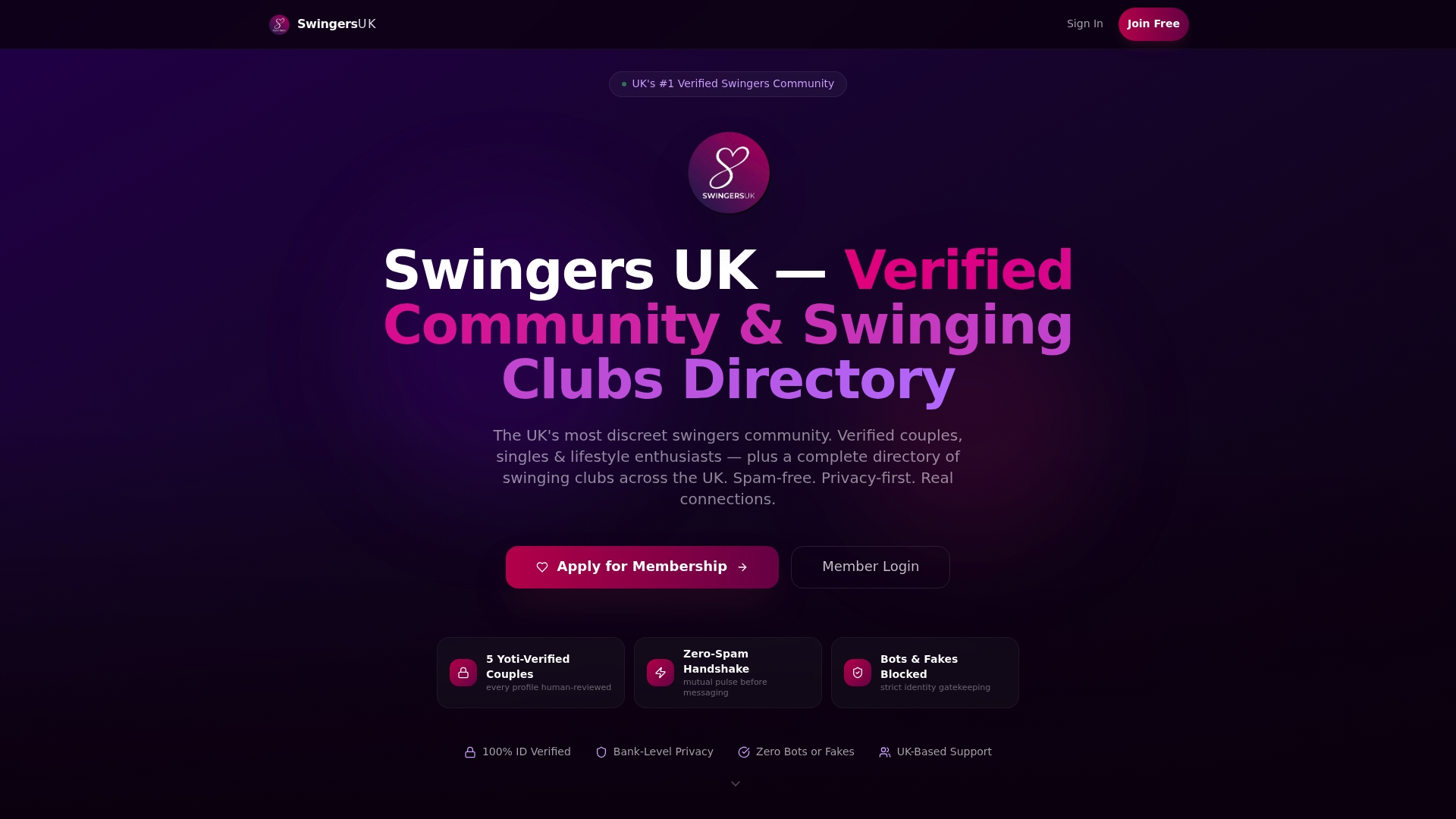
The platform’s Pulse Handshake System means messages only go through once both people show mutual interest, so you’re never fielding cold, unwanted contact. Combine that with a live events and club directory, region-based private cam rooms, and incognito privacy controls, and you get a structure that mirrors the couple-first, verification-heavy norms serious swinging communities already expect.
Before joining any platform, look for:
- ID verification that actually screens out fake or duplicate profiles.
- Mutual opt-in messaging so contact never feels one-sided or invasive.
- Vetted event listings with clear house rules stated up front.
Verify your profile to start browsing events and connecting with couples who’ve already been through the same screening process, or check current membership pricing to see which tier fits how actively you plan to explore the lifestyle.
Frequently Asked Questions
Is swinging considered cheating? No. Swinging requires mutual consent and shared knowledge between both partners, which is the opposite of cheating by definition.
Can an open relationship turn into swinging, or vice versa? Yes. Many couples start with one style and shift toward the other as they learn what actually works for their relationship, often after a few staged experiments.
Do open relationships or swinging hurt long-term relationship stability? Neither inherently does. Couples who maintain clear agreements, revisit them regularly, and communicate honestly about jealousy tend to report stronger, more resilient primary bonds, according to research cited by Men’s Health.
How do I know if swinging is right for me? Ask yourself whether you want shared experiences with your partner or individual freedom outside the relationship. If it’s the former, swinging’s couple-first structure likely fits better than an open relationship.
What’s the biggest mistake newcomers make? Skipping the conversation stage and jumping straight to an event or a first outside encounter without agreeing on disclosure, safer-sex expectations, and a stop word in advance.
Sources
- Polyamory, Open Relationships & Swinging: What They All Mean — Men’s Health
- Being in an open relationship isn’t the same as being polyamorous — Business Insider
- Open relationship — Wikipedia
- Polyamory vs Open Relationship vs Swinging: A Non-Monogamy — Rachel Wright (therapist resource)
- Open Marriage vs Polyamory vs Swinging: Understanding Ethical Non-Monogamy — Sagebrush Counseling