
What Is a Hotwife? Definition, Lifestyle, and Rules
What Is a Hotwife? Definition, Lifestyle, and Rules
A hotwife is a married woman who has her partner’s explicit permission to engage sexually outside the marriage, with both partners deriving mutual erotic pleasure from the arrangement. This is not infidelity. It is a form of consensual non-monogamy built on open communication, trust, and agreed boundaries.
What is a hotwife, exactly?
The hotwife definition centers on three non-negotiable elements: consent, communication, and mutual pleasure. As sex therapist Gloria Brame, PhD, puts it plainly: a person who has sex outside their relationship without their partner’s endorsement is an adulterer, not a hotwife.
The hotwife lifestyle looks different for every couple, but the core structure is consistent:
- Consent is explicit. Both partners actively agree to the arrangement before anything happens.
- The partner is involved. Whether watching, waiting at home, or hearing details afterward, the partner participates emotionally.
- Pleasure is mutual. The dynamic is designed to benefit both people, not just one.
- Rules are negotiated. Boundaries around safety, emotional involvement, and privacy are set together.
- It is not cheating. Secrecy is what defines infidelity. Transparency is what defines hotwifing.
Pro Tip: If you are exploring this lifestyle for the first time, review the community guidelines at Swingersuk before your first conversation with your partner. Having a framework makes that talk easier.
Where did the term “hotwife” come from?

The term originates from kink and slang communities, emerging as a label within consensual non-monogamy circles to describe a married woman enjoying extramarital intimacy by consent. Its roots are heteronormative, playing directly on the cultural expectation that a wife remains sexually exclusive to her husband. The erotic charge, for many couples, comes precisely from subverting that expectation.
Over time, the term migrated from niche online forums into broader lifestyle communities, including swinging and ethical non-monogamy spaces. Societal pressure around monogamy gave the concept its tension and its appeal. As those conversations became more mainstream, so did the vocabulary around them.
How hotwifing works in practice
The day-to-day reality of the hotwife lifestyle varies widely, but most couples organize it around a set of shared agreements rather than rigid rules. Anna Richards, sex educator and founder of FrolicMe, describes the range clearly: sometimes the husband watches or joins a threesome; other times, the wife’s encounters happen privately and are shared in detail afterward.
Common lifestyle practices include:
- Veto power. Either partner can stop an encounter at any point, for any reason, without owing an explanation.
- Safer sex agreements. Protection rules are set in advance. A 2015 Kinsey Institute study found that people in consensual non-monogamy reported greater condom use and higher STI testing rates than monogamous couples.
- No emotional entanglement. Physical freedom does not extend to building new romantic relationships outside the primary partnership.
- Full debriefs. Talking immediately after an encounter, before feelings settle into silence, keeps both partners emotionally connected.
- Privacy boundaries. Most couples keep the lifestyle completely separate from work, family, and mutual friends.
- Regular check-ins. Agreements are revisited every few months, and after any experience that surfaces unexpected feelings.
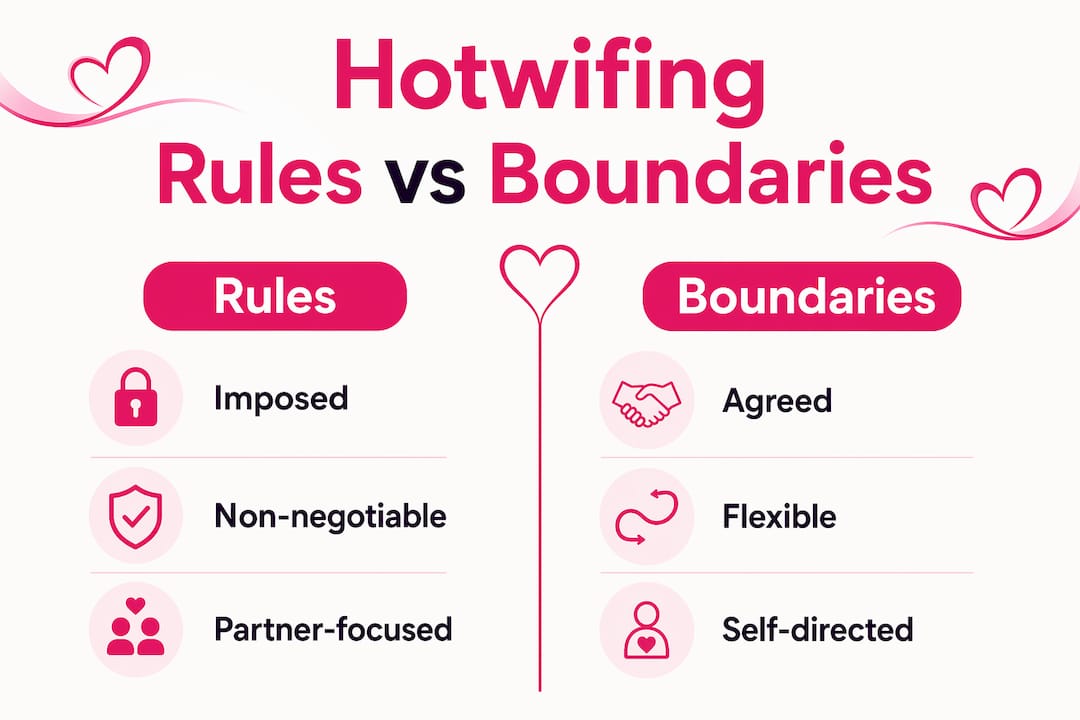
The distinction between rules, boundaries, and agreements matters here. A rule is imposed on a partner; a boundary is a personal guideline you enforce for yourself; an agreement is something both people negotiate and genuinely buy into. Couples who last in this lifestyle tend to graduate from rules to agreements over time.
How hotwifing differs from cuckolding
These two terms overlap but are not interchangeable. Hotwifing emphasizes the wife’s sexual agency and mutual pleasure. Cuckolding centers on the observing partner’s experience, often involving humiliation, power exchange, or submissiveness.
| Element | Hotwifing | Cuckolding |
|---|---|---|
| Primary focus | Wife’s empowerment and shared pleasure | Partner’s psychological experience |
| Emotional tone | Compersive, affirming | Often includes humiliation or power play |
| Partner’s role | May or may not watch; can be absent | Watching or listening is usually central |
| Motivation | Subversion, liberation, intimacy | Power surrender, fantasy, roleplay |
| Humiliation element | Typically absent | Often present and intentional |
Some couples sit at the intersection of both dynamics. Others keep them clearly separate. The key is that both partners understand which dynamic they are actually in.
Who uses the hotwife term and why language matters
The term is traditionally tied to heterosexual marriage, but the underlying desires apply far more broadly. As sex therapist Stefani Goerlich, LCSW, CST, explains, anyone of any gender, sexuality, or relationship orientation can be drawn to sharing a partner or being shared. The vocabulary has expanded to reflect that reality.
Inclusive terms now in use include:
- Hothusbanding for couples where the husband is the one being shared.
- Hotspouse, a gender-neutral alternative that removes the gendered framing.
- Hotslut, which takes the concept of marriage out of the equation entirely.
Language shapes identity. When people find a term that accurately describes their desires, it reduces shame, builds community, and makes honest conversations with partners easier. The evolution of these terms reflects a broader cultural shift toward recognizing diverse relationship structures as legitimate.
Expert insights on benefits, communication, and best practices
Psychologist Justin Lehmiller, PhD, a research fellow at The Kinsey Institute, identifies several motivations that draw couples to hotwifing: compersion (deriving pleasure from a partner’s pleasure), subversion of social norms around monogamy, deeper intimacy, and the affirmation that comes from knowing your partner is desired by others and still chooses you.
Practical guidance from relationship and sex therapy professionals points to a few consistent best practices:
- Frame agreements as shared turn-ons, not restrictions. Boundaries that protect emotional safety actually free both partners to be more present and adventurous.
- Write agreements down. Specificity is what makes them holdable. “We’ll communicate” is vague. “We’ll text within two hours when something significant happens” is an agreement.
- Debrief after every encounter. Processing emotions together immediately after maintains the primary relationship’s connection.
- Use veto power responsibly. It is a safety net, not a control mechanism. Both partners should feel free to use it without fear of judgment.
- Revisit agreements regularly. What worked at the start often needs to flex as trust deepens and the dynamic evolves.
Rigid rules tend to breed resentment. Negotiated agreements grounded in shared values are what sustain the lifestyle long term. The couples who look back on hotwifing positively are the ones who kept talking to each other throughout.
Challenges hotwife couples commonly face

No lifestyle is without friction, and hotwifing is no exception. Jealousy is the most common early challenge, even among couples who expected to feel only compersion. Feelings do not always follow the script, and that gap between expectation and reality can catch partners off guard.
Emotional entanglement is another real risk. Clear agreements about the nature of outside connections help, but they do not eliminate the possibility that feelings develop. When they do, the primary relationship needs enough trust and communication infrastructure to handle it honestly.
Social stigma adds external pressure. Most couples keep the lifestyle private, but accidental disclosure, whether through a mutual friend or a careless digital trail, can create serious personal and professional consequences. Privacy planning is not optional. The beginners’ guide at Swingersuk covers practical steps for protecting your identity while participating in lifestyle communities.
Finally, mismatched enthusiasm is common. One partner may be more invested in the lifestyle than the other, and that imbalance, left unaddressed, erodes the relationship. Scheduled check-ins and a clear exit strategy, agreed upon before the first encounter, give both partners a way to speak honestly without feeling trapped.
Key Takeaways
A hotwife arrangement works when both partners treat it as a shared, evolving agreement rather than a fixed set of rules imposed by one person on the other.
| Point | Details |
|---|---|
| Consent defines it | A hotwife has her partner’s explicit permission; without it, the arrangement is infidelity, not hotwifing. |
| Agreements beat rules | Negotiated, revisited agreements sustain the lifestyle; rigid rules tend to create resentment over time. |
| Debriefing is essential | Talking immediately after each encounter prevents emotional distance and keeps the primary relationship connected. |
| Veto power protects both partners | Either partner can stop an encounter at any point, for any reason, without owing an explanation. |
| Language reflects identity | Terms like hotspouse and hothusbanding extend the concept beyond its heteronormative roots to any gender or orientation. |