
Liveness Check on Dating Apps: How It Works and What It Proves
Liveness Check on Dating Apps: How It Works and What It Proves
A liveness check on a dating app asks you to prove that a real, live person is in front of the camera right now, not a photo, a recording or a synthetic face. You usually do it with a short video selfie. The app then compares it with your profile photos or your ID. It is a strong filter against bots and stolen pictures. It is not a guarantee that the person behind a profile is honest. This guide explains how the check works, what happens to your data in the UK, and how to read a “verified” badge sensibly.
TL;DR
- A liveness check confirms a live human is generating the face data in real time. It can catch prerecorded footage and many deepfakes.
- Active checks (turn your head, speak) resist replay attacks better, but reject more genuine users. Passive checks are smoother but easier to game.
- A pass at sign-up is a single moment in time. It does not prove how someone behaves afterwards, so keep your own judgment switched on.
- In the UK, check how long a selfie is kept and who processes it before you hand it over.
- If a check fails, fix lighting and framing first. If a profile looks fake, stop engaging and report it.
Table of Contents
- What a liveness check actually is
- Active vs passive liveness
- What it catches, and what it can miss
- What happens to your selfie in the UK
- How to judge a “verified” badge
- Perspective: why we pair verification with consent
- Verification and privacy on SwingersUK
- If a liveness check fails
- If you think a profile is fake
- A short checklist before you trust a profile
- FAQ
- Sources
What a liveness check actually is
Liveness detection answers one narrow question: is a live person generating this biometric data in real time? According to TechTarget’s guide to liveness detection, it can identify AI-generated deepfakes and prerecorded biometric data. The systems look at factors such as skin texture, depth and natural motion like blinking, to tell a live subject from a synthetic artifact.
It is separate from two other things people often confuse it with:
- Face matching: comparing your selfie with your profile photos or an ID document.
- Age estimation or age assurance: working out whether you are an adult.
Many apps run all three in one flow, which is why a single “verification” screen can feel like one test. Wired reports that more than a dozen major dating apps and sites now use face recognition, often through liveness checks, 3D authentication, video selfies or biometric ID, to show their users are human.
Active vs passive liveness
There are two broad designs, and the difference shapes your experience as a user.
| Active liveness | Passive liveness | |
|---|---|---|
| What you do | Follow prompts: turn, blink, speak | Hold still for a moment |
| Strength | Generally more effective against replay attacks | Fast, little friction |
| Weakness | More false rejections of real users | Can be less robust against replays |
The trade-off between the two is described in the same TechTarget analysis: active methods tend to stop more attacks, but they may turn away more legitimate people. That is why a perfectly honest member can fail a check in a dim room.
What it catches, and what it can miss
A good liveness check removes a lot of low-effort fraud: bots, profiles built on someone else’s photos, and recorded clips played back to a camera. That alone makes a platform noticeably cleaner.
It has limits, and you should know them.
Sophisticated AI is getting harder to spot. Liveness detection can help identify deepfakes, but increasingly capable AI makes them more difficult to identify. Attackers also try to inject synthetic video straight into the camera feed rather than hold a screen up to it.
A pass is a snapshot. Critics quoted by Dating Industry Insights argue that treating verification as pass/fail at one point in time creates systematic blind spots, because a scammer can clear the first check and then behave deceptively for months. The same piece describes a “verification paradox”: platforms chasing friction-free sign-up end up with single-point checks that are weak against automated fraud.

A badge is not character. Cybersecurity researcher Katie Moussouris has called biometric verification on dating apps “security theater”, warning that a verified profile can still be run by a bad actor using AI tools or a compromised account, as Wired reports. You do not have to agree with the strongest version of that view to take the practical point: verification proves a face and a moment, not intentions.
What happens to your selfie in the UK
A video selfie is biometric data, so it is fair to ask where it goes. Practices differ by app. As one example from the industry, Biometric Update reports that one major app keeps age estimates and three audit images, with UK age-check photos held for up to three months and hashed photos and results held for one year.
The UK age-check backdrop matters too. Under Ofcom guidance, dating apps in the UK must require users to verify their age by selfie video or government ID from 25 July 2025. Platforms use a mix of facial age estimation, ID, credit-card, open-banking and digital-identity checks, with phone verification only as a supplement, according to Dating Industry Insights, which also advises assessing vendors’ accuracy and data-handling practices.
Some vendors convert your face into a mathematical template rather than storing a plain photo. One analysis of a common vendor’s software describes a 3D face map and a unique numerical identifier (State of Surveillance). Templates are less readable than photos, but they are still personal data.
Before you verify on any app, look for answers to these questions in its privacy policy:
- Is the selfie deleted after the check, and when?
- Is a template or hash kept, and for how long?
- Which third-party vendor processes it?
- Is the data used for anything beyond verification?
- Can you ask for deletion?
There is a wider debate here as well. Technology law professor Woodrow Hartzog argues that normalizing pervasive facial scanning for online interactions sets a dangerous precedent for privacy (Wired). If that worries you, it is reasonable to prefer platforms that explain their handling plainly.
How to judge a “verified” badge
Not every badge means the same thing. Ask these questions:
- What was checked? A liveness selfie, an ID document, a phone number, or just an email link?
- Who reviewed it? Fully automated, or with a human looking at doubtful cases?
- Is it one-off or ongoing? Can a profile be re-checked or removed after a report?
- Can you control who messages you? Verification at the door matters less if anyone can message you freely afterwards.
That last point is where design beats badges. A verified account that can still spam a thousand people is still a spam account. Mutual-consent features, reporting tools and quick moderation do the work that a single check cannot.
Perspective: why we pair verification with consent
We built SwingersUK for a community where privacy is not a nice extra. Couples and singles in the lifestyle often have jobs, families and reputations to protect, so the two big fears are fake profiles and unwanted contact. Those are different problems and they need different tools.
For fake profiles, we use both AI and human review of verification, because automation alone is fast but misses edge cases, and people alone are slow. Our ID verification is there to keep bots and impersonators out.

For unwanted contact, a badge is not enough. That is why messaging on SwingersUK runs on our Pulse Handshake System: both people show interest before a conversation opens. Nobody lands in your inbox uninvited, however well they passed a check.
Our honest view is that no verification method is perfect, and we would rather say so. Treat any badge, ours included, as a strong first filter and keep using common sense: video chat before you meet, meet somewhere public, and tell a friend your plans.
— Daniel
Verification and privacy on SwingersUK
If you want a UK swingers community where profiles are checked and conversations are consensual, this is what members get:
- Identity verification reviewed by AI and by people, aiming for no fake profiles and no bots
- Pulse Handshake: mutual interest before anyone can message you
- Incognito and privacy controls
- Region-based private cam rooms, one-to-one and group
- A directory of live events and clubs
You can start with a free membership and look at what premium adds when you are ready.
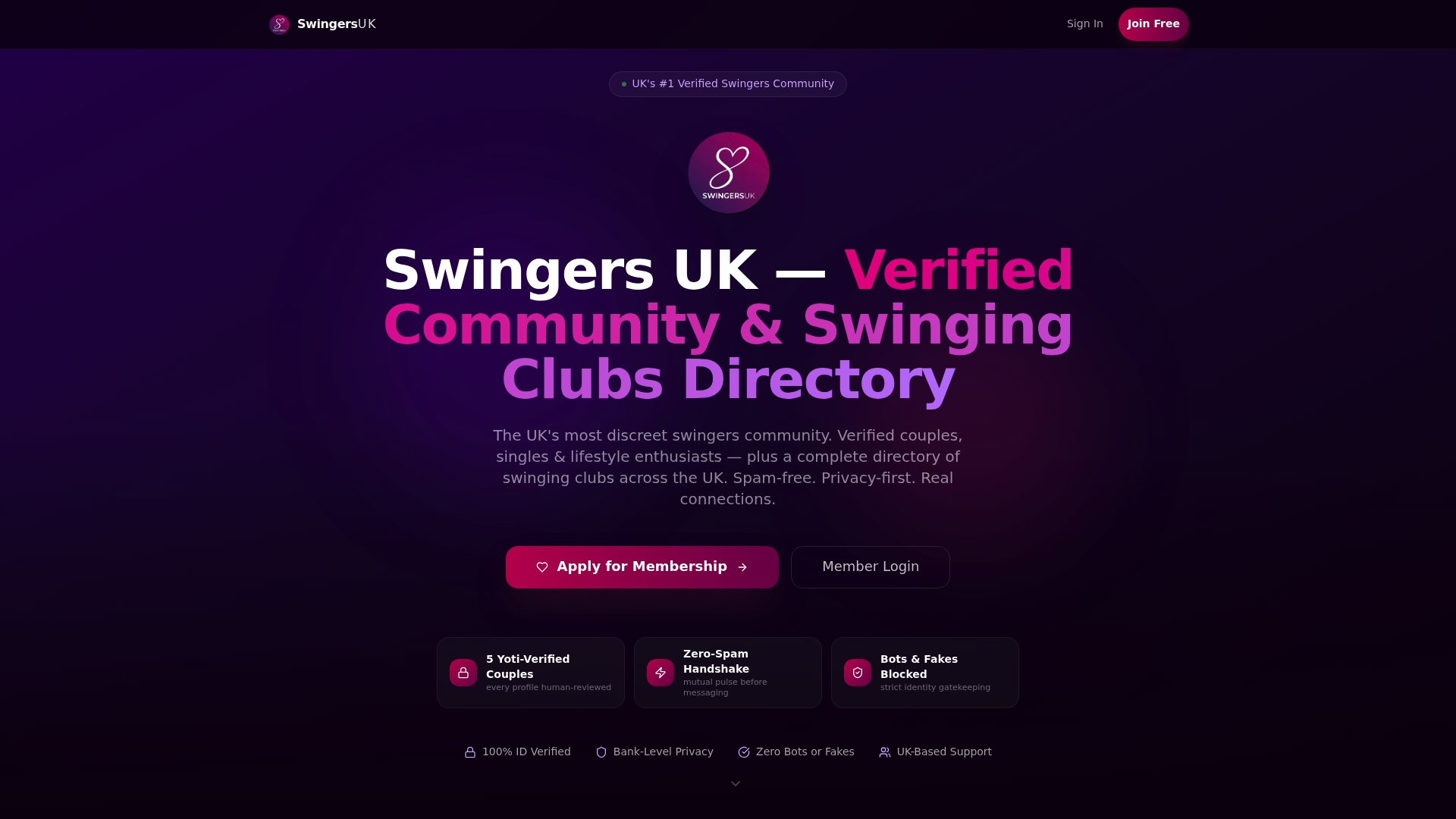
If you are new, begin with SwingersUK, complete verification, and set your privacy options before you browse.
If a liveness check fails
Most failures are mundane. Run through this list before assuming something is wrong with your account:
- Fix the light. Face a window or lamp. Avoid strong backlight.
- Remove obstructions. Take off sunglasses, hats and anything covering your face. Hold the phone at eye level.
- Use a recent, clear photo for matching. If your profile photos are old, heavily filtered or show you with others, the face match can fail even when liveness passes.
- Update the app and use the front camera. Old versions and low-quality cameras cause errors.
- Retry calmly. Follow prompts at the pace they ask. Active checks punish rushing.
- Contact support. If you keep failing, ask for a manual review. A platform with human reviewers can look at your case.
Remember that active checks reject more genuine users by design, so a fail is not an accusation.
If you think a profile is fake
A verified badge does not end your vigilance. Warning signs of a romance scam include a person who always has an excuse not to meet and photos that turn out to belong to someone else, according to Equifax UK’s guide to romance scams. Scammers build trust over time and then ask for money or personal information, often citing medical bills or travel costs.
What to do:
- Run a reverse image search on their pictures. Stolen photos often show up elsewhere.
- Ask for a live video chat. A real person will usually agree. Endless excuses are a red flag.
- Never send money, gift cards or personal documents to someone you have not met.
- Keep screenshots of the profile and messages.
- Report the profile to the platform so moderators can act.
- Report fraud to Action Fraud online or on 0300 123 2040, as Equifax notes. If you have already sent money, contact your bank straight away.
In a community where discretion matters, scammers also try to exploit fear of exposure. If someone threatens to reveal your identity or images, stop replying, keep the evidence and report it to the police and the platform.
A short checklist before you trust a profile
| Check | Why it helps |
|---|---|
| Verified badge plus a clear explanation of what it means | Shows what was actually checked |
| Photos consistent across the profile | Mismatched styles hint at stolen images |
| Willingness to video chat | A live person can do this easily |
| No pressure around money or secrecy | Pressure is the core scam pattern |
| Mutual consent before messaging | Cuts unsolicited contact at source |
FAQ
Is a liveness check the same as ID verification?
No. A liveness check confirms a live person is on camera. ID verification checks a document and usually matches your face to it. Many platforms combine both, and some add age estimation on top.
Can deepfakes fool a liveness check?
Sometimes. Liveness detection can identify deepfakes and prerecorded data, but increasingly sophisticated AI makes them harder to spot. That is why layered checks, human review and reporting matter more than any single test.
Is my selfie stored after the check?
It depends on the app. Retention can range from deletion soon after to months for audit images and a year for hashed results, as in one UK example above. Read the privacy policy and look for retention periods and the name of the vendor.
Does a verified badge mean someone is safe to meet?
No. It shows a face matched at one point in time. Keep chatting by video first, meet in public and tell a friend where you are going.
Sources
- Face Recognition Is Becoming the Norm for Dating Apps (Wired)
- How liveness detection catches deepfakes and spoofing attacks (TechTarget)
- AI Romance Scams Expose Dating Apps’ Verification Failures (Dating Industry Insights)
- UK dating apps age verification (Dating Industry Insights)
- Age verification guide and best practices (Dating Industry Insights)
- Match Group extends FaceTec liveness to Hinge (Biometric Update)
- Hinge Now Scans Your Face. Here’s What They Keep. (State of Surveillance)
- How to spot and avoid romance scams (Equifax UK)