Ethical Non-Monogamy Types: A Full Breakdown of Your Options
Ethical Non-Monogamy Types: A Full Breakdown of Your Options
Ethical non-monogamy (ENM) is any relationship structure where all partners knowingly consent to multiple concurrent romantic or sexual connections, built on transparency instead of secrecy. That single distinction, consent versus concealment, is what separates ENM from cheating, and it’s also what separates it from polygamy, which is a specific marriage practice rather than a relationship philosophy.
The most common types you’ll encounter are:
- Polyamory, with hierarchical, non-hierarchical, solo, kitchen-table, and parallel variations
- Open relationships, including the lighter-touch “monogamish” style
- Swinging, a couple-focused and largely recreational practice
- Relationship anarchy, which rejects hierarchy altogether
- Polyfidelity, a closed group model
- Throuples and closed Vs, structured three-person configurations
Each one asks something different of you emotionally, logistically, and socially. The rest of this guide breaks down exactly what.
Key Takeaways
Ethical non-monogamy works when partners match a relationship structure to their actual emotional bandwidth, not to whichever label sounds most appealing.
| Point | Details |
|---|---|
| Consent defines ENM | All partners must knowingly agree to the arrangement; secrecy makes it cheating, not ENM. |
| Match type to bandwidth | Kitchen-table polyamory and polyfidelity demand more time and emotional labor than swinging or monogamish. |
| Labels aren’t contracts | Terms like “open” or “kitchen-table” vary by community; agree on specifics rather than assuming shared meaning. |
| Legal protections stay limited | Most jurisdictions don’t recognize multi-partner marriages, which affects inheritance and next-of-kin rights. |
| Pilot before scaling | Test a lower-complexity style first, then move toward more entangled structures only if it’s working. |
Table of Contents
- What Are the Main Types of Ethical Non-Monogamy?
- Polyamory and Its Subtypes: Which Structure Fits You?
- What Is an Open Relationship, and What Does Monogamish Mean?
- How Does Swinging Work in Practice?
- What Is Relationship Anarchy?
- Throuples, Closed Vs, and Polyfidelity: How Structured Group Relationships Work
- Other ENM Labels You’ll Come Across
- How Do You Choose the Right ENM Type for You?
- How Verified Platforms Support Safer ENM Connections
- Where Does Ethical Non-Monogamy Come From Historically?
- What Misconceptions Trip People Up in Each ENM Type?
- How Does ENM Affect Parenting and Co-Parenting?
- Where Can You Find ENM Communities and Support?
- Ready to Explore a Verified Swinging Community?
- Editorial Take: Start With the Cost, Not the Label
- Frequently Asked Questions
- Sources
What Are the Main Types of Ethical Non-Monogamy?
Before you dig into subtypes and edge cases, it helps to see the whole map at once. Every ENM style sits somewhere on a spectrum between emotional connection and sexual freedom, and some (like relationship anarchy) reject that spectrum entirely.
- Polyamory — multiple romantic relationships with the possibility of love and long-term commitment across partners. Focus: emotional.
- Open relationship — a primary couple that permits outside sexual or romantic connections under agreed rules. Focus: mostly sexual, sometimes romantic.
- Monogamish — a near-monogamous couple that allows rare, limited outside encounters. Focus: sexual, low frequency.
- Swinging — couples engaging in recreational sex with others, often as a shared activity. Focus: sexual.
- Relationship anarchy — no ranking of partners, no default rules borrowed from convention. Focus: anti-hierarchy, self-determined.
- Polyfidelity — a closed group of three or more partners exclusive to each other. Focus: emotional and sexual, but bounded.
- Throuple/closed V — a specific three-person structure, either fully interconnected or hinged through one person. Focus: emotional, structural.
Multiple established sources converge on roughly this same list, though the exact labels shift depending on who’s writing. Don’t get hung up on finding the “official” definition of any one term. Communities use these words loosely, and two people describing themselves as “polyamorous” or “swingers” can mean fairly different things in practice. What matters more than the label is whether you and your partner or partners agree on what it means for you.
Polyamory and Its Subtypes: Which Structure Fits You?
Polyamory centers on the possibility of loving more than one person at a time, which is what separates it from swinging’s largely sexual, non-romantic focus. It’s the most internally varied category in ENM, and the subtype you choose changes your day-to-day life more than the word “polyamory” alone ever could.
- Hierarchical polyamory ranks partners, typically into a “primary” (often a spouse or long-term partner who shares finances or a home) and “secondaries” with fewer entwined obligations. It offers structure and clarity but can leave secondary partners feeling like an afterthought if the hierarchy isn’t handled with care.
- Non-hierarchical polyamory treats all partners as equally significant, without a built-in ranking. It demands more explicit, ongoing negotiation since there’s no default rule to fall back on.
- Solo polyamory means you consider yourself your own primary partner. You may have multiple committed relationships, but you’re not moving toward shared finances, cohabitation, or a conventional escalator.
- Kitchen-table polyamory describes a network where metamours (your partner’s other partners) build friendly, direct relationships, often literally comfortable enough to share a kitchen table together.
- Parallel polyamory keeps relationships separate. Metamours may know of each other but have little to no direct contact.
Structural shapes like the throuple (three people, all connected), vee (one person dating two who aren’t involved with each other), and quad (four people, variably interconnected) describe the geometry of who’s dating whom. They can exist within any of the subtypes above.
Pro Tip: Don’t choose a polyamory subtype based on what sounds most enlightened. Choose based on your actual bandwidth for coordination and conflict, because kitchen-table dynamics take real emotional energy that parallel structures simply don’t demand.
What Is an Open Relationship, and What Does Monogamish Mean?
An open relationship is typically a primary couple that agrees to allow sexual or occasionally romantic connections outside the partnership, while the core relationship stays the central priority. It’s a broad bucket. Some couples open things up entirely; others keep tight restrictions.
Monogamish, a term popularized by columnist Dan Savage, describes couples who are monogamous in practice but allow rare, limited exceptions, think a threesome on vacation or a one-time hookup at a specific event, rather than an ongoing arrangement.
Rule sets vary widely, but the most common ones include:
- One-night-only arrangements, where repeat contact with the same outside partner isn’t allowed
- Zip-code rules, restricting outside partners to people outside a shared social or geographic circle
- Hall pass systems, where each partner gets pre-approved, occasional permission
- Shared play, where both partners participate in the same encounter, versus separate play, where each pursues outside connections independently
If you’re new to non-monogamy and unsure how much change you actually want, monogamish is often the lowest-friction way to test the waters. It requires less ongoing logistics than swinging and far less emotional restructuring than polyamory, which is part of why relationship experts often recommend starting with lower-complexity models before attempting anything with multiple concurrent emotional relationships.
How Does Swinging Work in Practice?
Swinging is couple-focused and recreational, built around shared sexual experiences rather than developing separate romantic relationships. It’s often the most social of the ENM types, with an established club and event culture that has its own etiquette.

The core distinction most swingers draw is between soft swap (activities that stop short of intercourse with other partners) and full swap (no such limit). A second distinction matters just as much: same-room play, where couples stay together throughout, versus separate-room play, where couples split up for privacy.
Community norms tend to be strict about a few things:
- Consent is confirmed before, not assumed from context or prior encounters
- Disclosure of health status and any changes to it is expected, not optional
- Party or club rules (dress codes, photography bans, no-means-no enforcement) are treated as firm, not suggestions
Pro Tip: Ask about a venue’s or platform’s verification and conduct standards before you show up. Communities with strict identity checks and clear consent protocols filter out the people who ruin the experience for everyone else.
That verification question is exactly where platform design starts to matter. A verified swinger community with identity checks and clear etiquette reduces the guesswork of meeting new couples, which is a real practical concern in a scene that runs on trust.
What Is Relationship Anarchy?
Relationship anarchy (RA) rejects the idea that romantic relationships automatically outrank friendships or that any relationship needs a default rulebook borrowed from convention. There’s no built-in hierarchy, no assumption that a partner takes priority over a close friend, and no template for what a relationship “should” include.
Instead, every connection is negotiated on its own terms:
- Agreements are made explicitly, per relationship, rather than inherited from cultural scripts about what couples “do”
- Commitment isn’t measured by escalators like moving in together or exclusivity; it’s measured by what the specific people involved actually want
- Autonomy is treated as a starting principle, not a compromise
The tradeoff is ambiguity. Without labels like “boyfriend” or “primary partner,” it can be harder to explain your relationships to friends, family, or even to the people you’re dating. Relationship anarchists mitigate this with regular, explicit check-ins rather than relying on assumed roles, which takes more communication upfront but avoids the mismatched expectations that vaguer arrangements tend to produce.
Throuples, Closed Vs, and Polyfidelity: How Structured Group Relationships Work
Group configurations describe geometry and exclusivity rather than emotional style, and getting the terms straight helps you understand what you’re agreeing to.
- A triad or throuple is three people in a relationship together, ideally with all three connected to each other, though in practice one pair sometimes has a stronger bond than the others.
- A vee is one person (the “hinge”) dating two partners who are not romantically involved with each other.
- A quad is four people, connected in varying configurations, sometimes as two couples merging, sometimes as four individuals.
- Polyfidelity is a closed group, usually three or more people, who are exclusive to each other the way a monogamous couple is exclusive to one partner.
The key operational difference is exclusivity. Polyfidelity and closed Vs restrict new partners from joining or connecting outside the group. Open triads or quads may allow individual members to date outside the structure.
One practical limit applies across all of these: most jurisdictions don’t legally recognize marriage among more than two people, so group arrangements typically operate outside standard marital protections around inheritance, next-of-kin status, and shared property. That’s worth factoring into any long-term group commitment, regardless of how emotionally solid it feels.
Other ENM Labels You’ll Come Across
Terminology in this space shifts constantly, and the same word can mean different things in different communities. A few labels worth knowing:
- Kitchen-table poly describes a network comfortable enough for everyone, partners and metamours alike, to socialize together casually.
- Parallel poly keeps relationships and metamours largely separate, with minimal direct interaction.
- Don’t ask, don’t tell (DADT) is an arrangement where partners permit outside connections but don’t want details shared. It’s consensual, which makes it ENM, but it trades transparency for privacy in a way that other styles don’t.
- Monogamish variants range from a single pre-approved exception to a recurring but limited allowance.
None of these terms are standardized. Consumer health resources that cover ENM consistently note how much meaning varies by community and even by couple. The practical takeaway: treat every label as a conversation starter, not a contract. Ask your partner what they mean by “open” or “poly” before assuming you already know.
How Do You Choose the Right ENM Type for You?
Picking a structure isn’t about finding the “correct” answer. It’s about matching a style to your actual capacity, goals, and constraints.
- Assess your emotional bandwidth. Kitchen-table polyamory and hierarchical structures with multiple partners take significant time and emotional labor. If you’re already stretched thin, a lower-complexity option like monogamish or swinging may fit better.
- Clarify what you actually want. Are you drawn to more romantic connection, more sexual variety, or a rejection of relationship rules altogether? Those point toward very different structures.
- Account for parenting and home life. Shared custody schedules, young children, or a demanding job all shrink the time available for a complex, multi-partner network.
- Have the conversation before the opportunity arises, not in the middle of it. Cover what counts as cheating in your arrangement specifically, how often you’ll check in, and what needs to be disclosed versus what can stay private.
Before piloting anything, work through a short agreement checklist together:
- Boundaries: what’s allowed, what requires a conversation first, what’s off-limits entirely
- STI testing cadence and safer-sex practices, agreed on explicitly rather than assumed
- Privacy: what gets shared with mutual friends or family, and what doesn’t
- An emergency contact protocol and an exit plan if the arrangement isn’t working
Pro Tip: If you notice one partner consistently avoiding these conversations or treating boundary discussions as an inconvenience, that’s a bigger red flag than any specific rule disagreement. Structure problems can be renegotiated; avoidance patterns usually can’t.
Jumping straight into a high-complexity structure without groundwork is one of the more common ways people get hurt in this space. Piloting with something lower-stakes, like a single monogamish exception or an evening at a swingers’ event, gives you real information about your own reactions before you commit to anything more entangled. If jealousy, communication breakdowns, or persistent conflict show up early, that’s worth working through with a therapist familiar with non-monogamy before scaling up further.
How Verified Platforms Support Safer ENM Connections
Meeting people for swinging or open-relationship exploration carries real safety and privacy concerns, and platform design either addresses those concerns or ignores them entirely.
- ID verification, checked by both AI and human reviewers, removes a large share of the fake profiles that plague open swinger forums
- The Pulse Handshake System requires mutual interest before messaging opens, which keeps interactions consent-first instead of one-sided
- Local event listings and private cam rooms give members structured, lower-pressure ways to meet before committing to anything in person
A community built on verified identities and mutual consent doesn’t just filter out bad actors. It changes the tone of every conversation that happens inside it, because everyone present has already agreed to be there.
Swingersuk built these features specifically to address the trust gap that makes many newcomers hesitant to explore swinging in the first place.
Where Does Ethical Non-Monogamy Come From Historically?
Non-monogamous relationship structures aren’t new. Many societies throughout history have practiced various forms of plural partnership, though rarely with the explicit consent framework that defines ENM today. What’s changed is the emphasis on transparency and mutual agreement rather than one partner (often a woman) having no say in the arrangement.
The modern ENM movement traces much of its language and philosophy to the polyamory community that emerged in the late 20th century, alongside sex-positive and queer liberation movements that questioned default assumptions about monogamy, marriage, and family structure. Terms like “polyfidelity” and “relationship anarchy” both came out of that broader cultural questioning.
Swinging has a separate lineage, often traced to social circles in the mid-20th century United States, and it developed its own club culture and etiquette independent of the polyamory movement. That’s part of why swinging and polyamory can feel like different worlds even though both fall under the ENM umbrella.
Cultural acceptance has shifted noticeably in the last decade. What was once discussed only in specialist forums now appears in mainstream advice columns, therapy practices, and dating apps that explicitly support non-monogamous configurations. That normalization doesn’t mean stigma has disappeared, but it does mean more people have accurate information available than a generation ago.
What Misconceptions Trip People Up in Each ENM Type?
Every ENM type carries its own myths, and believing them tends to set people up for a rockier start than necessary.
With polyamory, the biggest misconception is that more partners means less commitment. In practice, non-hierarchical and kitchen-table structures often demand more sustained commitment and communication than monogamy, not less. With open relationships, people often assume “open” means unrestricted, when most couples operate under fairly specific rules that took real negotiation to establish.
Swinging gets stereotyped as purely impulsive, but established swinger communities run on explicit etiquette and consent norms that are often stricter than what happens in mainstream dating. Relationship anarchy is frequently mistaken for “no commitment at all,” when it actually requires more deliberate agreement-making since there’s no default script to fall back on.
Polyfidelity and closed group structures face a different myth: that a closed group is automatically more stable than an open one. Closure limits new connections, but it doesn’t eliminate the need for ongoing communication among existing members. Every type has a learning curve, and the biggest realistic expectation to set is that none of them run on autopilot. All of them require more explicit conversation than monogamy typically does, which is either the cost or the benefit, depending on how you look at it.
How Does ENM Affect Parenting and Co-Parenting?
Raising children within an ENM household adds logistical layers that monogamous families don’t usually face, but it doesn’t inherently disadvantage kids. What matters most is stability and clarity, not the number of adults involved.
Families practicing hierarchical polyamory often keep the primary household relatively stable for children, introducing other partners gradually and only once a relationship has proven durable. Solo polyamorous parents may keep dating partners more separate from parenting life altogether, treating co-parenting as its own distinct commitment.
Co-parenting after a divorce or separation adds another layer when one or both parents are exploring ENM. Clear agreements about what gets disclosed to children, at what age, and how new partners are introduced matter more than the relationship structure itself. Many ENM parents choose not to use specific relationship labels with young children at all, focusing instead on consistent, trustworthy adults in the household.
Custody arrangements can also raise legal complications, since family courts vary widely in how they view non-monogamous parents. Documentation of stability, consistent routines, and a united co-parenting front tend to matter more in custody discussions than the relationship structure itself. If you’re navigating a custody situation while practicing ENM, a family law professional familiar with non-traditional households is worth consulting early rather than after a dispute arises.
Where Can You Find ENM Communities and Support?
Finding your footing in any ENM style is easier with a community that already understands the terminology and the common pitfalls, rather than explaining yourself from scratch every time.
For polyamory, local meetup groups and online forums focused specifically on polyamory offer space to discuss hierarchy, metamour relationships, and scheduling logistics with people who’ve navigated the same questions. For open relationships and monogamish arrangements, couples’ counseling that specializes in consensual non-monogamy can help set initial rules without projecting monogamous assumptions onto a different structure.
Swinging communities tend to be the most socially organized, with dedicated clubs, events, and verified online platforms built specifically around meeting other couples safely. Relationship anarchy has a smaller but active online presence, often overlapping with broader anarchist and queer theory communities where the philosophy first took root.
Regardless of which type fits you, a therapist with specific non-monogamy experience, not just general couples counseling, tends to produce better outcomes when conflicts arise. General relationship advice built around monogamous assumptions doesn’t always translate cleanly, and a mismatched therapist can slow progress rather than help it.
Ready to Explore a Verified Swinging Community?
If swinging or a couple-focused open dynamic sounds like the right entry point, the biggest practical hurdle is usually finding people who are serious, verified, and on the same page about consent. That’s the exact gap Swingersuk was built to close.
Every profile goes through AI and human identity verification before it’s active, which cuts down significantly on the fake accounts and bots that plague open forums. The Pulse Handshake System means messaging only opens once both people have shown mutual interest, so you’re never fielding unwanted contact. Beyond messaging, members get access to local event listings, a club directory, and private cam rooms for one-to-one or group sessions, giving you multiple low-pressure ways to meet before anything happens in person.
If you’re ready to explore a verified, privacy-first swinging community, Swingersuk gives couples and singles a structured, consent-driven way to start.
Editorial Take: Start With the Cost, Not the Label
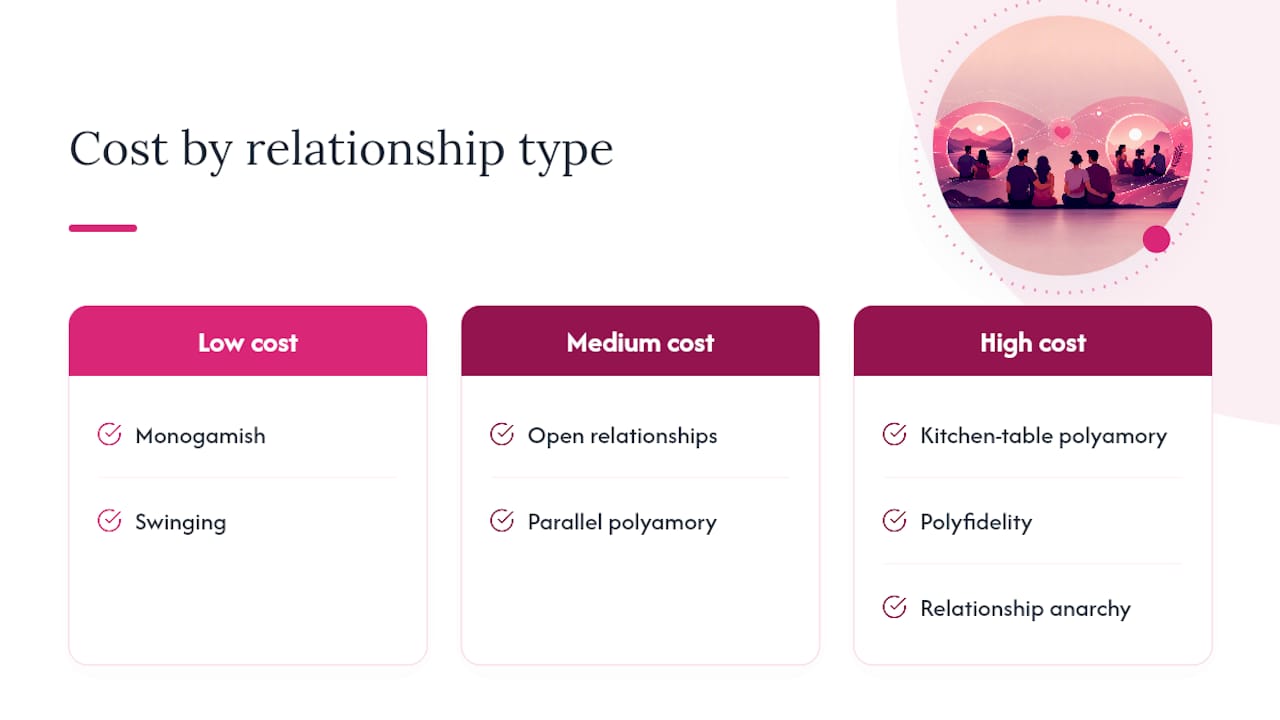
Most guides to ethical non-monogamy sort types alphabetically or by popularity, which is exactly backward. The more useful sort is by cost: emotional labor, coordination, and social exposure. Monogamish and swinging sit at the low end. Open relationships and parallel polyamory sit in the middle. Kitchen-table polyamory, polyfidelity, and relationship anarchy sit at the high end, because they demand sustained negotiation with no cultural script to fall back on.
The conventional advice, “figure out what you want, then pick a label,” skips the harder and more honest question: what can you realistically sustain right now, given your actual schedule, emotional reserves, and relationship history? A couple with two demanding jobs and a toddler has no business starting with kitchen-table polyamory, no matter how appealing the philosophy sounds on paper.
Pilot low, then scale if it earns it. Complexity should be something you grow into deliberately, not something you back into because a label sounded compelling at 11 p.m. on a forum.
Frequently Asked Questions
Is ENM the same as polyamory? No. Polyamory is one type of ethical non-monogamy, specifically the one focused on multiple romantic relationships. ENM is the umbrella term that also includes swinging, open relationships, relationship anarchy, and polyfidelity.
How many types of ethical non-monogamy are there? Most guides list between six and nine core types, though the exact count depends on whether subtypes (hierarchical, solo, kitchen-table, parallel) are counted separately or grouped under polyamory.
What’s the difference between an open relationship and swinging? Open relationships often permit both sexual and romantic outside connections pursued individually, while swinging is typically a shared, recreational activity couples do together, with less emphasis on outside romantic bonds.
Is relationship anarchy a form of ethical non-monogamy? Yes, when practiced with full transparency and consent. RA rejects hierarchy and default relationship rules, but it still requires the same explicit agreement-making that defines all ENM types.
Can ENM arrangements involve marriage? Legal marriage remains limited to two people in most jurisdictions, so group arrangements like polyfidelity or triads typically operate without the legal protections a married couple has.
Sources
- ENM Relationship: What It Is, How It Works, Types, and More — Healthline
- 9 Types of Ethical Non-Monogamy (ENM) Explained | Select Psychology
- Ethical non-monogamy — Wikipedia
- Ethical non-monogamy explainer — The Australia Institute (Ethics)
- What is ethical non-monogamy? — Verywell Mind