
Stag and Vixen Meaning: A Clear Guide for Couples
Stag and Vixen Meaning: A Clear Guide for Couples
In the stag and vixen dynamic, one partner (the stag) takes active, proud pleasure in watching or knowing their partner (the vixen) has consensual sexual encounters with other people, while the couple remains the primary emotional and relational unit throughout.
Three features define it immediately: it is consensual non-monogamy directed by both partners together; the emotional register is pride and compersion, not humiliation or submission; and the couple sets all rules, vetting, and reconnection rituals before any encounter takes place.
Key Takeaways
The stag and vixen dynamic works because both partners co-own the arrangement, the emotional register is pride rather than humiliation, and structured aftercare keeps the couple’s bond intact through every stage of exploration.
| Point | Details |
|---|---|
| Couple is always the unit | Both partners co-direct the arrangement; neither acts unilaterally on partner selection or encounter terms. |
| Pride, not humiliation | The stag’s identity is strengthened by the dynamic; any arrangement that relies on shame is a different model entirely. |
| Rules before encounters | Negotiate consent scope, STI protocols, privacy, and reconnection rituals before the first meet, not during it. |
| Debrief is non-negotiable | A structured post-encounter check-in is what sustains the arrangement and converts jealousy into compersion over time. |
| Verify before you meet | Use layered verification (profile, photo check, live video, ID confirmation) to protect both partners before sharing personal details. |
Table of Contents
- What does stag and vixen mean, exactly?
- What do the stag, vixen, and third-party roles actually look like?
- How does stag and vixen differ from cuckolding, hotwifing, swinging, and polyamory?
- What rules and boundaries do stag-and-vixen couples typically use?
- How do you start a stag-and-vixen arrangement safely?
- Where do couples find consenting partners and communities?
- Safety, sexual health, and privacy: what you need to know
- How do you keep the relationship healthy long-term?
- Where do the terms “stag” and “vixen” come from?
- How do you vet partners and spot fake profiles?
- What the stag-and-vixen dynamic gets right that most guides miss
- Useful sources and further reading
What does stag and vixen mean, exactly?
The stag and vixen definition goes beyond a simple label. It describes a specific architecture: a committed couple who agree that the vixen will have sexual experiences outside the relationship, with the stag’s full knowledge, enthusiasm, and often active involvement in selecting or approving partners.
The couple is the unit. That framing matters more than any other feature of the dynamic. Decisions about who qualifies as a third party, what activities are permitted, and how the couple reconnects afterward all flow from that shared ownership.
Defining components of the stag-and-vixen arrangement:
- The couple as unit: Both partners co-own the arrangement. Neither acts unilaterally.
- Emotional register: Pride, excitement, and compersion (genuine pleasure in a partner’s pleasure) replace any element of shame or submission.
- Directed encounters: The stag typically helps vet, approve, or even co-direct who the vixen meets and under what conditions.
- Vixen agency: The vixen is an active, enthusiastic participant, not a passive subject. Her desire and comfort are central.
- Vetting expectation: Third parties are expected to respect the couple’s rules and treat the relationship as primary, per community etiquette standards.
- Reconnection rituals: Post-encounter check-ins or dedicated couple time are standard practice, not optional extras.
Quick glossary for community profiles:
- Stag: The partner (often but not always male) who takes pride in the vixen’s encounters and participates in directing them.
- Vixen: The partner (often but not always female) who engages with approved third parties.
- Bull: A third-party man invited to meet the vixen. The bull meaning in swinging contexts refers to a confident, capable guest who respects couple-led rules.
- Hotwife: A closely related term where the wife has encounters with others; the stag-and-vixen framing emphasizes the couple unit more explicitly than hotwife terminology typically does.
What do the stag, vixen, and third-party roles actually look like?
The stag
The stag is proud, present, and participatory. His role is not passive acceptance. He actively helps screen potential partners, sets the conditions for encounters, and often participates in the debrief or reconnection ritual afterward. Some stags are present during encounters; others prefer to know details afterward. Both are valid. What distinguishes the stag from a cuckold is the absence of humiliation: the stag’s identity is strengthened by the arrangement, not diminished.

The vixen
The vixen is the partner who engages with approved third parties. She holds real agency in the dynamic. She can decline a proposed partner, set her own comfort limits within the couple’s agreed framework, and shape how encounters unfold. The vixen role is not defined by gender exclusively. Same-sex couples and non-binary partners adapt the labels to fit their own configuration. What stays constant is the vixen’s position as an active, consenting participant whose enjoyment is the point.
Third parties (bulls and guests)
A third party, often called a bull in this context, enters the arrangement on the couple’s terms. Lifestyle handbooks are consistent on this point: the bull’s role is to respect the couple’s relationship as primary, follow the rules set before the encounter, and exit cleanly when the encounter ends. A third party who pushes against couple-led boundaries, tries to contact the vixen independently, or ignores agreed limits is a red flag, not a feature.
Common variations worth knowing:
- The stag’s participation spectrum runs from fully present (in-room) to co-director (approves partners, reviews details) to informed observer (knows it happened, hears about it later).
- Privacy rules often map directly to role expectations: some couples keep the vixen’s encounters entirely private from social circles; others are open within a trusted community.
- Reconnection rituals, such as a dedicated night together after an encounter, are a boundary practice as much as an emotional one.
How does stag and vixen differ from cuckolding, hotwifing, swinging, and polyamory?
The primary contrast is tone and unit. Stag and vixen runs on pride and couple-led control. Cuckolding runs on submission and humiliation. Hotwifing centers the wife’s freedom. Swinging is typically mutual and recreational. Polyamory builds multiple emotional relationships. These are not interchangeable labels.
Mislabeling matters in practice. Community resources note that presenting a stag-and-vixen profile as cuckolding attracts partners who expect humiliation play, whereas presenting it as swinging attracts people who expect mutual participation from both partners. Getting the label right filters for the right matches before the first message is sent.
The overlap areas are real: a stag-and-vixen couple may attend swinger events to find partners, and some hotwife arrangements evolve into a more structured stag-and-vixen framework over time. The distinction between hotwifing and stag-and-vixen is primarily emphasis: hotwifing focuses on the wife’s freedom; stag and vixen emphasizes the couple unit and the stag’s active pride.
What rules and boundaries do stag-and-vixen couples typically use?
Most stag-and-vixen couples operate on couple-led rules that cover consent scope, physical boundaries, STI protocols, communication timing, and privacy. The rules are negotiated before any encounter, revisited after each one, and updated as the arrangement evolves.
Negotiation checklist (work through these together before you start):
- Consent scope: What activities are permitted? What requires a separate conversation each time?
- Partner approval: Does the stag approve all partners in advance? Is there a veto right for either partner?
- Physical boundaries: Are there specific acts that are off-limits? Does this change by partner type?
- STI and sexual health: What testing cadence do both partners commit to? What barrier methods are required with third parties?
- Communication timing: Does the stag want real-time updates, a debrief afterward, or no details at all?
- Privacy rules: Who in your social circle knows? Can third parties contact the vixen independently after an encounter?
- Reconnection ritual: What happens after an encounter to reaffirm the couple’s bond?
- Pause protocol: What signal does either partner use to pause or stop the arrangement entirely, without judgment?
Sample negotiation questions you can use directly:
- “What would make you feel proud and connected during this, rather than anxious?”
- “Is there a type of person or situation that would feel like a hard limit for you?”
- “How soon after an encounter do you want to talk about it?”
- “What does a good reconnection night look like for you?”
Red flags that should stop the conversation:
- One partner is agreeing under pressure rather than genuine enthusiasm.
- Either partner cannot name a single hard limit.
- The proposed arrangement benefits one partner’s desires while the other’s comfort is treated as secondary.
- Third-party candidates are being discussed before the couple’s own rules are finalized.
How do you start a stag-and-vixen arrangement safely?
A safe start follows this sequence: conversation → rules → vetting → first meet (low pressure) → debrief. Skipping any step, especially the debrief, is where arrangements run into trouble.
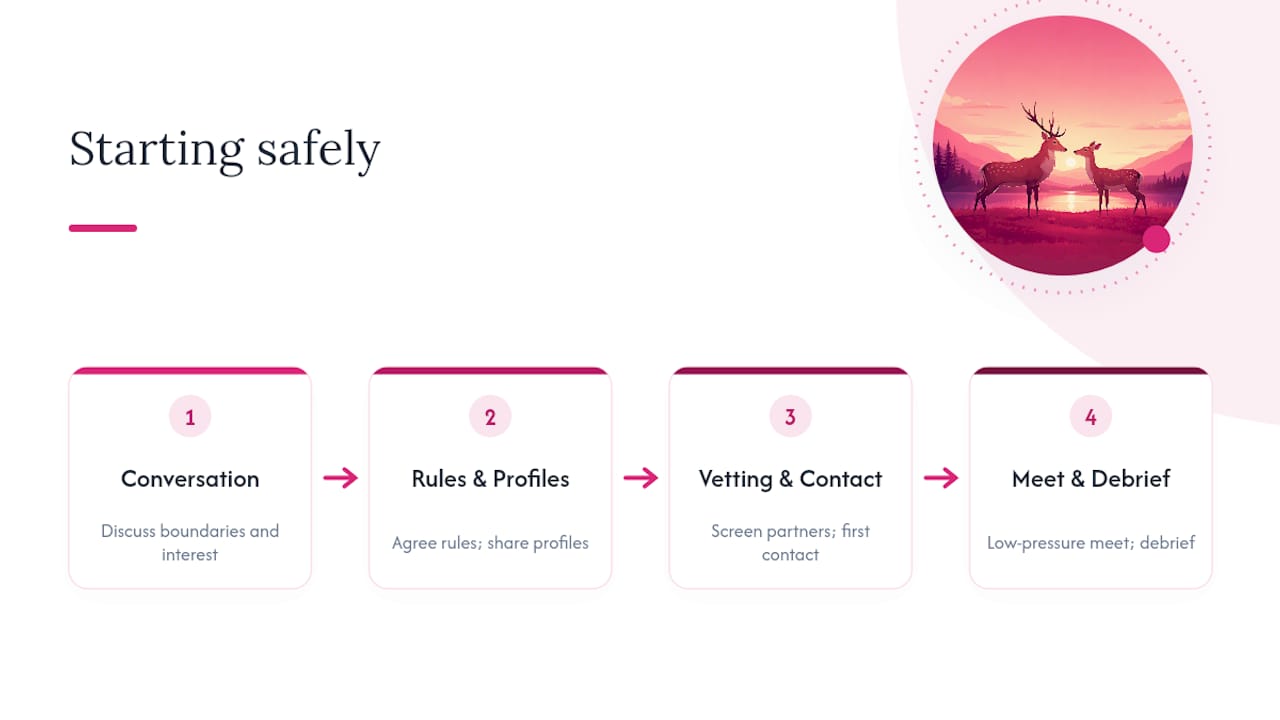
Phase 1: The first conversation (weeks 1–2)
Start with curiosity, not a plan. The goal of the first conversation is to understand whether both partners are genuinely interested, not to schedule anything. Use the negotiation questions above. If one partner is hesitant, that hesitation is information, not an obstacle to push through. Read the beginners guide to the lifestyle together as a low-stakes starting point.
Phase 2: Setting rules and creating profiles (weeks 2–4)
Once both partners are aligned, write your rules down. A shared document works well. Create profiles on verified platforms that present you as a couple unit, not as two separate individuals. Profile language like “stag and vixen couple seeking a respectful bull” signals the dynamic clearly and filters out mismatched approaches from the start.
Phase 3: Vetting and first contact (weeks 4–6)
Begin reaching out to potential partners. Use the verification steps in the vetting section below. A video call before any in-person meet is standard practice. The first in-person meeting should be social only, with no expectation of an encounter. This meeting exists to confirm chemistry and mutual comfort.
Phase 4: First encounter and debrief (weeks 6–8)
Keep the first encounter low-pressure. Afterward, use a structured debrief: each partner shares one thing that felt good and one thing they want to adjust. This conversation is the most important part of the first experience. It sets the tone for how the arrangement grows.
Pacing note: If either partner feels the timeline is moving too fast, slow down. There is no external deadline. Couples who rush the early phases to reach an encounter often find the arrangement destabilizing in ways that a slower build would have prevented.
Where do couples find consenting partners and communities?
Couples find partners online through verified lifestyle platforms, at in-person club nights and private events, through mutual introductions within trusted communities, and at lifestyle-specific social gatherings. Each channel has a different risk and reward profile.
Online options:
- Verified lifestyle platforms with ID checks and mutual-interest features (such as Swingersuk, which uses AI and human review to eliminate fake profiles and requires mutual interest before messaging).
- Interest-tagged profiles that let you filter for stag-and-vixen-specific arrangements rather than generic swinger listings.
- Private forums and community groups where members have established reputations over time.
- For a broader view of platform options, the best open relationship apps guide covers what to look for in a verified platform.
Offline options:
- Licensed lifestyle clubs that enforce age verification and consent policies at the door.
- Private house parties within an established community, typically accessed through referral.
- Lifestyle events and socials where couples meet in a non-sexual setting first before deciding whether to connect further.
Etiquette for initial outreach:
Present as a couple unit in your opening message. State the dynamic clearly (“We’re a stag-and-vixen couple”) so the recipient understands the structure before responding. Avoid opening with explicit content. A short, respectful introduction that names what you’re looking for and invites a conversation is the approach that gets genuine responses. Community guidelines consistently emphasize consent-first communication as the baseline expectation.
Safety, sexual health, and privacy: what you need to know
Safety starts with transparent testing, documented consent, and controlling who has access to any shared content. These are not optional considerations; they are the foundation the arrangement rests on.
STI testing and barrier methods:
Regular STI testing for both partners is non-negotiable. A common cadence is every three months for active couples, or before and after each new partner. Negotiate condom use with third parties explicitly before an encounter, not during. PrEP (pre-exposure prophylaxis for HIV prevention) is worth discussing with a healthcare provider if relevant to your situation. The CDC’s sexual health resources at Cdc provide current U.S. testing guidelines.
Consent documentation:
Consent for specific activities can be confirmed verbally and reinforced in writing (a shared notes document works). This does not need to be formal or transactional. The goal is clarity: both partners and any third party know exactly what is agreed before anything begins.
Privacy and content protection:
- Never share photos or videos that include identifiable features (faces, tattoos, distinctive locations) without explicit consent from everyone in the image.
- Strip metadata from any images before sharing online. Most smartphones embed GPS coordinates in photo files by default.
- Use a separate email address and phone number for lifestyle profiles if you want to keep this part of your life private from your professional or social networks.
- Agree in advance on what, if anything, a third party may share about the encounter.
Legal note: Laws governing consensual adult activity, privacy, and content sharing vary by U.S. state. This article is general information, not legal advice. Confirm the rules that apply in your state with a qualified attorney if you have specific concerns.
How do you keep the relationship healthy long-term?
Aftercare and structured reconnection are the practices that sustain stag-and-vixen relationships. Without them, even well-negotiated arrangements can erode the emotional bond they were built on.
Aftercare rituals that work:
- A dedicated reconnection night shortly after an encounter, focused entirely on the couple.
- A brief check-in immediately after an encounter (even a text if the stag was not present) to confirm both partners are feeling good.
- A weekly or bi-weekly debrief conversation that reviews what’s working and what needs adjustment.
Debrief conversation template:
Use three prompts: “What felt good this time?”, “What would I change?”, and “Is there anything I need from you right now?” Keep it low-stakes. The goal is shared narrative, not a performance review.
Jealousy management:
Jealousy is a signal, not a verdict. When it appears, treat it as information about an unmet need rather than evidence the arrangement is failing. Structured post-encounter check-ins help transform potentially destabilizing feelings into shared narrative and compersion. If jealousy becomes persistent or disproportionate, that is a signal to pause the arrangement and talk.
Signs the arrangement needs a pause:
- Either partner is consistently anxious before or after encounters.
- Reconnection rituals are being skipped or feel perfunctory.
- One partner is using the arrangement to avoid addressing relationship issues.
- Communication about the arrangement has become defensive or avoidant.
When to seek a therapist: A therapist trained in consensual non-monogamy (CNM) can help couples navigate jealousy, communication breakdowns, and boundary renegotiation without judgment. The American Association of Sexuality Educators, Counselors and Therapists (AASECT) maintains a directory of CNM-informed practitioners at Aasect.
Where do the terms “stag” and “vixen” come from?
The terms originated in online lifestyle forums in the late 1990s and early 2000s, where community members needed shorthand to distinguish pride-based arrangements from humiliation-based ones. “Stag” drew on the image of a dominant, confident male animal. “Vixen” carried connotations of an alluring, independent female. Together, the pair-term signaled a specific emotional register that separated this dynamic from cuckolding.
The terminology evolved as lifestyle communities moved from private forums to dedicated platforms. Today, stag and vixen sits alongside hotwifing and cuckolding as overlapping but distinct subcultures, each with its own shorthand, etiquette norms, and community spaces.
Language note for profiles: The pair-term carries weight when both partners claim the roles. A profile that says “stag and vixen couple” signals that both people are present in the arrangement and that the couple is the unit. A profile that says only “vixen seeking bull” signals something different: individual-led rather than couple-led. That distinction shapes who responds and what they expect.
How do you vet partners and spot fake profiles?
Do layered verification before any in-person meet: check the profile, cross-reference photos, confirm identity on a live video call, and use platforms with built-in ID verification where available. Each layer removes a category of risk.
Verification checklist:
- Profile signals: Does the profile have a consistent history, multiple photos, and a bio that matches the dynamic they claim? Thin profiles with one photo and no bio are a starting red flag.
- Reverse image search: Run profile photos through Google Images or TinEye to check whether they appear elsewhere under a different name.
- Social cross-reference: Ask for a social media profile or a community reference from someone you both know. This is standard practice in established lifestyle communities.
- Live video call: A short video call before any in-person meeting confirms the person matches their photos and gives you a read on their communication style.
- ID verification: On platforms that offer it, ID-verified badges materially reduce fake-profile risk. Swingersuk’s ID verification workflow is a member-facing feature designed specifically to increase trust between members before first contact.
- Mutual interest confirmation: Use platforms that require both parties to express interest before messaging begins. This filters out unsolicited approaches and confirms baseline mutual intent.
Pro Tip: Build a privacy-preserving verification workflow: use a dedicated email address for lifestyle platforms, conduct video calls through a platform that does not expose your phone number, and confirm ID on a verified platform before sharing any personal contact details. This sequence protects your identity while still giving you the confirmation you need.
Platforms that combine ID verification with mutual-interest messaging, like Swingersuk, reduce the friction of early-stage vetting by handling the baseline checks at the platform level. That means you spend less time filtering fakes and more time having real conversations with verified members.
What the stag-and-vixen dynamic gets right that most guides miss
Most explainers of the stag-and-vixen dynamic focus on the mechanics: who does what, with whom, and under what rules. That framing is useful but incomplete. The more interesting observation is that the arrangement works best when both partners are genuinely curious about each other’s experience, not just managing logistics.
The couples who sustain this dynamic long-term tend to share one trait: they treat the debrief as the most intimate part of the arrangement, not an administrative afterthought. The encounter itself is almost secondary. What builds the relationship is the conversation that follows, where both partners process what happened and find their way back to each other. That is compersion in practice, not just in theory.
The other thing most guides understate is how much the framing of the couple as a unit matters in practice. When couples present as a single unit, they attract third parties who understand the structure. When they present the roles separately, they get mismatched expectations and frustrating early conversations. The label is not just a descriptor. It is a filter.
Useful sources and further reading
The resources below cover sexual health testing, CNM therapy, community etiquette, and platform verification features relevant to U.S. readers exploring the stag-and-vixen dynamic.
| Resource | What it covers | Why it’s useful |
|---|---|---|
| CDC Sexual Health | STI testing guidelines and prevention resources for U.S. adults | Current, authoritative U.S. testing cadence recommendations |
| AASECT Therapist Directory | Directory of CNM-informed sex therapists and counselors | Find a qualified therapist who understands consensual non-monogamy |
| Swingersuk Community Guidelines | Consent, privacy, and conduct standards for lifestyle interactions | Practical etiquette baseline applicable beyond the platform |
| Swingersuk ID Verification | Member-facing ID verification workflow | Demonstrates layered verification in practice; reduces fake-profile risk |
| Swingersuk Platform | Verified community with mutual-interest messaging and privacy controls | Starting point for finding verified partners in a consent-first environment |
| VEX Society Stag & Vixen Guide | Core distinctions between stag-and-vixen and cuckolding | Clear framing of the pride-vs-submission contrast |
| Wifecraft Bull Etiquette | Third-party etiquette and community glossary | Practical guidance for bulls and couples on role expectations |