Three Consent First Moves for Safer Sexting for UK Adults
Three Consent First Moves for Safer Sexting for UK Adults
Sexting is never risk-free, but you can cut that risk dramatically with three moves: lock in continuous consent before you send anything, strip identifying details from the media itself, and turn off automatic cloud backups. Get those three right, and you’ve closed off most of the ways a private exchange turns into a public problem.
TL;DR:
- Continuous consent checks are essential; explicitly ask and confirm what happens to the content after viewing and whether it can be screenshotted.
- Stripping geolocation data, tattoos, or backgrounds from photos and deleting local copies minimizes identification risks before sending the media.
- Using encrypted messaging apps helps protect content during transmission, but trust depends on the recipient’s behavior and device security.
- Disabling automatic cloud backups and enabling two-factor authentication significantly reduce the chance of unintended leaks or account breaches.
- Verified platforms with identity checks and mutual interest systems lower the likelihood of encountering fake profiles or untrustworthy partners.
Table of Contents
- What Does a Safer Sexting Guide Actually Cover?
- How Do You Set Consent and Boundaries Before Sexting?
- How Do You Prepare Photos to Remove Identifying Details?
- Which Messaging App Is Actually Safe for Sexting?
- How Do You Lock Down Your Accounts and Devices?
- What Habits Keep Sexting Safer in the Moment?
- What Should You Do if Your Photos Are Shared Without Consent?
- How Does a Verified Platform Reduce Sexting Risk?
- A Consent-First Approach Is the Only One That Holds Up
- Why Swingersuk Fits Adults Who Want Verified, Consensual Connections
- Sources
- FAQ
What Does a Safer Sexting Guide Actually Cover?
A real safer sexting guide isn’t a list of app recommendations. It’s a combination of interpersonal rules and technical habits, because the biggest risks come from two different directions at once: a partner who can’t be trusted with the content, and a device or platform that holds onto it longer than you think.
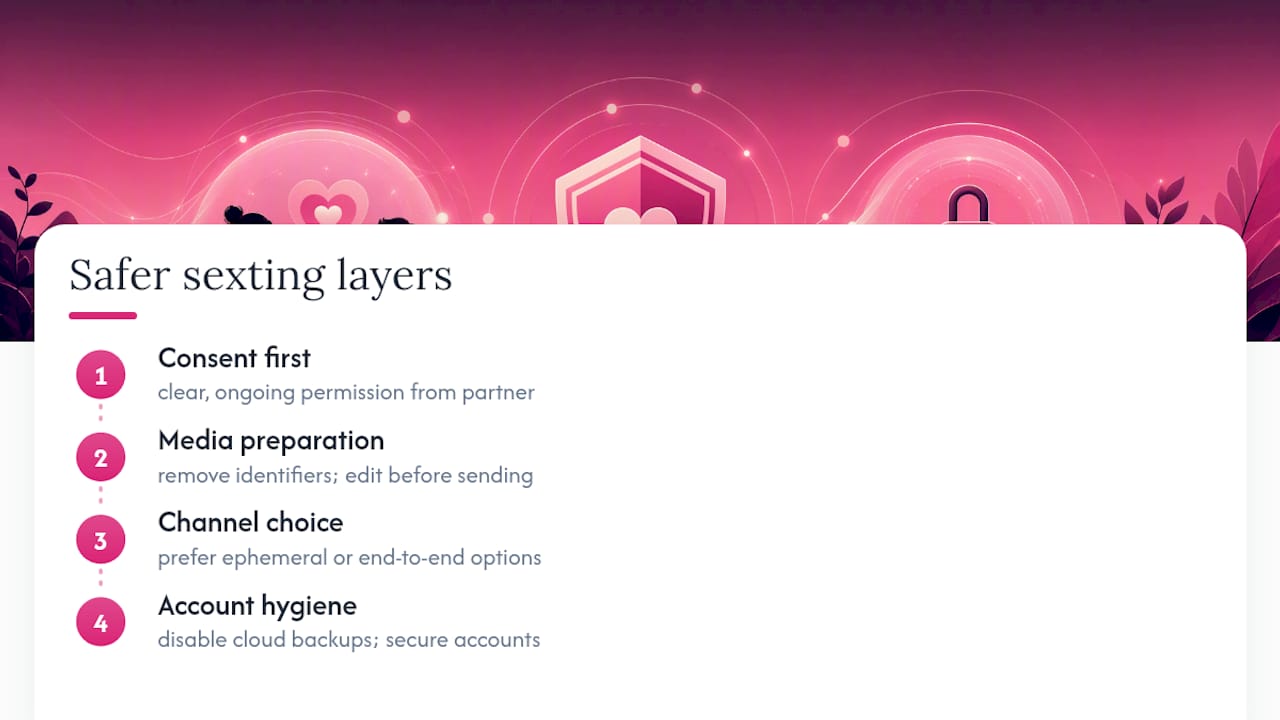
Most advice online fixates on encryption. That’s only half the picture. You could send a photo through the most secure app on earth and still get burned if the person on the other end screenshots it, or if your phone quietly backs it up to a cloud account you forgot existed. Safe sexting practices work best as layers: consent first, then media prep, then channel choice, then account hygiene. Skip a layer and the others don’t compensate for it.
How Do You Set Consent and Boundaries Before Sexting?
Consent for sexting isn’t a single “yes” at the start of a conversation. Boundaries need to be discussed before content is sent and revisited as things change, according to Psychology Today. That’s what continuous consent means in practice: you check in, not just once at the start, but any time the situation shifts, whether that’s a new type of content, a new platform, or a new mood.
Before you send anything, get clear answers to a few direct questions. Treat this like a short checklist you actually run through, not a vibe you assume:
- Will you delete this after viewing, and on what timeline?
- Who else, if anyone, might see your phone or accounts?
- Is screenshotting or saving off-limits, and will you say so if you break that rule?
- What happens to this content if we stop talking?
Pay attention to how someone answers, not just what they say. Hesitation is fine. Evasiveness is not. If someone brushes off a deletion request, jokes about “keeping it forever,” or pressures you to send something you’ve already declined, that’s a red flag worth taking seriously before you send anything at all.
Pro Tip: Ask the deletion question early in the conversation, not right before you hit send. A partner’s reaction when there’s no pressure yet tells you more than their reaction in the moment.
How Do You Prepare Photos to Remove Identifying Details?
Strip your device and your image of anything that could trace back to you before you ever open the camera app.
- Turn off location services for your camera app, or disable geotagging entirely in your phone’s privacy settings.
- Use a metadata stripping app, or manually clear EXIF data, since most photos carry embedded GPS coordinates and device information by default, per Psychology Today’s continuous consent piece.
- Frame the shot to exclude your face, tattoos, scars, jewelry, and background details like mail, street signs, or anything else that could identify you, a core recommendation from PCMag’s messaging security guide.
- Save the image to a folder that isn’t synced to a cloud service, then send it through your chosen channel.
- Delete the local copy afterward and empty your phone’s “Recently Deleted” folder, since phones often keep deleted photos for some time by default.
Cloud backups are the part people forget. WebMD notes that automatic photo backups can retain a copy of an image even after you’ve deleted it from your device, which means a “deleted” photo can still exist somewhere you’re not thinking about. Check your phone’s backup settings before you take a single photo, not after.
Which Messaging App Is Actually Safe for Sexting?
End-to-end encrypted apps like Signal or WhatsApp protect content in transit better than standard SMS or social media direct messages, since encryption prevents outside interception. That’s a real advantage. It’s also not the whole story.
Encryption protects the pipe, not the person on the other end. Even with strong end-to-end encryption, the recipient’s behavior determines what actually happens to your content once it arrives, a point PCMag makes directly about Signal itself. A trustworthy partner on SMS is safer than an untrustworthy one on the most secure app available.
Disappearing messages and view-once features deserve a specific caution here:
- They don’t stop screenshots on most devices, and some apps don’t even notify you when one happens.
- They don’t stop someone photographing the screen with a second device, which defeats any in-app protection entirely.
- The ACLU has warned that these features create a false sense of security precisely because the branding implies the content vanishes for good.
- Treat “disappearing” as a convenience setting, not a guarantee, and assume anything you send could technically be saved.
Device-to-device transfers, like AirDrop or Quick Share, skip cloud servers entirely, which is a genuine privacy plus. The tradeoff is that once a file lands on someone else’s phone, it’s theirs. There’s no recall button.
How Do You Lock Down Your Accounts and Devices?
Messaging hygiene matters as much as the message itself, because most leaks trace back to account compromise, not clever hacking.
- Turn on two-factor authentication for your messaging apps, email, and cloud accounts so a stolen password alone isn’t enough to get in.
- Use a password manager instead of reusing the same password across accounts, since credential reuse is one of the most common ways accounts get breached.
- Disable automatic photo backups to iCloud, Google Photos, or similar services, and check where copies might already be sitting.
- Hide message previews on your lock screen and set a passcode on individual messaging apps if your phone supports it.
Basic technical hygiene, things like two-factor authentication and disabling auto-backup, meaningfully lowers the odds that a compromised account turns into a leaked photo, according to Private Internet Access.
Pro Tip: Check your cloud storage settings once, right now, before you read any further. It takes two minutes and closes one of the most common leak paths there is.
What Habits Keep Sexting Safer in the Moment?
The best device hygiene in the world won’t save you from a rushed decision. A few habits close that gap:
- Double-check the recipient’s name and number before you hit send. Autocomplete has ruined more than one relationship by sending an intimate photo to the wrong contact.
- Never sext while drunk or high. Impaired judgment leads to worse safety decisions, and Psychology Today’s research on the topic backs this up directly.
- Start slow with a new partner. Test trust with flirty text or a non-identifying photo before sending anything that shows your face or body.
- Consider a subtle watermark or share content incrementally, building up rather than sending everything at once.
None of these steps are about distrust for its own sake. They’re about giving yourself room to notice a red flag before it becomes a screenshot you can’t undo.
What Should You Do if Your Photos Are Shared Without Consent?
Act fast, and act in the right order. The first hour matters more than the first day.
- Preserve evidence immediately: screenshot the post, the URL, the account that shared it, and timestamps, before anything gets taken down or deleted.
- Report the content through the platform’s own reporting tools, which usually move faster than a generic complaint.
- Use a hash-matching removal service. eSafety’s guidance on non-consensual sharing explains that these tools create a digital fingerprint of the image and block re-uploads across participating platforms without requiring the image to be shared again.
- Do not pay anyone threatening to leak more content. Sextortion demands escalate when victims pay, and payment rarely stops the threat.
- Contact police or a specialist support organization if the person threatens continued distribution or if a minor is involved.
Documenting a leak well means capturing the URL, the platform, and the exact timestamp before you report anything. That evidence package is what makes a removal request or police report actually actionable, rather than a vague complaint with nothing to point to.
Move through these steps in order. Reporting before you’ve preserved evidence means you might lose your own proof the moment a platform removes the post.
How Does a Verified Platform Reduce Sexting Risk?
Most sexting risk comes from not knowing who’s actually on the other end of the conversation. That’s a harder problem to fix with an app setting than with a verification process.
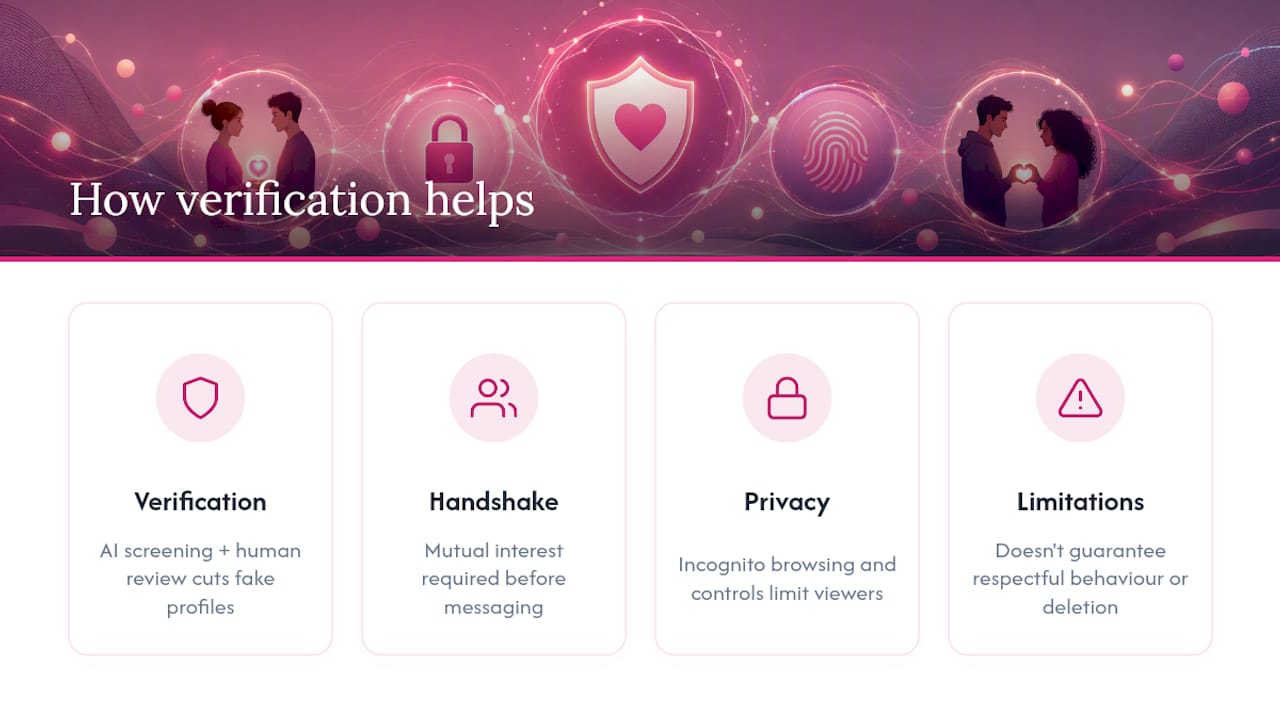
Swingersuk is built around that exact gap. Every member goes through identity verification that combines AI screening with human review, which cuts down on the fake profiles and bots that make it hard to know who you’re really talking to. The platform’s Pulse Handshake System requires mutual interest before either person can message the other, so there’s no unsolicited pressure to share anything before you’re both actually ready. Members also get incognito browsing and privacy controls that limit who can see their profile at all.
None of this replaces the interpersonal work of setting boundaries. Verification tells you a profile is likely real; it doesn’t guarantee the person behind it will respect a deletion request once content is sent. That part still comes down to the conversation you have before you send anything, no matter how verified the platform is.
A Consent-First Approach Is the Only One That Holds Up
The technical side of this guide, the EXIF stripping, the 2FA, the backup settings, gets most of the attention because it’s concrete and checkable. But the actual failure point in most sexting incidents isn’t a settings menu. It’s a partner who never really agreed to what happened next, or who agreed once and assumed that covered everything indefinitely.
Verification and moderation on a platform can filter out bad actors before a conversation even starts, which matters more than people give it credit for. But no amount of platform infrastructure replaces the two minutes it takes to ask someone directly what happens to a photo after they see it. That question, asked plainly and answered honestly, does more for your safety than any app setting on this list.
— Daniel
Why Swingersuk Fits Adults Who Want Verified, Consensual Connections
Swingersuk exists for exactly the situation this guide is about: adults who want to explore sexting and intimacy with people they can actually trust, inside a community built to filter out the fake profiles and unsolicited pressure that make sexting risky in the first place.

Every profile goes through AI and human identity verification before it’s visible, which means you’re not gambling on whether the person messaging you is real. The Pulse Handshake System keeps things consent-first from the very first message, since neither side can start a conversation without mutual interest confirmed on both ends. Incognito browsing lets you control your own visibility, and private cam rooms give users a space for one-to-one or group interaction that stays within the platform’s privacy controls. If you’re weighing whether to sext with someone you’ve just matched with, that verification layer is the difference between a calculated risk and a blind one.
Check out membership options to see what fits, or head to the Swingersuk homepage to create a verified profile and start browsing on your own terms.
Sources
- Safe sexting (Psychology Today, 2024-04-07)
- Signal isn’t the problem — some basic tips for successful secure messaging (PCMag)
- What is sexting? (WebMD, 2020-11-24)
- Disappearing messages don’t work (ACLU)
- Sexting and sending nudes (eSafety Commissioner)
FAQ
What are the basic rules of sexting safely?
Get continuous consent before sending anything, remove identifying details like your face and tattoos from any media, disable cloud backups, and avoid sending content while intoxicated.
What are two risks of sexting?
The two biggest risks are a partner sharing content without your consent, and technical exposure through cloud backups or account compromise that keeps copies you thought were deleted.
Are disappearing messages actually safe for sexting?
No. Features like view-once and disappearing messages don’t stop screenshots or a second device photographing the screen, so treat them as a convenience rather than real protection.
How do I verify who I’m actually sexting with?
Look for consistency across a conversation, ask for a video call before sharing anything identifying, and consider using a platform with identity verification, like Swingersuk’s AI and human review process, before assuming a profile is genuine.
What should I say to start a consent conversation before sexting?
Ask directly what happens to the content afterward, whether it will be deleted, and whether screenshots are allowed. How someone answers matters more than the words they use.