
5 Preplay Ways to Curb Jealousy in Swinging for UK Couples: Research
5 Preplay Ways to Curb Jealousy in Swinging for UK Couples: Research
Yes, jealousy is common in swinging, and it doesn’t mean the lifestyle is wrong for you or your relationship. The first useful step is simple: pause, name what you’re feeling out loud, and check in with your partner before the moment escalates. Treat jealousy as information you can work with, not a verdict on your relationship. Most couples who thrive in this lifestyle don’t eliminate jealousy. They get better at spotting it early and responding to it together.
TL;DR:
- Most couples in swinging manage jealousy through early recognition and shared boundaries rather than attempting to eliminate it altogether.
- Jealousy often stems from fear of loss, insecurity, social comparison, or attachment issues, requiring tailored coping strategies.
- Pre-play check-ins, brief during-play signals, and post-play aftercare significantly reduce emotional reactivity and foster trust.
- Expressing feelings with “I” statements and setting specific boundaries helps prevent blame and promotes healthy communication.
- Using verified communities with safety features can lessen insecurity caused by uncertainty and dishonest profiles.
Table of Contents
- Why Does Jealousy Happen in Swinging?
- Step-By-Step Techniques to Reduce Reactivity Before, During, and After Play
- How to Talk About Jealousy Without Blame or Shame
- Aftercare and Building Compersion Without Dismissing Jealousy
- When Jealousy Signals a Bigger Problem
- How a Verified Community Can Ease the Uncertainty
- A Brief Reflection on Jealousy as Data
- Sources
Why Does Jealousy Happen in Swinging?
Jealousy, envy, and compersion often get lumped together, but they’re distinct experiences. Jealousy is the fear of losing something you already have, usually your partner’s attention or emotional priority. Envy is wanting something someone else has, like the confidence a partner is showing with a new connection. Compersion is the flip side of both: genuine happiness at seeing your partner experience pleasure or connection. Most people in the lifestyle feel some blend of all three in a single evening, sometimes within minutes of each other.
A qualitative study of active swinging couples found jealousy showed up regularly among participants, but it rarely broke relationships apart. Instead, couples developed shared rules and boundaries to manage it, and some even used the discomfort to build anticipation and excitement rather than treat it as a problem to solve. The same research, recorded in the academic literature, reinforces that management, not eradication, is the realistic and healthier goal.
The psychological roots usually trace back to a handful of patterns:
- Fear of loss: worry that a partner’s attention or affection will shift permanently toward someone else.
- Insecurity: doubts about your own attractiveness, performance, or value in the relationship.
- Social comparison: measuring yourself against another person in the room and coming up short in your own head.
- Attachment patterns: earlier relationship experiences, especially anxious or avoidant attachment styles, that get activated under the stress of watching a partner with someone new.
Knowing which root you’re dealing with changes which coping tool actually works. Insecurity calls for reassurance. Comparison calls for grounding in your own value, not your partner’s evening.
Step-By-Step Techniques to Reduce Reactivity Before, During, and After Play
Jealousy tends to spike hardest at three moments: right before play starts, in the middle of it, and in the quiet after. Each phase needs its own tools.
Before you walk into any shared scenario, run a short self-check. Ask yourself: Am I doing this because I want to, or because I feel pressured? Have I slept and eaten enough to regulate my emotions tonight? Is there a specific fear I haven’t said out loud yet? Do I know exactly what my partner and I have agreed to? If any answer feels shaky, that’s the signal to talk before you go further, not after.
A pre-play negotiation checklist keeps both partners on the same page:
- Confirm what’s on and off the table for this specific event, not just in general.
- Agree on a check-in signal, verbal or physical, that either partner can use without explanation.
- Decide how much privacy versus visibility you both want during play.
- Set a rough time to regroup, even briefly, during the evening.
- Name one thing each of you needs to feel secure tonight.
During play, small check-ins matter more than long conversations. A hand squeeze, a specific word, or brief eye contact across the room can reset a partner’s nervous system without breaking the moment for anyone else. Many couples deliberately preserve eye contact or a quick kiss before separating, since that small ritual reduces the sense of disconnection that often fuels jealousy.
Afterward, aftercare is where most of the emotional repair happens. A simple debrief script works well: “What felt good tonight? What felt hard? What do you need from me right now?” Physical closeness, like cuddling or a shower together, helps regulate the nervous system faster than conversation alone.
Pro Tip: Keep a folded card or note on your phone with your top three grounding techniques, box breathing, a five senses check, or a single reframe phrase like “this is discomfort, not danger.” Reading it in the moment is easier than trying to remember it cold.
How to Talk About Jealousy Without Blame or Shame
The way you open a jealousy conversation determines whether it turns into problem solving or a fight. Start with “I” statements: “I felt anxious when I couldn’t see you” lands very differently than “You ignored me all night.” Timing matters too. Bring up hard feelings when you’re both calm and rested, not mid scene and not the second you walk in the door exhausted.
Boundaries work best when they’re specific rather than vague. Some examples worth considering:
- Soft swap versus full swap: agreeing in advance which acts are on the table with other partners, explained in more detail here.
- Emotional limits: rules around repeated meetings with the same person, or limits on pet names and intimate language with others.
- Overnight rules: whether staying over is ever acceptable, and under what circumstances.
Boundaries aren’t static. Build in a rhythm for revisiting them, weekly during an active period, after any event that stirred up strong feelings, or the moment either partner notices resentment building. Red flags that a boundary needs immediate attention include one partner consistently avoiding the conversation, repeated “small” rule bending, or a growing sense of dread before events. Reviewing your community’s guidelines on consent and communication can give you language to structure these check-ins.
Aftercare and Building Compersion Without Dismissing Jealousy
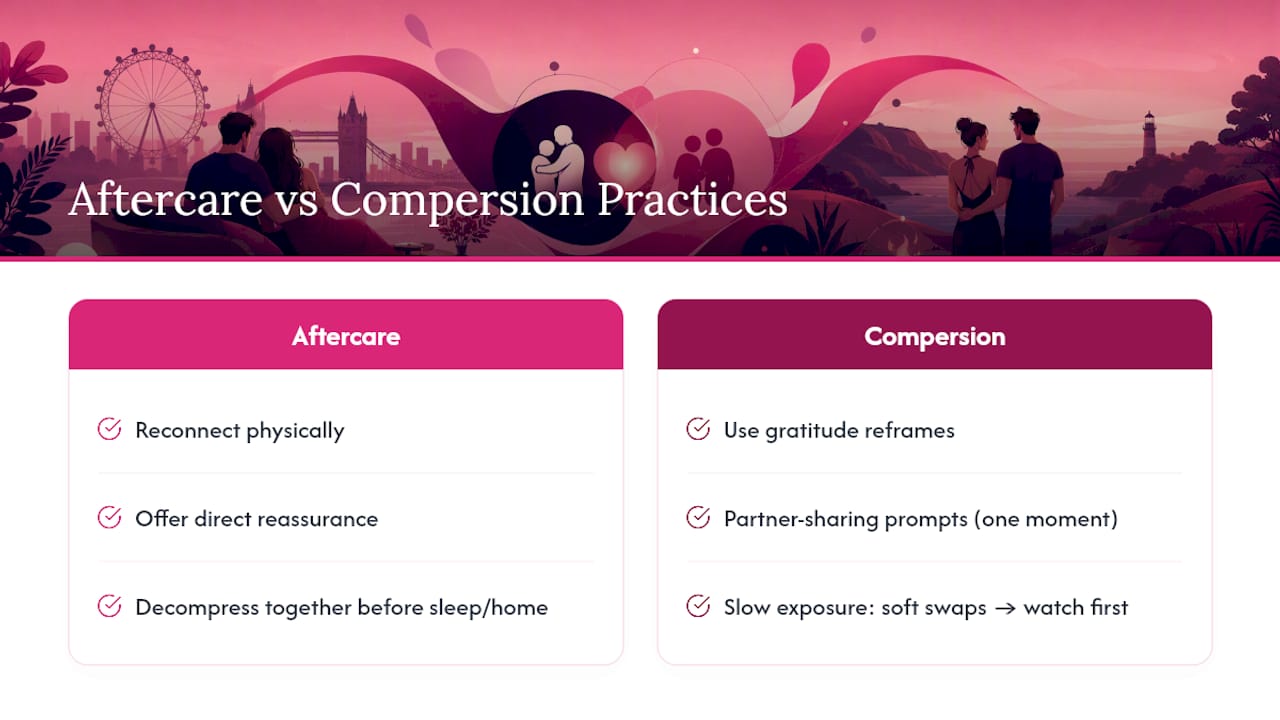
A solid aftercare routine has three parts: reconnecting physically, offering direct reassurance, and decompressing together before you both fall asleep or head home. Skipping this step is one of the fastest ways jealousy curdles into resentment overnight.
Compersion isn’t something you can force, but you can practice toward it. Gratitude reframes help: instead of “she got more attention than me,” try “he had a genuinely good night, and that’s part of why we do this.” Some couples use partner-sharing prompts, asking each other to describe one moment from the night they enjoyed watching. Slow exposure, starting with soft swaps or watching before participating, outlined in this lifestyle guide, builds tolerance gradually rather than all at once.
Here’s the honest part: compersion isn’t guaranteed, and forcing it can backfire. Some people manage jealousy well and never feel that specific joy, and that’s a legitimate place to land, not a failure.
When Jealousy Signals a Bigger Problem
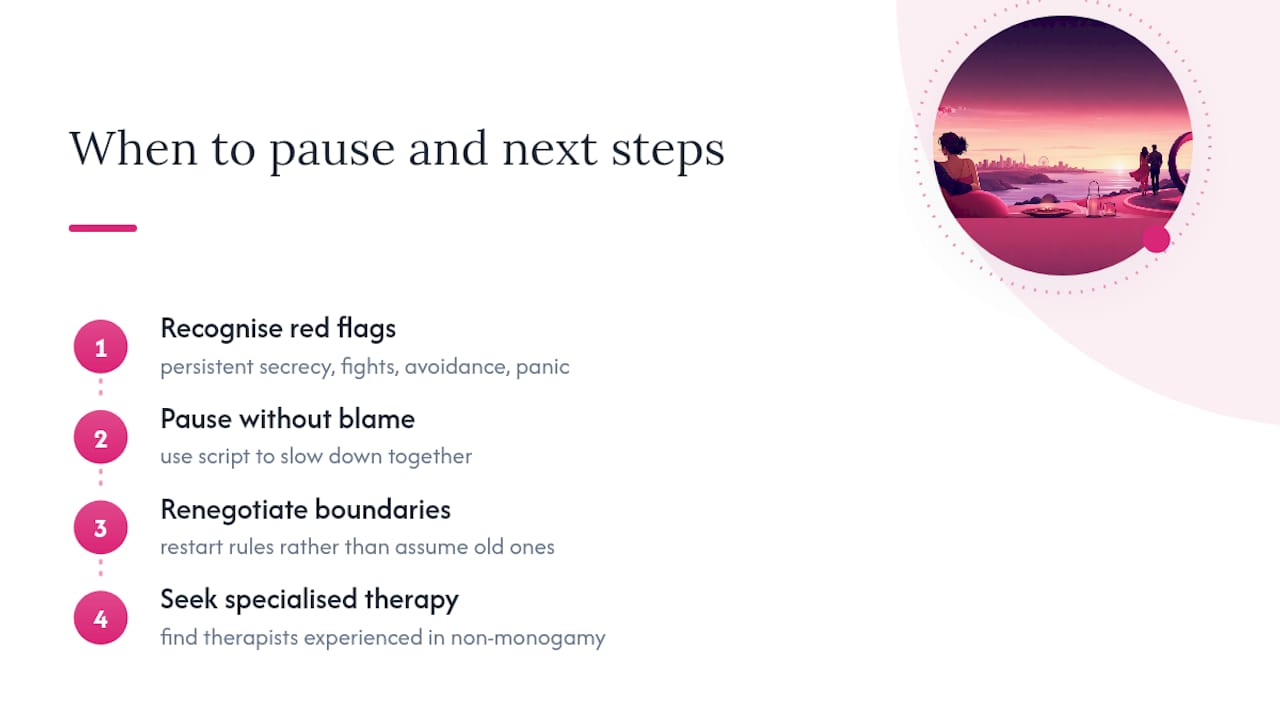
Occasional jealousy is normal. Persistent secrecy, recurring fights after every event, one partner avoiding intimacy altogether, or anxiety that spikes into panic are different signals. Those patterns suggest it’s time to pause play, not push through it.
Pausing doesn’t require blame. A simple script works: “I want to keep doing this together, but I need us to slow down and figure out what’s underneath this.” From there, community resources on handling recurring jealousy recommend renegotiating boundaries from scratch rather than assuming the old rules still fit.
If the pattern persists, a therapist experienced in consensual non-monogamy is worth seeking out specifically. Ask any prospective therapist directly whether they’ve worked with non-monogamous or swinging clients before booking, since general couples counseling doesn’t always translate well to this context.
How a Verified Community Can Ease the Uncertainty
A lot of jealousy in swinging gets amplified by uncertainty, fake profiles, unclear intentions, or partners who ghost mid-conversation. Verified communities and mutual opt-in messaging reduce that noise considerably. Swingersuk’s Pulse Handshake system requires mutual interest before either side can message, which cuts down on the one-sided pursuit that often triggers insecurity in a primary partner.
A few features worth building into your safety plan:
- ID verification (both AI and human reviewed) to reduce the fear of catfishing or dishonest profiles.
- A local events and club directory so new couples can meet people in structured, lower-pressure settings first.
- Incognito and privacy controls that let you control exactly who sees your profile and when.
Using these tools doesn’t remove jealousy. It removes some of the guesswork that makes jealousy worse.
A Brief Reflection on Jealousy as Data
One couple I heard about early in their lifestyle journey almost quit after their first event, until they built a two-minute check-in ritual before and after every meetup. The jealousy didn’t vanish. It just stopped surprising them. That’s the real shift: jealousy stops being an emergency once you expect it, name it, and treat it as feedback rather than a threat. Experiment gently. The goal was never a jealousy-free relationship. It was a relationship that can hold the feeling without breaking.
— Daniel
Sources
The Swings and roundabouts study remains the clearest academic look at how real swinging couples manage jealousy. For community-level guidance, Swingers Club’s emotional considerations page and Swingtasy’s jealousy guide both offer grounded, practical scripts worth bookmarking.
- Swings and roundabouts: management of jealousy in heterosexual ‘swinging’ couples
- Swings and roundabouts: Management of jealousy in heterosexual ‘swinging’ couples (DOI record)
- How to Overcome Jealousy in the Swinging Lifestyle: Turning Insecurity into Growth and Connection
- Jealousy in Swinger Relationships — and How to Handle It