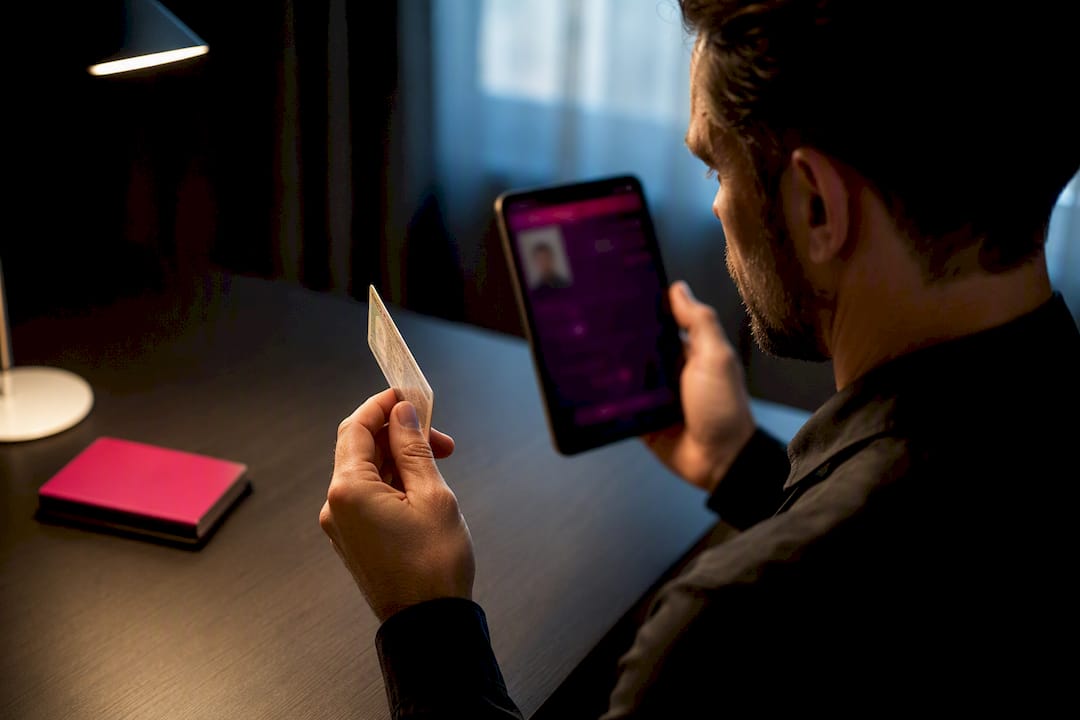
Under 2 Minutes: Privacy-First ID Verification for Swingers
Under 2 Minutes: Privacy-First ID Verification for Swingers
The safest way to confirm real, consenting adults on a swingers or dating platform combines document authentication, selfie biometric matching, liveness detection, and risk-based step-up checks, backed by human review for edge cases. Privacy stays intact when raw biometric data is never stored, only attestations or tokens are. Done well, verification takes under two minutes and can end in a visible verified badge. SwingersUK builds its member protections around this exact layered model.
TL;DR:
- Document authentication is essential but can fail due to worn or unusual IDs, requiring retries or human review to avoid wrongful rejections.
- Selfie-to-ID face matching is vulnerable to false positives caused by lighting issues, glasses, or appearance changes, but retries and fallback options help mitigate these errors.
- Privacy is maintained through tokenized attestations that confirm verification without storing raw biometric data, supporting GDPR compliance and member trust.
- Automated verification should be tiered and risk-based, with clear escalation protocols and metrics like false positives and appeal rates guiding system adjustments.
- A transparent appeal process with quick human review ensures legitimate members can challenge errors, reducing false rejections and improving overall trust.
Table of Contents
- What Is ID Verification Safety and Why Does It Matter Here?
- How Do Document Checks, Biometrics, and Liveness Detection Work?
- Can Verification Stay Private While Still Being Effective?
- Building a Verification Program Operators Can Actually Run
- What Happens When a Member Disputes a Verification Decision?
- How Do You Evaluate a Third-Party Verification Provider?
- SwingersUK’s Approach to Verification in Practice
- Get Verified and Start Connecting on SwingersUK
- Sources
What Is ID Verification Safety and Why Does It Matter Here?
ID verification safety in a swingers or lifestyle community means confirming that the person behind a profile is a real, consenting adult, without exposing that person’s sensitive data in the process. Get this wrong and the harms are specific to this space: catfishing that leads to wasted evenings, romance scams that target couples exploring the lifestyle for the first time, deepfake profile photos, repeat offenders creating new accounts after a ban, and unsafe in-person meetups with someone who lied about who they are. Feeld’s rollout of automated verification with human review pushed adoption to roughly 38% of profiles and lifted its internal trust-and-safety score by 25%, a clear signal that identity confidence pays off in measurable trust, not just good intentions.
The benefits compound once verification is running well:
- Members trust the community enough to actually show up to events and meetups.
- Support teams field fewer fake-profile complaints and account disputes.
- In-person meetings carry lower risk because both sides know who they are meeting.
- Retention improves because genuine members stop competing with bots and scammers for attention.
Verification only earns its keep as governance, not decoration. It has to feed directly into moderation queues and account lifecycle decisions, including suspicious activity flags, ban-evasion detection, and recovery workflows. A verification badge that sits disconnected from moderation is just a sticker.
How Do Document Checks, Biometrics, and Liveness Detection Work?
Every layer proves something different, and none of them alone is enough.
- Document authentication. The system reads the machine-readable zone (MRZ) on a passport or driving license, checks the document template against known formats, and looks for tampering such as altered photos or mismatched fonts. This step confirms the document is real, not that the person holding it owns it.
- Selfie-to-ID matching. A live selfie gets compared against the photo on the document to confirm the same face appears on both. This is where fraud attempts most often get caught in dating and lifestyle contexts, since roughly three-quarters of UK dating app users report encountering deepfakes, making static photo matching alone unreliable.
- Liveness detection. The member performs a quick action, such as blinking or turning their head, so the system can confirm a live person is present rather than a photo, mask, or AI-generated video. This is the direct countermeasure to deepfake attempts.
- Device and behavioral signals. Device fingerprinting, IP and location anomalies, and rate limiting don’t verify identity on their own, but they flag accounts worth a second look, such as five signups from one device in an hour.
Each layer has a cost. Document checks can fail for members with worn or unusual documents. Selfie matching produces false positives for people with lighting issues, glasses glare, or recent appearance changes, which is usually solved with a retry prompt or a fallback to human review rather than an automatic rejection. Layered systems like Veriff’s recommended approach for dating apps exist precisely because no single check should carry the entire trust decision alone.
Pro Tip: Route the first failed liveness check straight to a retry with clearer instructions before escalating to human review. Most legitimate members pass on the second attempt, and this alone cuts unnecessary appeal volume.
Can Verification Stay Private While Still Being Effective?
Yes, and this is where most platforms get the trade-off wrong. Data minimization means the platform never stores a raw biometric template, the actual facial map generated during a selfie check. Instead, it stores an attestation: a token confirming “this profile was verified” without retaining the biometric data behind that confirmation.
Biometric-bound credentials, sometimes called tokenized attestations, let a platform re-confirm the same verified person later without ever touching stored biometric data again. TrustStamp’s approach shows how this pattern supports on-device checks and offline verification, which keeps sensitive data off central servers entirely, a meaningful advantage under GDPR for a platform where discretion matters as much as trust.
Practical patterns that protect members without weakening verification:
- Store a pass/fail attestation and a token, never the underlying document image or face scan.
- Offer staged verification: a lighter check to browse, a fuller check to message or join cam rooms.
- Make the verified badge optional to display, since some members want the trust signal without broadcasting it publicly.
- Provide a human review pathway for members who can’t or won’t submit a government ID, including a documented reason and an alternative proof path.
Members in this community often have real reasons to be cautious about handing over identity documents. A platform that explains, in plain terms, what gets deleted and what gets kept builds more trust than one that simply demands documents and stays quiet about the rest.
Building a Verification Program Operators Can Actually Run
A working verification program starts with assurance tiers, not a single pass/fail gate. Map specific events, new account creation, password recovery, a spike in reports against one profile, to the level of check each one deserves.
- Define at least three assurance tiers: browse-only, standard verified, and high-trust (needed for cam rooms or event hosting).
- Trigger step-up verification automatically on risk signals: a device already flagged, a location mismatch, or a report from another member.
- Design the flow so automated checks run first and human review only activates on a failure or an ambiguous match, keeping the process fast for the majority who pass cleanly.
- Write clear, non-judgmental messaging at every step explaining why a check is happening and what happens next if it fails.
- Connect verification results directly to moderation: block messaging for unverified high-risk accounts, and flag likely ban-evasion when a new account’s document data resembles a previously banned one.
- Track four metrics from day one: verified ratio, fraud or fake-profile reports, appeal rate, and signup-to-verified conversion.
- Pilot the flow with a small user segment before a full rollout, and adjust thresholds based on what the appeal rate reveals about false positives.
Feeld’s case data backs the operational payoff here directly: automated verification with human review cut fake-profile support tickets and enabled automated account recovery for legitimate members who lost access to their accounts.
Pro Tip: Watch the appeal rate as closely as the fraud rate. A verification system with near-zero appeals and high fraud catch is rare, if your appeals stay near zero, your thresholds are probably too loose.
What Happens When a Member Disputes a Verification Decision?
Every verification system produces false rejections, a real member whose document check fails for reasons that have nothing to do with fraud. Worn passports, name changes, unusual lighting, and older document formats all trigger legitimate failures. A dispute process needs to exist before the first appeal ever comes in, not built reactively after complaints pile up.
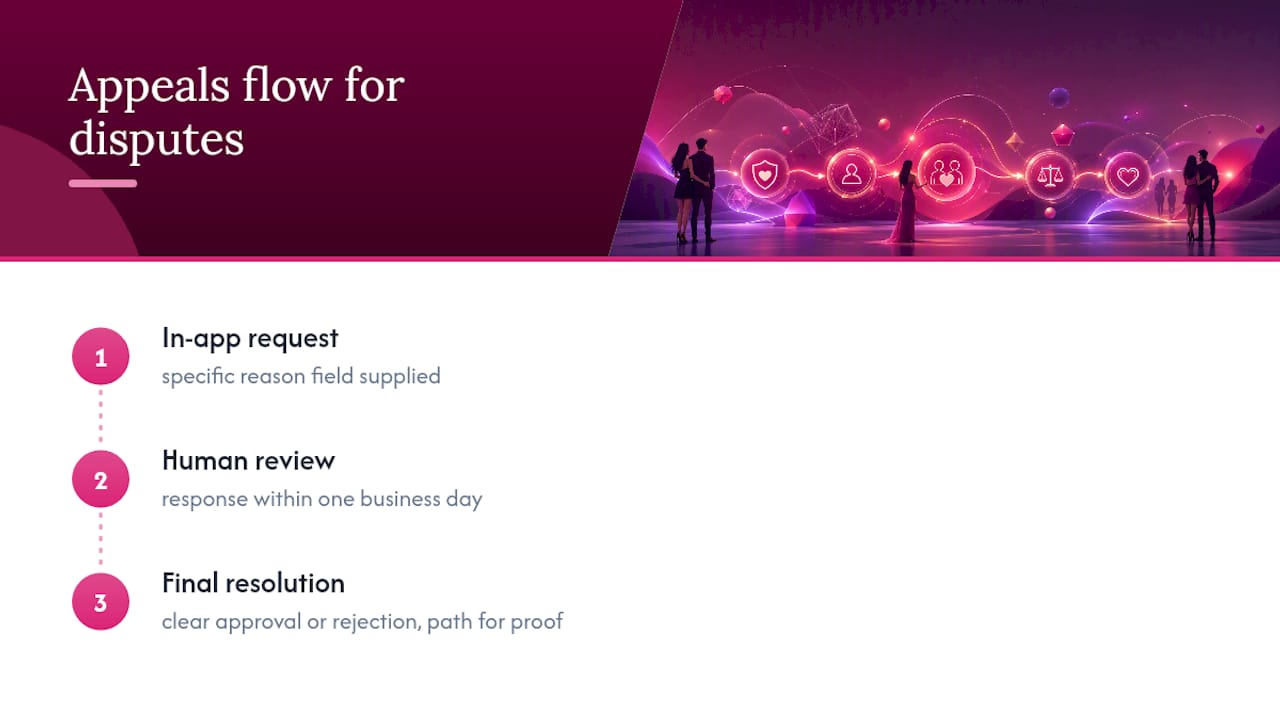
A workable appeals flow has three parts. First, a clear in-app path to request human review, with a specific reason field so the reviewer isn’t guessing what went wrong. Second, a documented service standard for how quickly a human reviewer responds, ideally within one business day, since members left in limbo tend to abandon the platform rather than wait. Third, a resolution that’s actually final: either the account gets upgraded to verified with a clear explanation, or the member gets a specific reason for the rejection and a path to submit alternative proof.
Transparency matters more here than in most consumer apps. A member submitting an ID to a lifestyle platform is already taking a leap of trust, and a vague “verification failed” message with no explanation reads as suspicious rather than routine. Reviewers should be trained to distinguish between a technical failure (bad lighting, document glare) and a genuine fraud signal (mismatched face, altered document), and the messaging to the member should reflect that distinction honestly. Platforms that document every appeal outcome also build a feedback loop: patterns in false rejections point directly at where the automated system’s thresholds need adjustment.
How Do You Evaluate a Third-Party Verification Provider?
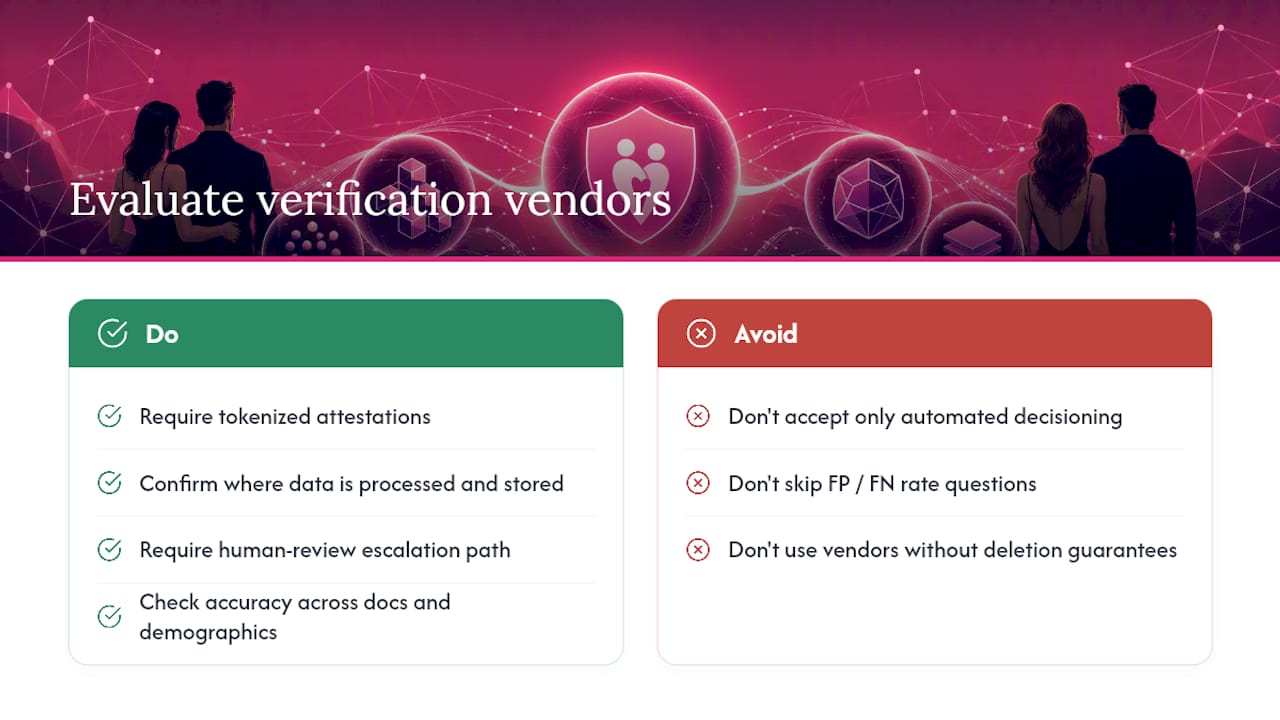
Not every identity verification vendor is built for a community where discretion and sensitive personal circumstances matter as much as fraud prevention. A provider evaluation should go beyond accuracy claims and look at four areas specifically.
Data handling practices come first: does the vendor support tokenized attestations instead of raw biometric storage, and where exactly is data processed and retained? A vendor that can’t answer this precisely is a liability, not a feature. Second, check the balance of automation and human review; a provider offering only automated decisioning with no escalation path will generate appeals your team can’t resolve fairly. Third, look at documented accuracy across different document types and demographics, since a system tuned mostly on one document format will produce uneven false-positive rates for members using less common ID types. Fourth, confirm the provider’s compliance posture matches your obligations under GDPR or equivalent data protection frameworks, including clear data retention limits and deletion guarantees.
Ask for the false-positive and false-negative rates the vendor reports, not just the headline accuracy number, and ask how those numbers change for older documents or lower-quality selfie conditions. A vendor unwilling to share this detail is telling you something about how confident they actually are in their own system.
SwingersUK’s Approach to Verification in Practice
SwingersUK combines AI screening with human review rather than leaning on automation alone, which keeps false positives low without slowing down genuine members. The Pulse Handshake System adds a second layer of protection by requiring mutual interest before anyone can message, cutting down on unwanted contact regardless of verification status. Verified badges give members a visible signal of who’s real, while the platform keeps its privacy posture front and center for a community where discretion is the price of trust.
— Daniel
Get Verified and Start Connecting on SwingersUK
SwingersUK’s verification runs on the same layered model this article just walked through: AI screening paired with human review, catching fake profiles and bots before they ever reach your inbox, without the platform demanding more of your personal data than it needs.
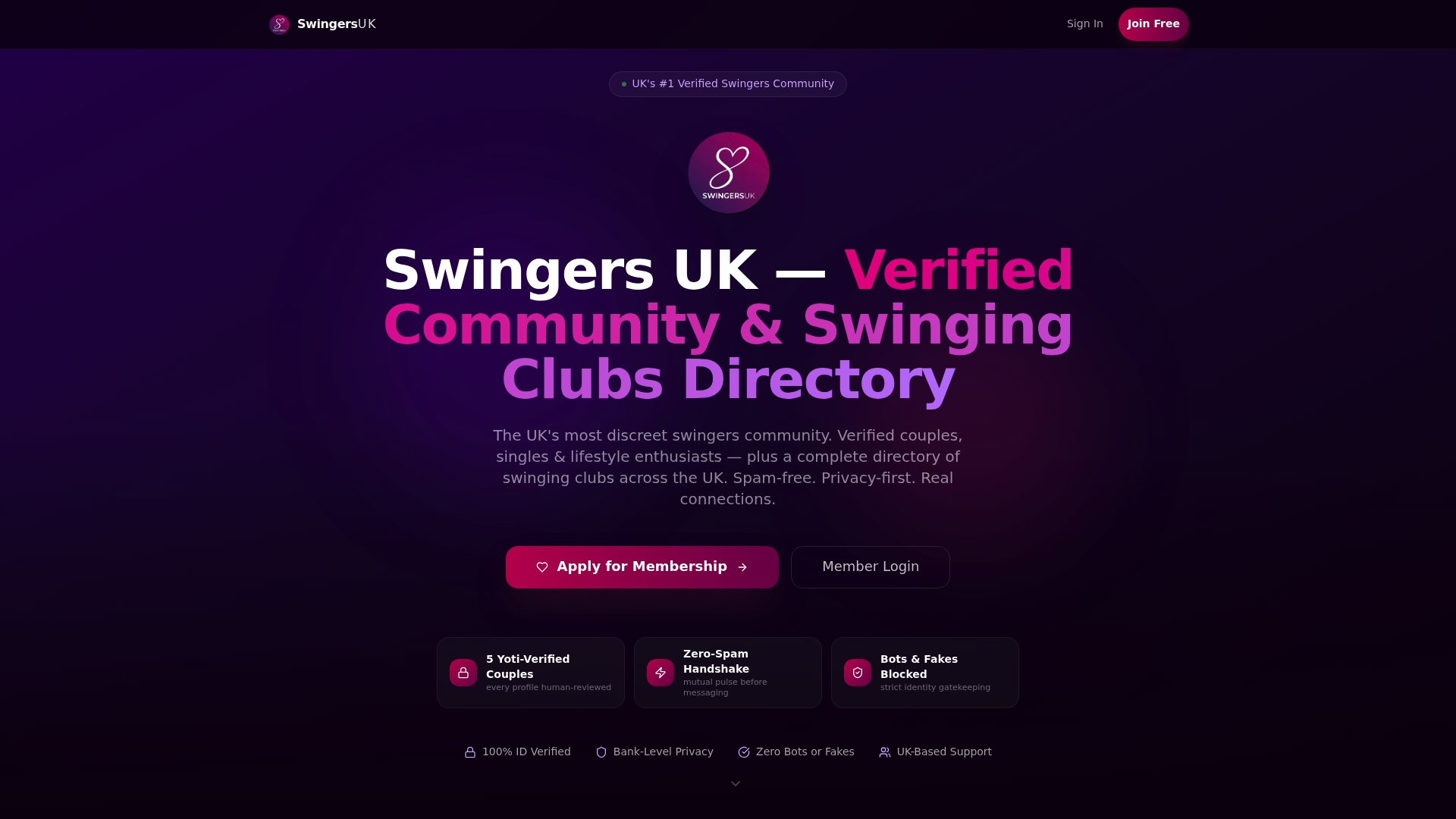
The Pulse Handshake System means nobody messages you without mutual interest confirmed first, so verification isn’t the only thing standing between you and unwanted contact. Once you’re verified, you get access to special features and a member base that’s actually who they say they are. Head to the ID verification page to see exactly what the process involves, then check current membership options to unlock full messaging and cam access once you’re through.
Sources
- Building trust with the Feeld dating app: How a leading platform protects its community - Veriff
- Securing user trust and safeguarding platforms with biometric identity verification - BiometricUpdate
- Biometric age verification & privacy benefits - TrustStamp