
Privacy First ID Checks for UK Swinger Clubs: What UK Law Requires
Privacy First ID Checks for UK Swinger Clubs: What UK Law Requires
Verified UK swingers communities typically confirm age and identity using tokenized third-party checks plus AI-assisted selfie-to-ID with human review, not by permanently storing your passport. UK law and ICO guidance require transparent, proportionate methods, so you should expect a clear privacy notice, minimum data collection, and an explanation of alternatives whenever a platform asks for a hard identifier.
TL;DR:
- Most UK platforms use tokenized third-party checks and AI-assisted selfie matching to verify identities without storing full documents, reducing breach risks.
- Verification steps typically start with self-declaration, followed by attribute checks, and escalate to document upload only if necessary, respecting privacy guidelines.
- Platforms are required to disclose clear retention periods, lawful basis, and data handling practices, especially when biometric data is involved, to comply with UK GDPR.
- In-person event entry checks are less regulated, involve quick visual ID confirmation, and do not require long-term data storage or biometric processing.
- Failing or inconsistent verification processes can lead to regulatory scrutiny, so users should verify platform transparency and exercise their data rights under UK law.
Table of Contents
- How online ID and age verification actually works
- Privacy and data protection: what platforms must disclose
- UK law and guidance affecting ID checks
- What to expect as a user: steps, alternatives and red flags
- What happens if a verified community adjoins a physical event
- Comparing online account verification and on-site entry checks
- Where online and venue-linked ID protocols genuinely diverge
- Legal risks when identity checks fail or are faked
- Your rights over the data collected during verification
- Why privacy-first verification matters in this community
- Start verification on a platform built around privacy
- Sources
- FAQ
How online ID and age verification actually works
Platforms serving the UK lifestyle community generally build verification in layers rather than demanding a passport scan on day one. The goal is to confirm you’re a real adult without collecting more than necessary.
The most common methods include:
- Tokenized attribute checks: a third-party provider confirms a yes or no answer (over 18, identity matches) without passing your actual documents to the platform.
- Hard-identifier verification: a passport or driving licence is requested only when lower-friction checks fail or risk signals appear, with ICO guidance recommending acceptable alternatives such as a utility bill or a GP letter where appropriate.
- AI-assisted selfie-to-ID matching: automated software compares a live selfie against a document photo, flagging mismatches for a human to review.
- Human moderation: real reviewers check flagged cases, since AI-only matching produces false positives that unfairly lock out genuine members.
- Authentication binding: a strong password paired with multi-factor authentication keeps your verified account from being hijacked after the check is complete.
This is often called a waterfall approach: start with the least intrusive method, and escalate only when something doesn’t add up. The ICO’s age assurance opinion treats this staged model as both more privacy-respecting and more accessible for people who lack standard photo ID. Authentication binding matters just as much as the initial check. Verifying someone once means little if their account can be taken over the next week, which is why NCSC guidance treats device trust and multi-factor authentication as part of the same identity picture, not an afterthought bolted on later.
Privacy and data protection: what platforms must disclose
Verification only earns your trust when the platform is upfront about what it collects and for how long. A tokenized confirmation from a third party is far lower risk than a platform storing your actual passport scan, because there’s no document sitting in a database waiting to be breached.
Biometric selfie-to-ID matching raises the stakes further. Once a system processes your face to confirm identity, that data commonly becomes special-category data under UK GDPR, which means the platform needs a valid Article 9 condition and typically a completed Data Protection Impact Assessment before it can proceed, according to the ICO’s expectations for age assurance.
Before you hand over any document, check the privacy notice for:
- The specific retention period for verification data, not a vague “as needed” statement.
- Whether the platform uses tokenization rather than storing your raw document.
- A stated lawful basis for processing and confirmation that a DPIA has been completed where biometrics are involved.
- A clear route to request deletion or challenge how your data is being used.
Pro Tip: Before verifying, search the platform’s help center for the word “retention.” If you can’t find a straight answer, ask support directly and keep the reply in writing.
UK law and guidance affecting ID checks
Age assurance for UK user-to-user platforms doesn’t happen in a regulatory vacuum. Several overlapping frameworks shape what a verified community is expected to do.
- Section 64 of the Online Safety Act 2023 requires providers of certain user-to-user services to offer adult users an option to verify their identity and to explain that process in their terms of service.
- Section 65 puts Ofcom in charge of guidance on identity verification, including making sure options are accessible to vulnerable adults and setting standards for what counts as “highly effective” age assurance.
- The ICO expects age checks to be fair, transparent, accurate and proportionate, with data protection built in from the start rather than added afterward.
- NCSC guidance on identity and access control recommends that verification strength match the sensitivity of what’s being protected, which supports strong authentication for a platform handling intimate personal data.
Together these mean a lawful UK platform should publish an accessible statement on how verification works, not bury the process behind a login wall you only see after signing up.
What to expect as a user: steps, alternatives and red flags
A trustworthy verification flow usually follows a predictable order:
- Self-declaration: you confirm your age and identity details at sign-up.
- Attribute or token check: a third party quietly confirms those details without exposing documents.
- Selfie or document upload: requested only if the earlier step can’t confirm you, or if risk signals appear.
- Human review: a real person checks flagged cases rather than leaving decisions entirely to software.
- Result and next steps: you’re told the outcome and, if declined, given a reason and a path to appeal.
Where a passport or driving licence isn’t available, ICO guidance supports accepting reasonable alternatives such as a utility bill or a GP letter, so a platform that refuses any flexibility is worth questioning.
Watch for these red flags:
- A platform asking for unrelated financial details during identity verification.
- Storage of your raw documents with no explanation of how long they’re kept.
- No visible privacy statement covering the verification process at all.
If something feels off, contact support and ask directly how long your data will be retained. If the answer doesn’t satisfy UK data protection law, you can escalate the matter to the ICO. In the meantime, enable multi-factor authentication, use any privacy or incognito features on offer, and keep a written record of your correspondence.
What happens if a verified community adjoins a physical event
Some verified platforms also list private parties, meetups or venue nights alongside their online community. Where that’s the case, in-person entry checks are a separate process from the online verification you completed at sign-up. A staff member or organizer at the door typically asks for a physical photo ID to confirm you match the profile that was already verified online, rather than repeating the entire digital check from scratch.
This two-step pattern exists because online verification confirms who you are on a screen, while an entry check confirms the person walking through the door is that same individual. A club or event host checking ID at the point of entry is handling a fleeting visual confirmation, not building a stored database of documents, which keeps the physical process quick and low-friction for attendees who’ve already cleared the online step.
For readers using a verified online community primarily to browse profiles, join private message threads and access cam rooms, this distinction matters less day to day. It becomes relevant only when an online connection moves toward an in-person meetup or a listed event, at which point it’s worth asking the organizer beforehand what they’ll expect you to bring.
Comparing online account verification and on-site entry checks
Online verification and any on-premises entry checks connected to an event serve different purposes, even when they’re linked to the same community. The online check exists to keep a digital space free of fake accounts, bots and underage sign-ups over time, so it relies on document matching, selfie comparison and ongoing account authentication.

An entry check at a physical gathering, by contrast, is a one-time, in-the-moment confirmation that the person arriving matches who they claimed to be online. It doesn’t need to store data long-term or run biometric matching software. A quick glance at a photo ID against a guest list or a verified profile is usually enough.
The compliance obligations differ accordingly. Online platforms carry the heavier data protection load: they’re processing, storing and potentially retaining identity data over time, which triggers the full weight of UK GDPR, the transparency duties under the Online Safety Act, and ICO expectations around minimization and retention. A one-off entry check at a door carries far less regulatory weight, since nothing is typically stored beyond the moment of admission. That’s why a verified online community’s published verification statement matters more to your long-term privacy than any door check you might encounter at a one-off event.
Where online and venue-linked ID protocols genuinely diverge
The clearest difference between online platform verification and any physical entry check tied to an event comes down to what’s collected and for how long. Online verification is designed to be repeatable and auditable: the platform needs to prove, potentially to a regulator, that it ran a proportionate check and handled the resulting data lawfully. That means documented consent, a defined retention period, and often a tokenized result rather than a stored image of your ID.
A physical check at an event has no such audit trail requirement in most cases. It’s a human decision made in seconds, based on a visual match, with nothing retained afterward. There’s no database entry, no biometric algorithm and no DPIA to complete, because nothing persists once you’re through the door.
This also affects what you can ask for. With an online platform, you have a right to know what was collected, how long it’s kept and how to request its deletion, because the processing is ongoing and documented. With a momentary entry check at a physical gathering, there’s typically nothing to request deletion of, since nothing was stored in the first place. Understanding which category a given check falls into helps you know what questions are worth asking and of whom.
Legal risks when identity checks fail or are faked
Getting verification wrong carries consequences for the platform running it, not just the individual who slipped through. If a service fails to run the checks it claims to run, or an underage user gains access because of a lapse in the process, the operator can face scrutiny under the Online Safety Act, which requires providers to actually deliver the identity verification options they’ve published, not merely describe them.
Data protection failures carry their own exposure. If a platform collects more identity data than it needs, keeps it longer than justified, or suffers a breach involving biometric or document data, it risks enforcement action under UK GDPR, since the ICO treats biometric mishandling as a special-category matter with its own accountability requirements.
Fraudulent verification, someone using a stolen or fake ID to pass a check, creates a different kind of liability. A platform that relies solely on automated matching without human review is more exposed here, which is exactly why the waterfall model recommended by the ICO reserves human judgment for the cases where automation alone can’t be trusted. A documented reason code for every review decision gives a platform something concrete to point to if a verification is later challenged or investigated, and gives the user a meaningful basis for appeal.

Your rights over the data collected during verification
Once you’ve gone through identity verification, UK data protection law gives you ongoing control over what happens to that information. You have the right to ask a platform what personal data it holds about you, why it’s processing that data, and how long it plans to keep it.
You can also request correction of inaccurate details, ask for your verification data to be deleted once it’s no longer needed, and object to processing that goes beyond what was disclosed when you signed up. A platform that has built privacy in by design, using tokenized checks rather than stored documents, should already have very little sensitive material sitting in its systems for you to worry about.
If a platform declines to answer these requests or gives vague responses about retention, that’s worth pushing on directly with their support team first. Should the response still fall short of what UK GDPR requires, you can raise a complaint with the ICO, which oversees how organizations handle exactly this kind of sensitive personal data.
Why privacy-first verification matters in this community
Verification in a lifestyle space isn’t just a compliance checkbox, it’s what lets people show up honestly. Swingers UK builds its community around that idea, combining AI and human review to keep profiles genuine and spam-free. The Pulse Handshake System, which requires mutual interest before anyone can message, extends that same principle of consent into everyday interactions, and it carries through to local events and private cam rooms. Privacy and safety aren’t competing goals here. Done properly, one enables the other.
— Daniel
Start verification on a platform built around privacy
You shouldn’t have to trade your privacy for a genuine connection. This platform combines AI and human-reviewed verification to keep profiles real, paired with a mutual interest system so messages only arrive when interest is mutual.
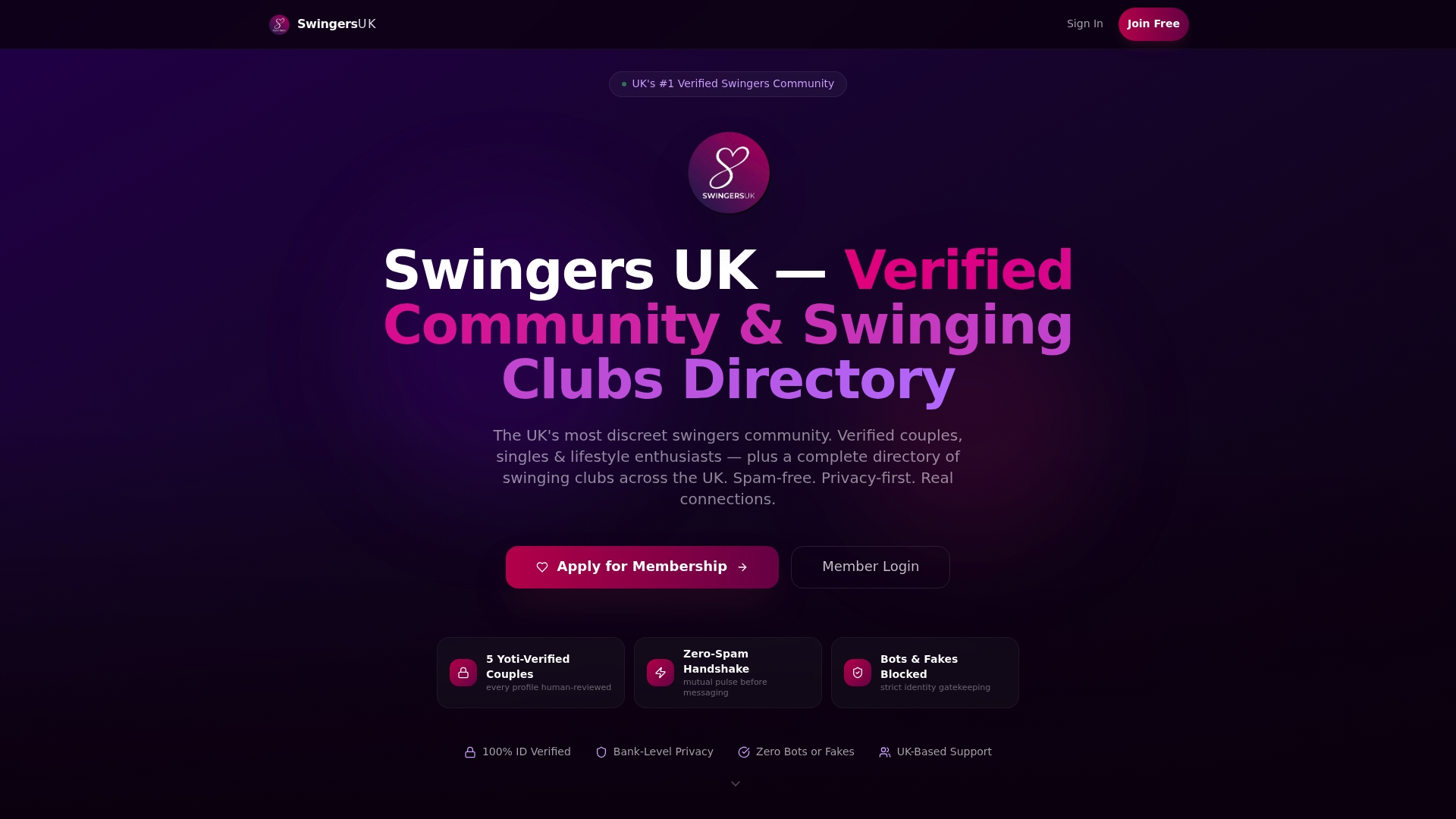
- Visit the main Swingers UK site to explore membership, local events and private cam rooms.
If privacy-first verification and consent-based messaging matter to you, start with the verification page and see how the process works before you commit to anything further.
Sources
FAQ
Do verified swingers platforms store my passport permanently?
Most reputable UK platforms use tokenized third-party checks that confirm your age and identity without keeping a copy of your passport on file. Where a document upload is needed, ICO guidance expects platforms to state a clear retention period rather than keeping it indefinitely.
What’s the difference between age verification and self-declaration?
Self-declaration just means ticking a box to confirm you’re over 18, with no independent check behind it. Genuine age verification uses a third-party attribute check, document matching or selfie comparison to actually confirm that claim, which is what the Online Safety Act expects from platforms with adult content or contact features.
Can I use something other than a passport to verify my identity?
Yes. ICO guidance supports accepting reasonable alternatives, such as a utility bill or a GP letter, where a passport or driving licence isn’t available. A platform that refuses any flexibility here is worth questioning.
How does Swingers UK verify members?
Swingers UK combines AI-assisted checks with human review to confirm real, unique profiles and remove fake accounts, as described on its ID verification page. This is paired with the Pulse Handshake System, which requires mutual interest before members can message each other.
What should I do if a platform’s verification process seems unsafe?
Contact the platform’s support team and ask directly about data retention, the lawful basis for processing and deletion options. If the response doesn’t meet UK data protection standards, you can raise a complaint with the ICO.