Avoid a £5,000 Noise Fine: How to Host a Private Adult Party in the UK
Avoid a £5,000 Noise Fine: How to Host a Private Adult Party in the UK
Private adult parties are legal in the UK, but legality depends entirely on how you run them. Hosts must manage noise under the Environmental Protection Act 1990, protect guest consent and privacy, and check whether charging entry or serving alcohol requires a Temporary Event Notice (TEN). If you plan to charge, sell alcohol, or advertise publicly, contact your local council’s licensing team before you commit to a date.
TL;DR:
- Hosting adult parties privately in the UK is legal as long as noise is managed, and activity remains private without public disturbance or licensable elements.
- Charging entry, selling alcohol, or advertising publicly requires a Temporary Event Notice and strict adherence to licensing rules to avoid legal issues.
- Neighbors should be warned in advance, with clear finish times and noise controls, as councils can issue fines of up to 5,000 pounds for nuisance or persistent complaints.
- Vet guests carefully through verified invitations and enforce strict house rules on consent, privacy, and recording to prevent disputes and protect privacy.
- For larger or more elaborate events, choosing a hired venue and using silent disco or minimal outdoor noise options helps reduce neighbor complaints and legal risks.
Table of Contents
- How Do You Host a Private Adult Party in the UK Legally?
- What Are the House Party Rules in the UK for Noise Control?
- How Do You Vet Guests and Protect Privacy at an Adult Party?
- Which Venues and Entertainment Choices Reduce Risk?
- When Do Ticketing and Alcohol Sales Require a License?
- What Should You Do If Something Goes Wrong on the Night?
- Do You Need Insurance to Host a Private Adult Party?
- What Are the Rules on Photos and Recording at Adult Parties?
- How Should You Handle Waste and Hygiene at an Adult Party?
- Are There Health Rules for Private Gatherings in the UK Now?
- A Practical Perspective on Hosting Safely
- Sources
How Do You Host a Private Adult Party in the UK Legally?
Nothing in UK law bans consenting adults from hosting a party with adult themes in a private home or hired venue. The legal exposure comes from three specific triggers: noise that disturbs neighbors, activity that strays into public view or public indecency, and commercial elements like ticket sales or alcohol service that shift your gathering from private to licensable.
Noise is the most common problem. Under the Environmental Protection Act 1990, councils can investigate any noise that qualifies as a “statutory nuisance” and issue an abatement notice ordering it to stop. Ignore that notice and you’re looking at a fine of up to £5,000, plus the real possibility of a council officer confiscating your speakers on the spot.
Licensing is the second trigger. If you’re charging admission, selling alcohol, or advertising the event to anyone beyond your personal invite list, you’ve likely crossed from a private gathering into licensable territory. Event planning guidance points hosts toward a Temporary Event Notice for exactly this situation. A TEN is a short-term license application submitted to your local council, typically at least 10 working days before the event, covering the sale of alcohol or the provision of licensable entertainment to the public.
Public order and decency law is the third. A private party in a private space, among consenting adults who chose to attend, sits in a fundamentally different legal category than the same activity conducted somewhere visible to the public or to people who didn’t consent to see it. Open curtains, a garden visible from the street, or a venue with shared access changes that calculation.
Before you finalize a date, work through this short list:
- Call your local council’s licensing team and ask directly whether your event needs a TEN, especially if money changes hands.
- Ring the non-emergency police line (101) if you’re unsure whether your venue or activity plan raises public-order questions.
- Keep your guest list closed and your advertising private. Group chats and personal invites are safer than public event pages.
- Check your tenancy agreement or venue contract for clauses restricting parties, subletting, or commercial use of the space.
- Document that the event is private and invite-only. This paperwork matters if a complaint ever escalates.
What Are the House Party Rules in the UK for Noise Control?
Councils don’t wait for a formal complaint to act. Environmental health officers can issue warning notices for excessive noise specifically during the hours of 11pm to 7am, and repeat offenders face escalating enforcement, up to that £5,000 fine for serious or persistent nuisance.
Local councils are consistent on what actually prevents complaints in the first place. Every council guidance page draws from the same practical playbook:
- Warn every neighbor who might hear you, not just the one next door. A knock on the door two or three days ahead, with a rough finish time, does more to prevent a 2am police call than anything else on this list.
- Give neighbors a direct phone number for the night itself. Councils in areas like Greenwich specifically recommend this because it lets people flag a problem to you before they call the council.
- Set and stick to a finish time. Announce it on the invite and enforce it.
- Keep speakers away from shared walls, and avoid outdoor speakers entirely once you’re past 11pm, per Oxford City Council’s guidance.
- Step outside periodically during the party to check what the noise actually sounds like from the street or garden.
- Close windows and doors once the evening moves past 11pm, even if the house gets warm.
Pro Tip: Build a wind-down timeline into your plan rather than leaving it to chance. Drop the music volume 30 minutes before your stated finish time, start moving people indoors 20 minutes out, and treat the last stretch as a quiet clearance period rather than an abrupt cutoff.
If a neighbor does call with a complaint mid-party, the fastest fix is almost always to comply immediately rather than negotiate. Turn the volume down before you argue about whether it’s too loud.
How Do You Vet Guests and Protect Privacy at an Adult Party?
Guest vetting and clear house rules do more to prevent a bad night than any amount of party planning. Start with an invite-only list and verify RSVPs directly rather than letting invitations get forwarded. If your event grows beyond people you personally know, ID checks at the door aren’t excessive, they’re standard practice for lifestyle events across the UK.

Platforms built specifically for the swinging and lifestyle community solve part of this problem before the party even starts. Some platforms use verified profiles and mutual-interest messaging systems, so hosts sourcing guests through them aren’t relying purely on word of mouth to know who’s actually showing up.
Written house rules, shared with every guest before the event, prevent more disputes than a mid-party conversation ever will. Cover the essentials:
- Consent is required for every interaction, every time, with no assumptions carried over from a previous encounter or conversation.
- No photography or video without explicit, specific permission from everyone in frame.
- Clearly mark which rooms are open and which are off-limits, and put a sign on the door rather than relying on guests to remember.
- State the consequences for breaking a rule before anyone arrives, not after.
Staffing matters more than most hosts expect. A workable ratio for private events is roughly one steward or server per 10 to 15 guests, covering both hospitality and safety oversight. At least one person at the party should have no other job than watching the room.
If a boundary gets crossed, the response needs to be immediate and calm: remove the person involved discreetly, offer medical attention if needed, and preserve any relevant evidence rather than letting the moment get cleaned up. Call 999 without hesitation if anyone’s safety is genuinely at risk.
Which Venues and Entertainment Choices Reduce Risk?
A private home works fine for smaller, closer-knit gatherings, but a hired private venue often makes more sense once your guest list grows past what your living room can comfortably absorb. Hired spaces come with their own house rules, insurance, and sometimes on-site staff, which takes pressure off you as the sole person managing the night.
Whichever venue you choose, protect the space itself. Move valuables and breakables out of reach, cover soft furnishings if you’re expecting anything messier than a standard house party, and designate a cloakroom near the entrance so bags and coats don’t end up scattered through play areas.
Entertainment choices matter more for adult parties than a typical birthday bash, because speaker noise is often the single biggest source of neighbor complaints. Event hire specialists consistently point hosts toward silent disco setups for exactly this reason: headphones replace speakers, and the noise complaint problem disappears almost entirely. Roaming, intimate performers also tend to suit private homes better than a staged act, since they don’t concentrate sound in one corner of the room the way a fixed sound system does.
Stock the basics before guests arrive:
- A hydration station, since adult parties often run long and warm rooms dehydrate people faster than they expect.
- A basic first-aid kit, plus condoms and clean towels if the event includes play spaces.
- Clear signage marking no-go zones, quiet rooms, and where the first-aid kit lives.
If you go the silent disco route, book through a UK hire firm and tell them upfront that discretion matters for delivery and collection times. Most suppliers handle this routinely.
When Do Ticketing and Alcohol Sales Require a License?
Charging money changes your legal position faster than almost anything else you can do. The moment you sell tickets or serve alcohol commercially, you risk needing a Temporary Event Notice, and broad public advertising of a paid event pushes you further into licensable territory whether you intended that or not.
The safest route for most private hosts is to avoid on-site alcohol sales entirely. A few alternatives work well without triggering licensing questions:
- Run the event as BYO, so guests bring their own drinks rather than buying from you.
- Book a prepaid drinks package through a licensed caterer or venue that already holds the relevant permissions.
- If you want a contracted bartender, confirm they’re covered under the venue’s existing license rather than yours.
Keep your guest list closed and use invite-only ticketing rather than a public sales page, even for a free event. Hold onto records showing exactly who was invited and how. If a complaint or question ever comes up, that paper trail is what demonstrates you ran a private gathering, not a disguised public one.
What Should You Do If Something Goes Wrong on the Night?
However well you plan, have a fast, clear response ready for the moments that actually matter:
- Call 999 immediately for any medical emergency or if anyone’s safety is at risk, no hesitation and no judgment call needed.
- If you suspect a consent violation, separate the people involved, offer the affected person medical and emotional support, and avoid pressuring anyone to “sort it out” quietly.
- For serious intoxication, get the person somewhere safe, monitor them, and call for medical help if they become unresponsive or their condition worsens.
- If police or council officers attend, or a neighbor lodges a formal complaint, note the time, get witness names, and keep any relevant records. Never take intrusive photos of an injured or distressed person.
- Preserve your guest list and payment records in case you need to demonstrate the private nature of the event later.
Afterward, follow up with any neighbor who raised a concern. A short message acknowledging the issue and outlining what you’ll change next time goes further than silence, and it’s often the difference between a one-off grumble and a formal complaint the next time you host.
Do You Need Insurance to Host a Private Adult Party?
Standard home contents insurance rarely covers large private gatherings, and most policies exclude damage or injury claims tied to hosted events, especially ones involving alcohol or adult activity. If you’re hiring a venue, check whether the venue’s own public liability insurance extends to your event or whether you need separate event cover.
For entertainment suppliers, confirm they carry their own public liability insurance before booking. Reputable UK entertainment and silent disco hire firms carry this as standard and will usually mention it unprompted; if a supplier can’t answer the question, that’s worth treating as a warning sign rather than an oversight.
If you’re charging for entry or running anything resembling a commercial event, even a small one, a short-term event insurance policy is worth pricing out. These policies typically cover public liability, cancellation, and sometimes equipment hire, and they’re inexpensive relative to the exposure they cover. Guests injured at a party you charged admission for have a much stronger claim against you than guests at a genuinely free, informal gathering, so the insurance conversation matters more the moment money enters the picture.
What Are the Rules on Photos and Recording at Adult Parties?
Recording or photographing anyone without their clear, specific consent creates both a data protection problem and a serious breach of trust at an adult party, where privacy concerns run higher than almost any other type of event. UK data protection law treats images of identifiable people as personal data, and using or sharing that data without a lawful basis, consent being the relevant one here, exposes both the photographer and potentially the host to complaints.
The safest policy is a blanket no-photography rule unless every person in frame has explicitly agreed beforehand. State this in your written house rules and reinforce it verbally when guests arrive. Some hosts ask guests to hand over phones at the door or use phone pouches for the duration of the event, which removes the temptation entirely rather than relying on trust alone.
If any content does get shared afterward, whether a group photo from the entrance or anything more explicit, get explicit permission from everyone visible before it goes anywhere beyond that person’s own device. This matters even more for anything intimate, where a single unauthorized share can cause real harm to someone’s personal or professional life. Treat consent for recording exactly the way you’d treat consent for any other activity at the party: specific, ongoing, and never assumed from someone’s presence alone.
How Should You Handle Waste and Hygiene at an Adult Party?
Adult-themed parties generate waste that needs more thought than the usual paper plates and bottles. Stock enough bin bags and place clearly marked bins in every room where guests might need them, including bathrooms and any designated play areas.
Hygiene supplies matter as much as waste disposal. Keep clean towels, hand sanitizer, and disposable wipes stocked and easy to find throughout the night, and refresh them partway through if the party runs long. If your event includes shared equipment or furniture in play spaces, having a simple cleaning routine between uses, or at minimum clean coverings guests can swap out, keeps things sanitary without being clinical about it.
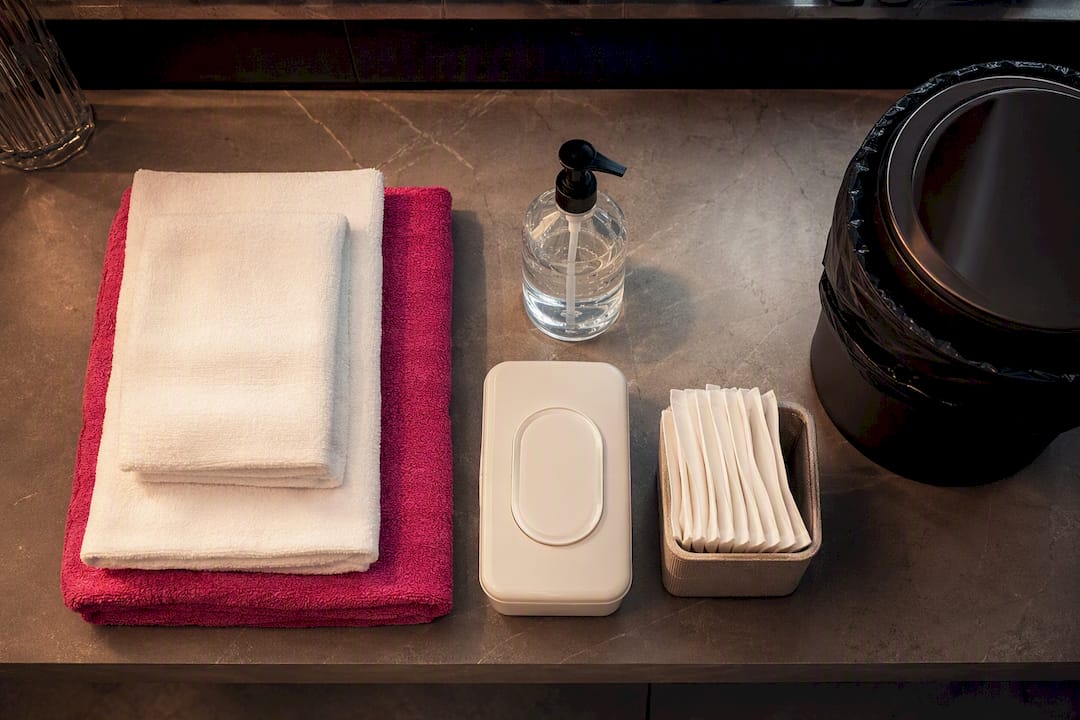
Set up a discreet disposal point for anything intimate that needs private handling, separate from general household waste bins. A small covered bin with a liner, tucked into a bathroom or designated area, solves this quietly without drawing attention to it.
Bathroom access tends to get heavier use at these events than at a standard party, so check supplies like soap and toilet paper partway through rather than assuming they’ll last. If you’re hosting in a hired venue, confirm with the venue in advance who handles post-event cleaning and whether their standard turnaround covers the kind of cleanup an adult party might require.
Are There Health Rules for Private Gatherings in the UK Now?
The formal COVID-19 restrictions that once limited gathering sizes and required social distancing in England, Scotland, Wales, and Northern Ireland have been lifted, and no UK-wide legal limit currently applies to private gatherings held at home or in a hired venue. That said, general public health guidance around respiratory illness hasn’t disappeared, it’s just shifted from law to personal judgment.
Basic precautions still make sense for close-contact gatherings. Encourage anyone feeling unwell to stay home rather than push through symptoms, and keep hand sanitizer available at the entrance and around the venue as a simple courtesy. Good ventilation matters too, not just for comfort but because a room full of people for several hours benefits from fresh air regardless of what illness is circulating that season.
If you’re hiring a venue, check whether the venue itself maintains any health-related policies, since some commercial spaces kept enhanced cleaning protocols even after government mandates ended. There’s no need to build your party around health rules that no longer exist, but a little common-sense preparation, especially heading into winter months when respiratory illness tends to spike, costs nothing and reassures guests who might otherwise worry.
A Practical Perspective on Hosting Safely
What strikes me most about UK private party law is how much of it comes down to preparation rather than permission. You don’t need a license to host consenting adults in your own home. You need a plan for noise, a clear consent policy, and a guest list you actually trust.
That last part is where most hosting problems start. A party that grows through forwarded invites and vague word of mouth is a party where nobody’s vetted anyone. Platforms that enforce ID verification and mutual-consent messaging, like Swingersuk’s approach with its Pulse Handshake System, solve a problem that used to rely entirely on trusting a friend of a friend. That’s not a replacement for good house rules. It’s a better starting point for building a guest list you can stand behind.
If you’re planning your first event, the hosting guidelines are worth reading before you send a single invite.
— Daniel
This article is general information, not a substitute for advice from a qualified lawyer. Consult a qualified legal professional about your own circumstances before acting on anything here.
Sources
- Gov
- Noise from house parties — Royal Borough of Greenwich
- Noise control for parties — Oxford City Council
- House Party Entertainment Hire | Chosen Events