
Find Local Swingers Safely Under UK Law With Verified Privacy Controls
Find Local Swingers Safely Under UK Law With Verified Privacy Controls
The safest way to find local swingers is to join a verified, privacy-first swingers community and follow a short safety checklist before you message or meet anyone. Look for platforms with identity verification, mutual-consent messaging, and clear reporting tools, such as SwingersUK. Set privacy controls immediately, keep early contact on-platform, and only move to an in-person meeting once you’ve confirmed the person’s identity.
TL;DR:
- Verified platforms like SwingersUK use AI and human review to prevent fake profiles and reduce spam, enhancing user safety.
- Mutual-interest messaging systems ensure unsolicited contact is minimized, lowering risks of cyberflashing and spam.
- Staying on-platform during early conversations and blocking location sharing helps protect against stalking and location leaks.
- Reporting sextortion, scams, or unwanted images to authorities and the platform is crucial, with advice to preserve evidence and avoid paying or deleting content.
- First-time meets should always occur in public, with direct communication about boundaries and a clear exit plan to maintain safety.
Table of Contents
- Where to actually look: apps, networks, events, and clubs
- Checking a platform and a profile before you commit
- A step-by-step routine for meeting someone the first time
- Scams, sextortion, and cyberflashing: what to do
- How verification and mutual-consent messaging lower your risk
- Setting boundaries you can actually communicate
- Etiquette that keeps the community welcoming
- What I’d actually tell a first-timer
- Finding local swingers safely with SwingersUK
- FAQ
- Sources
Where to actually look: apps, networks, events, and clubs
Finding local swingers comes down to four main channels, and each carries a different mix of convenience and risk.
- Mainstream location apps: general dating or hookup apps sometimes have lifestyle-friendly users, but they rarely offer verification or moderation built for swingers, so fake profiles and unsolicited images are more common.
- Dedicated swinger networks: platforms built specifically for the lifestyle often verify members and moderate content, which cuts down on bots and spam accounts.
- Invite-only forums and private groups: these can offer a sense of vetted community, but they vary widely in moderation quality and often lack formal reporting mechanisms.
- Club and event listings: local clubs and organized events give you a real-world, often supervised environment, though safety depends heavily on the venue’s own policies.
Within each of these, privacy settings matter as much as the platform itself. On any app or network, turn off exact location sharing when possible and use a username rather than your real name. Security researchers have found that some location-based apps can leak approximate coordinates that, with repeated use, let someone estimate where you spend most of your time. Hiding precise distance or switching to manual location entry removes that exposure without removing the feature’s usefulness.
Informal signals, like the well-known pineapple symbol, still circulate in some social and event spaces, but they depend entirely on shared understanding and carry no built-in accountability. Anyone can display a pineapple without belonging to the community, and there’s no way to verify intent or identity behind it. Moderated channels, whether a vetted app or a club with a door policy, give you something a symbol can’t: a mechanism to report bad behavior and a record of who you were actually talking to.
If anonymity matters most to you, a dedicated network with incognito browsing will usually beat a general app or an informal group chat. If you want the social element of meeting people face to face from the start, a reputable event or club adds a layer of real-world accountability that online-only channels can’t replicate.
Checking a platform and a profile before you commit
Before you create an account or respond to a message, run through a short set of checks on both the platform and the person.
Platform checks:
- Confirm the platform verifies identities (ideally with both automated and human review) rather than relying on self-reported details.
- Look for privacy controls such as incognito mode, hidden distance, and two-factor authentication.
- Check that reporting and blocking tools are easy to find and that the platform explains how it handles reports.
- Read the terms for auto-renewal clauses and data-sharing practices. UK government guidance recommends checking whether a dating platform shares profiles with other services and reviewing renewal notices before you subscribe.
Profile checks:
- Run a reverse-image search on profile photos; consistent, traceable images are a good sign, while stock-looking or inconsistent photos are a warning sign.
- Watch for bio details that don’t line up with later messages, such as a stated location that keeps changing.
- Ask a specific, low-stakes verification question early on, something only a real, consistent person would answer naturally.
- Avoid moving to WhatsApp, text, or email until you’ve had several consistent conversations on the platform itself.
Staying on-platform for longer than feels necessary is one of the simplest protective habits you can build. UK consumer advice recommends exactly this approach for romance fraud prevention, since platforms retain conversation records and offer reporting channels that a private text thread does not. The same logic applies directly to swinger community contact: the longer someone stays in an app’s messaging system, the more evidence exists if something goes wrong.
For photos specifically, avoid images you’ve used on LinkedIn, Instagram, or other public profiles. A reverse-image search can link those photos back to your real identity, something experienced community members have flagged as a common and avoidable mistake.
Pro Tip: Enable two-factor authentication on every lifestyle account you create. It’s a small step that makes account takeover and impersonation far harder.
A step-by-step routine for meeting someone the first time
A consistent routine for first meetings removes most of the guesswork and most of the risk.
- Meet in public first. A coffee shop, bar, or café works well, with no expectation of anything beyond conversation.
- Arrange your own transport. Driving yourself or booking your own taxi means you’re never dependent on the other person to leave.
- Set a check-in plan. Tell a friend where you’re going, who you’re meeting, and when you expect to be done, and agree on a time to check in.
- Give yourself a leave clause. Decide beforehand that you can end the meeting at any point for any reason, no explanation required.
- Hold back identifying details. Save your home address, workplace, and full real name for later, once trust is established.
If you’re vetting a club or event rather than an individual, ask about door policy, ID checks, staff conduct training, and whether the venue keeps records of reported incidents. A venue that answers these questions clearly and without hesitation is generally a better sign than one that brushes them off.
Pro Tip: Keep your phone charged and your location sharing on with a trusted friend for the duration of the meeting, not just before it starts.
Scams, sextortion, and cyberflashing: what to do
Three threats come up most often in online swinger and lifestyle spaces: romance fraud, sextortion, and cyberflashing. Romance fraud involves someone building trust over time before asking for money. Sextortion involves someone threatening to share intimate images or messages unless you pay or comply with further demands. Cyberflashing is the unsolicited sending of sexual images without consent.
Platforms must now take proactive steps to stop unsolicited sexual images before users see them.
Cyberflashing is now treated as a priority offence under the Online Safety Act, which requires platforms to act before users are exposed to this content rather than only responding after the fact. Companies that fail to comply face fines of up to 10% of their qualifying worldwide revenue, or being blocked from operating in the UK altogether. That’s a meaningful incentive for platforms to filter unsolicited images before they reach you, and it’s worth checking whether a platform mentions this kind of proactive filtering.
Coverage of sextortion cases shows a consistent pattern: victims are pressured to pay quickly and quietly, which almost never ends the threat. If you find yourself targeted, don’t pay, don’t delete the messages or images, and don’t engage further with the person making demands.
Instead, take these steps in order:
- Preserve every message, image, and username as evidence rather than deleting anything.
- Report the account directly to the platform, using its built-in reporting tool.
- Report romance fraud or sextortion to Action Fraud at 0300 123 2040 or through actionfraud.police.uk.
- Contact local police if you feel physically unsafe or if a threat escalates.
How verification and mutual-consent messaging lower your risk
Every checklist item above maps directly onto features a well-built platform should already have in place.
- Identity verification using both AI and human review reduces the volume of fake and duplicate profiles that make reverse-image checks and bio consistency checks necessary in the first place.
- Mutual-consent messaging systems mean unsolicited messages and images can’t reach you unless both parties have already expressed interest, which directly addresses the cyberflashing and spam problem described above.
- Incognito and privacy controls, including hidden distance and two-factor authentication, limit the stalking and doxing risks that location-leak research has pointed to.
- Moderated events and region-based private rooms add a layer of oversight that informal signals and unmoderated group chats simply don’t offer.
None of this replaces your own judgment or the routine outlined earlier. It does mean fewer threats reach you in the first place, which gives your own checks more room to work.
Setting boundaries you can actually communicate
Clear boundaries work best when they’re specific and stated early, not implied or assumed. Before you start talking to anyone new, decide what you are and aren’t open to, whether that’s full swap, soft swap, same-room only, or simply chatting with no in-person step planned yet.
Say these boundaries out loud, or in writing, before a meeting rather than during one. A short message along the lines of “I’m comfortable with X but not Y, and that’s not up for negotiation on the night” sets expectations without demanding a long explanation. Revisit boundaries regularly, since what feels comfortable can shift as trust builds or as a relationship changes.
Boundaries also need a way to be paused or withdrawn in the moment. Agree on a simple word or signal with your partner beforehand that means “stop” or “check in with me,” and treat that signal as final, no questions asked in the moment. A partner, person, or couple who respects a boundary without pushback or sulking is showing you exactly how they’ll behave later, which tells you more than anything they say about themselves.

Written boundaries aren’t about mistrust. They remove ambiguity, which is where most awkward or upsetting moments in the lifestyle actually come from.
Etiquette that keeps the community welcoming
Respectful behavior within swinger spaces tends to follow a few consistent, simple patterns. Ask before touching, always, even in spaces where that seems implied by the setting. Consent given once, for one activity, doesn’t extend automatically to anything else.
Reply to messages, even to say no, rather than leaving someone on read indefinitely, since a short decline costs little and spares the other person uncertainty. At events and clubs, follow the venue’s specific rules on photography, which are often stricter than a general assumption of privacy would suggest. Discretion matters outside the community as much as inside it: never share who you saw at an event or what you learned about someone’s personal life without their clear permission.
First-timers are generally welcomed warmly, but that welcome depends on a willingness to learn rather than assume. Watch how established members interact before jumping in, and ask questions rather than guessing at unwritten rules. A respectful “no” is just as valid a response as an enthusiastic “yes,” and communities that function well tend to treat both the same way.

What I’d actually tell a first-timer
Verified communities and in-person club scenes solve different problems. A platform like SwingersUK gives you time to vet someone before you ever meet, which suits anyone who values anonymity or simply wants to move slowly. Clubs and events give you faster social feedback but less control over who approaches you.
My honest recommendation for anyone starting out: begin online, verify thoroughly, and treat the in-person meeting as the last step, not the first. Etiquette matters as much as safety here. A community that feels welcoming usually is one where people took the vetting stage seriously before showing up.
— Daniel
Finding local swingers safely with SwingersUK
SwingersUK was built around the exact checklist covered above, so the safety steps aren’t extra work bolted onto a dating app, they’re part of how the platform functions.
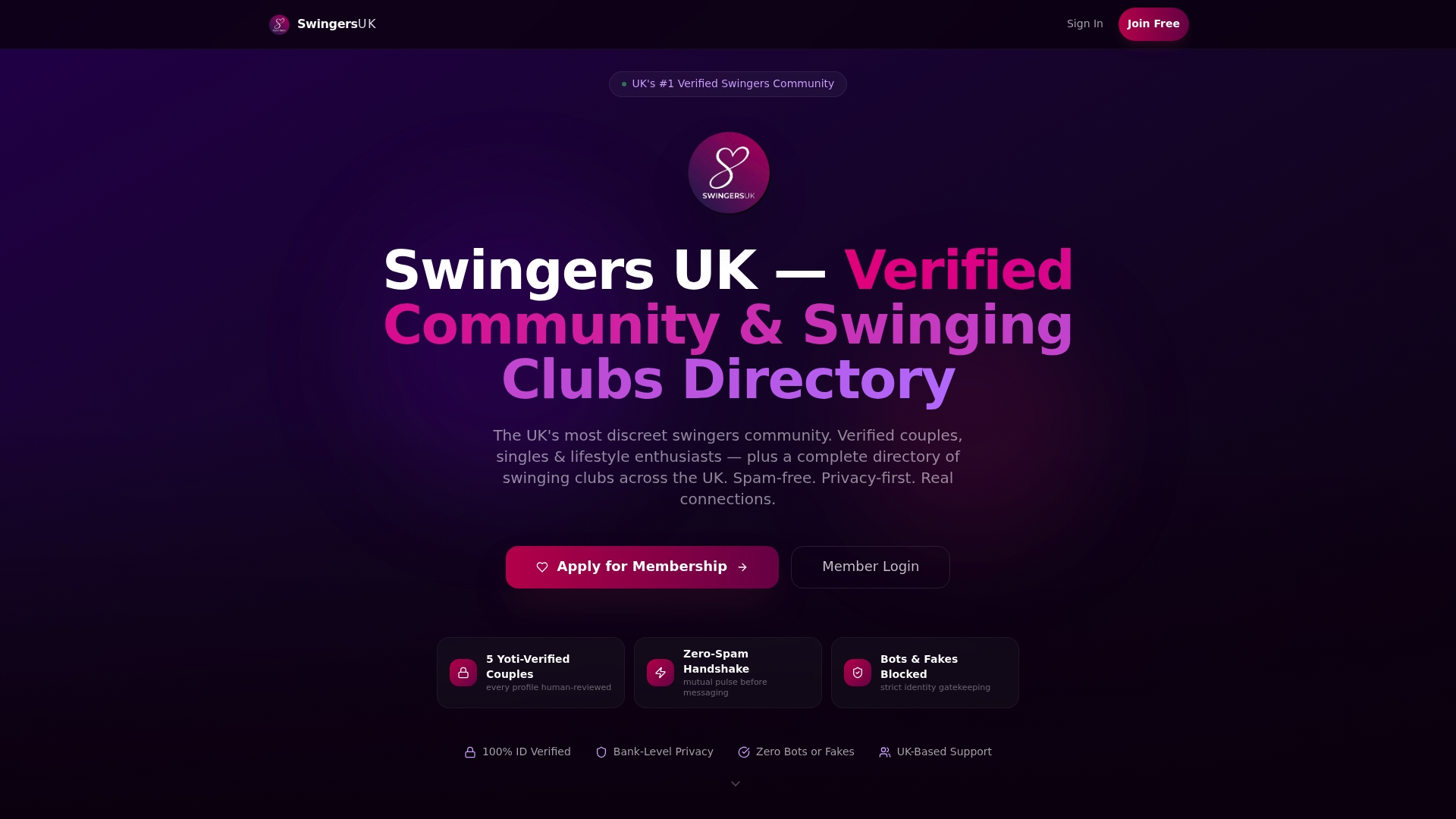
- ID verification combining AI and human review removes fake and duplicate profiles before they reach your inbox, as explained on the ID verification page.
- A mutual-interest handshake system requires mutual interest before messaging opens, which stops unsolicited contact at the source.
- Incognito and privacy modes keep your browsing and location private from anyone you haven’t approved.
- An events and venue directory lets you check clubs and events listed in your area before committing to attend.
Getting started takes a few minutes: create a profile, complete verification, and set your privacy preferences before browsing. From there, membership tiers unlock features like unlimited messaging and cam room access, detailed on the pricing page. Visit SwingersUK to create your account and see what a verified, privacy-first community actually looks like in practice.
FAQ
What’s the safest way to start looking for local swingers?
Join a verified platform with mutual-consent messaging and privacy controls like incognito mode, then stay on-platform until you’ve confirmed someone’s identity. Avoid moving to personal contact details or in-person plans until you’ve had several consistent conversations.
How do I know if a swinger platform is trustworthy?
Check for identity verification, clear reporting and blocking tools, and transparency around data sharing and auto-renewal terms, as UK government guidance recommends. Platforms that require mutual interest before messaging also tend to have far less spam and fewer unsolicited images.
What should I do if someone sends unsolicited explicit images?
Report the account to the platform immediately and avoid responding, since cyberflashing is now treated as a priority offence under the Online Safety Act. If the behavior continues or escalates into threats, report it to Action Fraud as well.
How do I protect myself from sextortion or romance scams?
Never pay or send further images, preserve every message as evidence, and report the situation to Action Fraud at 0300 123 2040. Romance fraud guidance also recommends staying on-platform during early conversations so there’s a record if something goes wrong.
Does SwingersUK verify profiles before allowing messaging?
Yes, SwingersUK uses both AI and human review to verify identities, and its Pulse Handshake system requires mutual interest before two members can message each other. Details on how verification badges work appear on the platform’s ID verification page.
Sources
- Police
- Gov
- BBC coverage on sextortion and scams
- Remote dating: How do the apps safeguard our data? | Securelist