
How to Find a Unicorn Without Losing Sight of Consent
How to Find a Unicorn Without Losing Sight of Consent
A “unicorn” is the common lifestyle term for a single person, usually a bisexual woman, who joins an existing couple for a sexual or romantic connection. Yes, you can find a unicorn, but the search only works when you treat her as a full person with her own needs, not a fantasy you’re recruiting to complete your relationship. That single rule decides whether your search succeeds or quietly collapses into resentment on all sides.
Before you message anyone, get these three things straight:
- Agree internally first. You and your partner need matching expectations on rules, jealousy triggers, and what “success” even looks like.
- Pick verified channels. Choose platforms and events with real identity checks over anonymous forums or vague social posts.
- Write a respectful approach. Lead with curiosity about her as a person, not a checklist of what you want her to be.
Key Takeaways
Finding a unicorn works best when couples pair ethical, consent-first communication with platforms that verify identity and require mutual interest before contact.
| Point | Details |
|---|---|
| Center her autonomy | Treat every decision as a three-way negotiation, not a couple’s rulebook handed down. |
| Choose verified channels | Favor platforms with ID checks and moderation over anonymous forums or vague posts. |
| Write individual profiles | Show both partners as distinct people with clear, specific intentions stated upfront. |
| Schedule real check-ins | Use a 48-hour, two-week, and monthly rhythm to catch shifting feelings early. |
| Watch for hunting behavior | End contact at the first sign of one-sided rules or pressure to skip verification. |
Table of Contents
- What Does Unicorn Mean in the Swinging and Polyamory World?
- Where Can You Meet a Unicorn Respectfully?
- How Should Couples Write Profiles and Approach Someone?
- How Do You Negotiate Boundaries and Keep Checking In?
- What Mistakes Turn a Search Into Unicorn Hunting?
- Why Verification and Mutual Consent Systems Actually Protect Everyone
- The Advice Nobody Wants to Hear About Unicorn Hunting
- Sources
What Does Unicorn Mean in the Swinging and Polyamory World?
The term describes someone rare and desirable, and that’s exactly where the trouble starts. In practice, a unicorn is a single bisexual woman who agrees to date or play with both members of a couple, sometimes once, sometimes as an ongoing triad. The definition shifts slightly between communities: swingers tend to use it for sexual encounters, while polyamorous groups often mean a deeper, ongoing emotional connection.
Counselors point out that framing a real person as a mythical creature can strip away her autonomy before you’ve even said hello. The fix isn’t dropping the word entirely, since it’s too embedded in community language, but using it while actively centering her preferences in every decision.
Realistic expectations matter here:
- Genuine unicorns are uncommon, and demand from couples outnumbers supply significantly.
- Motivations vary widely, from casual exploration to wanting a long-term triad.
- Most connections start as low-commitment and either fade naturally or deepen over months, not days.
Pro Tip: If your first message to a prospective unicorn reads like a job posting, rewrite it. Nobody wants to apply for a role in someone else’s fantasy.
Where Can You Meet a Unicorn Respectfully?
The venue you choose shapes the entire dynamic before a single message gets sent. Some spaces attract people looking for genuine connection; others attract volume and burnout.
- Dedicated lifestyle platforms. These typically require ID verification and joint or individual profile options, which filters out casual browsers and reduces catfishing.
- Mainstream dating apps. Workable if your bios are explicit about being a couple seeking a third, but expect more unverified profiles and mismatched expectations.
- Swinger clubs and lifestyle parties. In-person vetting happens naturally through the venue’s own membership screening, and body language tells you things text never can.
- Local poly meetups. Slower paced, less transactional, and better suited to couples hoping for a genuine triad rather than a single encounter.
Before joining any platform, check its moderation policy, whether events get vetted by real hosts, and what privacy controls exist for your profile visibility. Community guidance consistently favors platforms that verify identity over open forums where anyone can post without accountability.
Pro Tip: Read a platform’s reporting tools before you read its member photos. A community that makes it easy to flag bad behavior is telling you how seriously it takes safety.
How Should Couples Write Profiles and Approach Someone?
Your profile is often the first test of whether you’re treating this as a partnership search or a hunting trip. Structure matters more than most couples realize.
Profile essentials:
- Give each partner an individual voice and photo, not just a joint “we” statement that erases both people’s personalities.
- State your intentions clearly: one-time, ongoing, romantic, purely sexual. Vague profiles waste everyone’s time.
- Choose respectful photos and keep sensitive images behind privacy controls until trust is established.
Personalization increases response rates because it signals you’ve actually read her profile, according to community how-to guidance. A message referencing her specific interests beats a copy-pasted template every time.
Message guidelines to follow:
- Open with something from her profile, not a compliment about her body.
- Skip fantasy language like “our third” or “the missing piece.” Use her name.
- Ask an open question that invites her to talk about herself, not just confirm interest.
First meetup checklist:
- Meet in a public, verified location, never straight to a private residence.
- Choose a low-pressure activity like coffee or drinks, not a scenario that assumes sex is happening.
- Agree on a simple consent script beforehand: what’s on the table tonight, what isn’t.
- Give everyone an easy exit line if the chemistry isn’t there.
How Do You Negotiate Boundaries and Keep Checking In?
Five topics need explicit discussion before anything physical happens: exclusivity expectations, sexual health status, realistic time commitments, privacy around who knows about the arrangement, and what emotional involvement is welcome versus off limits. Skipping any one of these is how good intentions turn into a mess.

A workable negotiation script sounds like this: “Here’s what we’re hoping for, here’s what’s non negotiable for us, what does that look like from your side?” It’s a conversation, not a contract you’re handing over for signature.
Practitioners recommend a specific check-in rhythm: a short conversation 48 hours after a first date or play session, a deeper emotional check at the two-week mark, then monthly reviews once things stabilize. Writing down agreements, even informally, beats relying on memory when feelings shift.
Pro Tip: Feelings change, and that’s not a failure. Build a pause option into your agreement from day one so anyone can step back without it feeling like a breakup.
- Exclusivity: does this stay closed to just the three of you, or open to others?
- Sexual health: what testing, timelines, and disclosure norms apply before physical contact?
- Exit dignity: if someone wants out, how does the group handle it without blame?
What Mistakes Turn a Search Into Unicorn Hunting?
“Unicorn hunting” describes the pattern where a couple treats the search as recruiting an accessory rather than dating a person. It shows up as commodifying language, one-sided rules that protect the couple but restrict her, and secrecy that leaves her isolated from her own community.
Common harms include:
- Demanding she hide the relationship from friends while the couple stays fully open about it.
- Setting rules unilaterally, then presenting them to her as fixed.
- Prioritizing “couple privilege” so her needs always rank last.
The corrective is straightforward: negotiate terms with her present, not for her in advance, and give her real veto power over rules that affect her life. Ethical practice requires ongoing communication and respect for her autonomy, not a one time consent conversation you never revisit.
Watch for these red flags, and end contact if you see them:
- Pressure to skip health disclosures or verification steps.
- Vague or “we’ll figure it out later” terms around exclusivity and boundaries.
- Any sign the couple sees her interest as owed to them rather than freely given.
Why Verification and Mutual Consent Systems Actually Protect Everyone
A platform’s safety features aren’t a marketing footnote. They’re the difference between a search built on trust and one built on hope. Identity checks that combine automated screening with human review meaningfully cut down on fake accounts and predatory behavior, which matters enormously when you’re inviting a stranger into an intimate arrangement.
Swingersuk builds its verification around this exact problem, using AI and human review to confirm real identities before members can interact freely. Its Pulse Handshake System takes consent a step further by requiring mutual interest before either side can message, so nobody receives unwanted contact from someone who hasn’t reciprocated interest first.
A platform’s technical design can encode consent before a single message is sent. Requiring mutual interest before messaging removes the pressure of unsolicited contact entirely, which is the opposite of how most open dating apps work.
When evaluating any platform for your search, check for:
- A visible, enforced moderation policy.
- Genuine ID verification, not just an email confirmation.
- Community reporting tools that get acted on.
- Vetted event hosts if the platform lists in-person meetups.
- Privacy controls that let you manage exactly who sees your profile.
The Advice Nobody Wants to Hear About Unicorn Hunting
Most guides on this topic focus on where to look. That’s the easy part. The harder truth is that most couples fail before they ever meet a promising candidate, because they’ve spent all their negotiating energy on each other and none on preparing for a third person’s actual needs.
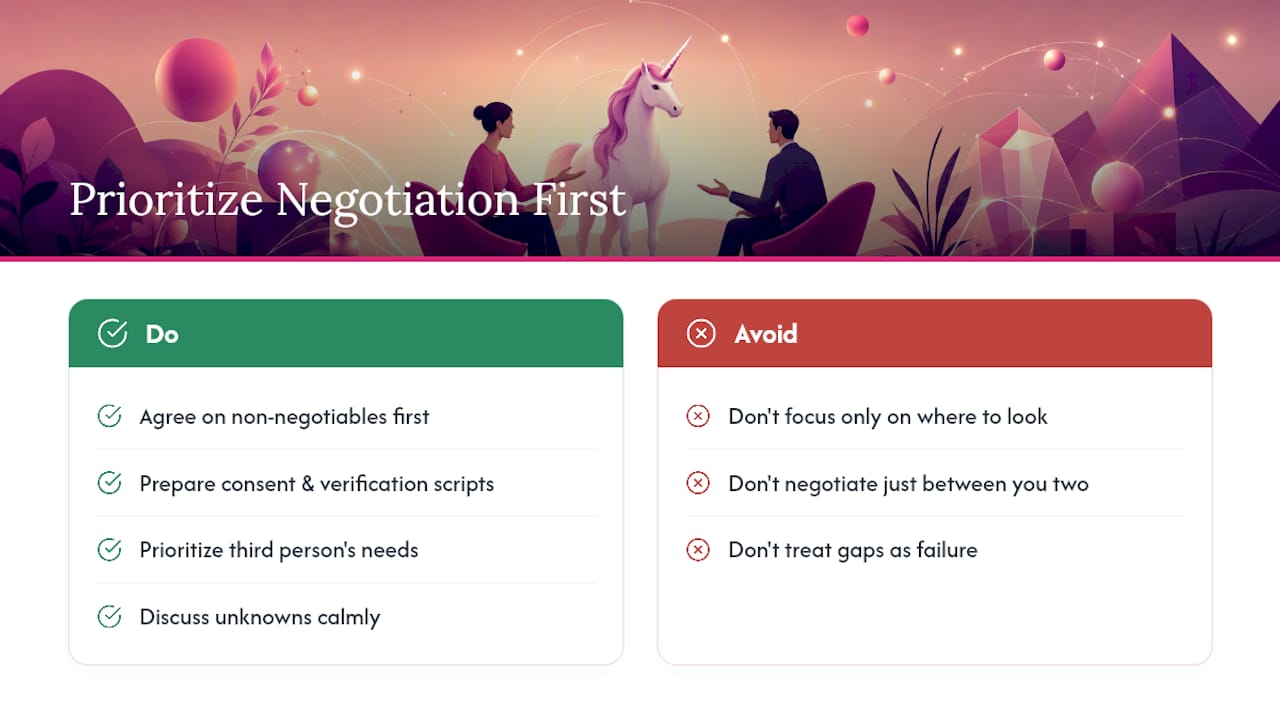
The conventional advice treats verification and consent scripts as bureaucratic add-ons. They’re not. They’re the entire mechanism that separates a couple that finds a lasting connection from one that burns through prospective partners and wonders why nobody sticks around. Prioritize the internal work first: agree on your non-negotiables before you write a single profile line.
What’s overrated is chemistry on the first date. What’s underrated is a couple that can calmly say “here’s what we haven’t figured out yet” without treating that gap as a failure. That honesty is rarer than any unicorn.
— Daniel
Sources
- What Is Unicorn Polyamory? - Verywell Mind
- What is a ‘unicorn’ in dating? - ABC News
- What Is a Unicorn in a Relationship? - WikiHow