
7 Best Dating Apps Without Bots for Real Connections
7 Best Dating Apps Without Bots for Real Connections
The safest dating apps without bots share three structural features: mandatory identity verification, ongoing human moderation, and a paid entry model that makes mass bot creation financially unviable. Here are the top picks, ranked by anti-bot strength:
- Verification-first communities (e.g., platforms requiring government ID + liveness check at signup): lowest bot risk, strongest real-profile guarantee
- Subscription matchmaking services (curated, human-reviewed profiles, paid access required): very low bot risk, relationship-focused
- Mainstream swipe apps with enhanced verification (optional ID, AI moderation, free tier available): moderate bot risk, high user volume
- Niche curated services (limited daily matches, human-reviewed profiles, free matchmaking): low bot risk, slower pace
- Emerging verification-first apps (liveness prompts, reliability scores, newer platforms): low-to-medium bot risk, smaller user base
Rankings reflect three criteria: whether verification is mandatory or optional, what moderation type the platform uses (human, AI, or hybrid), and how exposed the free tier is to bot farms.
Table of Contents
- Which dating apps without bots have the strongest anti-bot features?
- How each platform type limits fake profiles and bots
- How to choose a dating app if your priority is no bots
- Step-by-step: how to detect bots and what to do when you find one
- What the research shows actually removes bots from dating platforms
- Final recommendation: best pick by specific use case
- Per-app summary: verification approach, mandatory vs. optional, moderation type
- How dating apps protect your privacy during verification
- What users report about bot presence and app reliability
- How often do dating apps update their anti-bot measures?
- Key Takeaways
- Why verification-first communities are the only honest answer
- Swingersuk: a verified community built for real connections
Which dating apps without bots have the strongest anti-bot features?
| Platform Type | Verification | Moderation | Free-Tier Risk | Pricing Band | Bot-Resistance Features | US Availability |
|---|---|---|---|---|---|---|
| Verification-first community | Mandatory (Gov ID + liveness) | Human + AI hybrid | Very low (paid entry) | Subscription | ID sync, liveness check, dark-web email scan, 24/7 moderators | Yes |
| Subscription matchmaking | Mandatory (human-reviewed profile) | Human review | Low (limited free browse) | Subscription (paid) | Manual photo review, human approval before activation | Yes |
| Mainstream swipe app | Optional (photo verify) | AI primary | High (fully free tier) | Freemium (premium) | Photo verification badge, AI flagging, community reporting | Yes |
| Niche curated service | Mandatory (profile + compatibility screen) | Human | Very low (free but gated) | Free matchmaking, optional paid | Curated daily limit, human-reviewed profiles, no swiping | Yes |
| Emerging verification-first app | Mandatory (liveness video prompt) | AI + human | Low (paid messaging) | Freemium (premium) | 3-second live video at signup, reliability scores, paid messaging | Yes |
Platforms that combine mandatory ID with paid messaging make bot farms economically unviable: every fake account requires a real identity document and a payment, which kills mass account creation at the root. The feature combination that correlates most strongly with low bot risk is mandatory government ID plus human moderation plus a paid messaging or activation step.
Stat to know: Platforms that make messaging or full accounts paid are significantly harder for bot networks to exploit, because the per-account cost for attackers rises sharply with each additional barrier.
How each platform type limits fake profiles and bots

Verification-first communities
These platforms require government-issued ID verification and a liveness check before a profile goes live. Multi-layered verification combining government ID, liveness detection, and human review is the closest thing to a complete bot exclusion system available today. Moderation is hybrid: AI handles initial triage, humans review edge cases and appeals.
- Pros: Near-zero bot exposure; real-name accountability; strong reporting infrastructure
- Cons: Higher friction at signup; smaller user base than mainstream apps; subscription cost
- Bot risk level: Low
- Best for: Singles who want zero tolerance on fake profiles and are willing to pay for it
Subscription matchmaking services
Sites like Match and eHarmony operate on subscription models where profiles are reviewed before activation. Manual human review of every profile photo significantly reduces fake-profile incidence compared to AI-only moderation. Free browsing is limited; messaging requires a paid plan.
- Pros: Relationship-focused user base; human moderation; paid barrier deters casual bot farms
- Cons: Older interface on some platforms; subscription required for meaningful interaction
- Bot risk level: Low to medium
- Best for: Relationship-minded singles who want a curated, serious-intent pool
Mainstream swipe apps with enhanced verification
Hinge, Bumble, Tinder, and OkCupid all offer optional photo verification badges and AI-powered flagging, but their free tiers remain open to abuse. Bot farms exploit free access at scale, which is why engagement-driven metrics can tolerate bot activity — bots inflate interactions, which looks good for platform metrics even when it harms users. Bumble’s photo verification and Hinge’s “Most Compatible” algorithm add friction, but neither requires government ID.
- Pros: Massive user bases; familiar interfaces; free to start
- Cons: Free tiers are high-risk; verification is optional; AI moderation misses nuanced scams
- Bot risk level: Medium to high (free tier), medium (paid tier)
- Best for: Singles comfortable with some bot exposure who want volume and convenience
Niche curated services
Platforms like Coffee Meets Bagel and similar curated apps limit daily matches to a small number of human-reviewed profiles. The gated model (you receive a handful of curated matches per day rather than an open swipe pool) structurally limits bot exposure. Plenty of Fish sits in a different category: it has a large free tier and historically higher bot complaints, though its moderation has improved.
- Pros: Intentional, low-volume matching; human curation reduces fake profiles
- Cons: Slower pace; smaller pool; free tiers on some platforms still carry risk
- Bot risk level: Low (curated tier), medium (open free tier)
- Best for: Singles who prefer quality over quantity and don’t mind waiting for the right match
Emerging verification-first apps
Newer platforms like Gettit require 3-second live video prompts at signup and maintain reliability scores based on real interaction history. Real-time liveness detection neutralizes pre-recorded or static fake profile data because a bot cannot produce a spontaneous live video on demand. Paid messaging adds a second cost barrier.
- Pros: Strong liveness verification; reliability scoring; paid messaging deters bots
- Cons: Smaller user base; newer platforms have less track record
- Bot risk level: Low
- Best for: Tech-forward singles who want cutting-edge verification on a newer platform
Pro Tip: Before signing up for any app, search “[app name] fake profiles” or “[app name] bots” on Reddit. User threads from the past 12 months give you a faster read on real-world bot exposure than any official safety page.
How to choose a dating app if your priority is no bots
Prioritize mandatory verification, human moderation, and a paid entry model — in that order. Optional verification is nearly as weak as no verification, because bots simply skip the optional step.
Here is a ranked checklist of criteria to weigh:
- Is verification mandatory at signup? Platforms that require government ID or a liveness check before a profile goes live are structurally safer than those that make it optional.
- What moderation type does the platform use? Human plus AI hybrid moderation outperforms AI-only approaches because humans catch manipulation tactics algorithms miss.
- Is there a paid barrier to messaging or account activation? A payment step raises the per-account cost for bot operators and makes mass account creation financially unattractive.
- Does the platform publish a safety or verification page? Platforms that publish clear safety and verification processes and offer human support channels for reporting suspicious accounts earn higher user trust.
- How fast does the platform respond to abuse reports? Check community forums and app store reviews for mentions of response time.
- Does the platform use liveness detection? Photo verification alone is frequently bypassed; liveness checks are harder to fake.
- What privacy controls exist? Look for incognito modes, profile visibility controls, and data encryption disclosures.
- Is there a free tier, and what can free users do? A fully open free tier is the single biggest structural risk factor for bot exposure.
Pro Tip: Run a five-minute verification audit before joining any app. Go to the platform’s Help or Safety page and look for three things: (1) whether verification is described as “required” or “optional,” (2) whether a human moderation team is mentioned by name or role, and (3) whether there is a dedicated abuse-reporting workflow with a stated response time. If any of these are missing, treat the platform as higher risk.

Step-by-step: how to detect bots and what to do when you find one
Most bots share a recognizable pattern once you know what to look for. The key signals are timing, profile completeness, and message content.
How to spot a bot:
- Check the profile photo. Run it through Google Images or TinEye. Bot farms frequently use stolen stock photos or AI-generated faces. A reverse-image hit on a different name or site is a strong red flag.
- Look at the profile age and completeness. Accounts created recently with minimal bio text, no linked social profiles, and only one or two photos are disproportionately likely to be fake.
- Watch the message timing. Bots often respond within seconds at any hour. A reply at 3:00 AM within five seconds of your message is not a human.
- Assess message content. Generic compliments, rapid escalation to off-platform contact (“text me at…”), and links to external sites are classic bot behaviors.
- Send a liveness prompt. Ask the person to hold up three fingers in a photo, or reference something specific from their profile in your reply. Bots cannot respond to contextual, real-time requests.
- Check for profile metadata. On apps that show it, look at last-active timestamps and whether the account has any mutual connections or community activity.
- Ask an off-script question. Something specific and unpredictable (“What’s the last book you actually finished?”) will expose a scripted bot response quickly.
What to do when you find one:
- Stop engaging immediately. Do not click any links, share personal contact information, or respond further.
- Take screenshots of the profile, the conversation, and any links shared before reporting.
- Use the in-app report function. Select “fake profile” or “bot/spam” as the reason. Most platforms with human moderation act on these within 24–48 hours.
- Block the account after reporting so it cannot contact you again.
- Escalate if needed. If the platform has a human support channel (email or live chat), forward your screenshots with a brief note: “This account sent me [describe behavior] and I believe it is automated. I have reported it in-app. Please review.”
A simple decision rule: if you have sent three messages and received three generic, non-contextual replies, stop. The probability of a bot rises sharply with each non-specific response.
What the research shows actually removes bots from dating platforms
Mandatory government-ID-based verification at signup is the single most effective structural deterrent to bot farms, because it imposes real-world identity and cost barriers that automated scripts cannot clear. Photo verification alone is insufficient; adding liveness detection and ID sync is what verification-first platforms identify as non-negotiable.
The most reliable anti-bot architecture combines three layers:
- Mandatory ID verification: Government-grade ID checks at signup prevent anonymous account creation. Verification-first platforms describe combinations of ID checks, AI photo analysis, dark-web email validation, and 24/7 moderator teams as their core defenses.
- Liveness detection: Live selfie matching and short video prompts confirm a real person is present at signup, neutralizing pre-recorded or static fake data.
- Paid entry or paid messaging: Platforms that require payment for account creation or messaging raise the cost for bot operations and reduce mass account creation.
Human plus AI hybrid moderation is more effective than AI-only approaches because humans catch nuance and manipulation tactics that algorithms miss. AI handles volume triage; human reviewers handle edge cases, appeals, and sophisticated scam patterns.
Limitations to understand: No system is perfect. Sophisticated actors can obtain real IDs fraudulently, and liveness checks can occasionally be spoofed with deepfake technology. The realistic expectation from a verification-first platform is not zero bots, but a bot rate low enough that you are unlikely to encounter one in normal use. Free tiers on any platform, even verified ones, carry higher risk than paid tiers because they attract more casual and potentially abusive account creation.
How these recommendations were evaluated: Each platform type was assessed on four dimensions: whether verification is mandatory or optional at signup, what moderation type is used (human, AI, or hybrid), how exposed the free tier is to bot farms, and whether the platform publishes a transparent safety or verification page.
Final recommendation: best pick by specific use case
- Best for relationship-minded singles: Subscription matchmaking platforms (Match, eHarmony) — featuring human-reviewed profiles and a paid entry barrier, catering to users with serious intent
- Best for privacy-conscious users: Verification-first communities with incognito controls and government ID sync — your identity is confirmed but your browsing stays private
- Best for low-cost entry with verification: Niche curated services (Coffee Meets Bagel) — offering free matchmaking with human-reviewed profiles and a model limiting matches daily
- Best for local events and community: Platforms with integrated event directories and verified community profiles — you meet people in real-world contexts, not just through a screen
- Best for zero-tolerance verification: Swingersuk — mandatory ID verification (AI and human reviewed), the Pulse Handshake System requiring mutual interest before messaging, and active 24/7 moderation make it the strongest structural option for singles who want zero spam and real profiles
The honest trade-off: the platforms with the lowest bot risk are almost always the ones with the highest signup friction and a subscription cost. Convenience and safety pull in opposite directions on dating apps. Choosing a paid, verification-first platform is not a compromise — it is the correct prioritization if real connections are the goal.
Per-app summary: verification approach, mandatory vs. optional, moderation type
| App | Verification | Mandatory? | Moderation Type | Bot Risk |
|---|---|---|---|---|
| Hinge | Photo verification badge | Optional | AI + community reporting | Medium |
| Bumble | Photo verification (selfie match) | Optional | AI primary | Medium |
| Match | Profile review, optional ID | Optional | Human + AI | Low–Medium |
| eHarmony | Compatibility screening, profile review | Mandatory (profile) | Human review | Low |
| OkCupid | Photo upload, optional verification | Optional | AI flagging | Medium–High |
| Tinder | Photo verification badge | Optional | AI + community | Medium–High |
| Coffee Meets Bagel | Profile review, limited daily matches | Mandatory (profile) | Human curation | Low |
| Plenty of Fish | Basic email verification | Optional | AI + reporting | High (free tier) |
| Gettit | Government ID + liveness video | Mandatory | Human + AI hybrid | Low |
Hinge made an early commitment to measuring real-world dating success rather than engagement metrics, which aligns it more closely with verification-first values than pure swipe apps — but its verification remains optional. Gettit’s mandatory liveness check at signup places it in a structurally different category from the mainstream apps.
How dating apps protect your privacy during verification
Verification requires sharing sensitive data, which creates a legitimate privacy concern. Here is what to look for before submitting any identity document to a dating platform:
Data minimization: A trustworthy platform collects only what it needs to confirm identity and does not store raw ID images longer than necessary. Look for a stated data retention policy on the platform’s privacy page.
Encryption in transit and at rest: Government ID data and liveness check footage should be encrypted using current standards (AES-256 or equivalent) both during transmission and in storage. Platforms that publish their security architecture openly are more accountable than those that do not.
Third-party verification providers: Many platforms outsource ID verification to specialized providers (such as Jumio or Onfido) that are subject to their own compliance frameworks. This adds a layer of accountability but also means your data touches a third party — check the platform’s privacy policy for named sub-processors.
Right to deletion: Under US state privacy laws (California’s CCPA, for example), you have the right to request deletion of your personal data. Confirm the platform has a clear deletion request process before signing up.
Separation of identity from profile: The strongest privacy model keeps your verified identity separate from your public profile. Your real name and ID document should never be visible to other users — only to the platform’s moderation team for safety purposes.
What users report about bot presence and app reliability
User feedback on mainstream app stores and community forums consistently shows a clear pattern: free-tier, swipe-based apps draw the most bot complaints, while subscription and verification-first platforms draw the fewest.
On Tinder and Plenty of Fish, the most common user complaints involve accounts that send generic opening messages, quickly ask to move to WhatsApp or Snapchat, and disappear after a link is clicked. These are textbook bot behaviors, and they cluster on platforms with open free tiers and AI-only moderation.
Hinge and Bumble users report fewer bot encounters than Tinder users, which aligns with their optional verification badges and slightly higher friction at signup. The gap is meaningful but not absolute — optional verification still leaves a door open.
Platforms with mandatory verification and human moderation receive consistently better user trust ratings in app store reviews. Users on these platforms report that when they do flag a suspicious account, the response is faster and more decisive than on AI-only platforms. Platforms that publish safety pages and provide human support tend to have better user trust metrics and faster resolution of abuse reports.
The most reliable signal in user reviews is not the star rating — it is the ratio of bot-complaint reviews to total reviews. A platform with a 4.2-star average but dozens of recent bot complaints is riskier than a 3.8-star platform with almost none.
How often do dating apps update their anti-bot measures?
The honest answer: it varies widely, and most platforms do not publish a public changelog for security updates. What you can observe:
Mainstream apps (Tinder, Bumble, Hinge, OkCupid) release app updates frequently — often weekly — but security-specific changes are rarely disclosed in release notes. Their anti-bot measures evolve reactively, typically after a wave of user complaints or a press report about bot activity.
Subscription matchmaking platforms (Match, eHarmony) tend to update moderation policies on a slower cycle but with more deliberate human review processes. Their bot defense is structural (paid entry, human review) rather than algorithmic, so it degrades more slowly between updates.
Verification-first platforms treat anti-bot infrastructure as a core product feature rather than a background security function. Platforms that describe 24/7 moderator teams and multi-layered verification systems are continuously active rather than update-dependent. Their defenses do not wait for a quarterly release cycle.
What to look for: Check a platform’s blog, press page, or safety center for mentions of verification improvements in the past 12 months. A platform that has not published any safety update in over a year is likely not investing in this area. Swingersuk publishes updates to its verification and moderation systems through its platform changelog, which is a transparency signal worth checking before joining any verified community.
Key Takeaways
Mandatory identity verification combined with human moderation and a paid entry model is the most effective structural defense against dating app bots — no single measure works in isolation.
| Point | Details |
|---|---|
| Mandatory verification is non-negotiable | Optional verification leaves bots a clear path in; only mandatory ID or liveness checks close it. |
| Paid entry kills bot farms | A payment step raises the per-account cost for attackers, making mass bot creation financially unviable. |
| Human moderation catches what AI misses | Hybrid human plus AI moderation outperforms AI-only systems on nuanced scams and manipulation tactics. |
| Free tiers carry the highest bot risk | Fully open free tiers are the primary entry point for bot farms on mainstream swipe apps. |
| Swingersuk features mandatory ID verification | Swingersuk employs government ID synchronization, liveness checks, and round-the-clock human moderation to maintain a low-spam verified community. |
Why verification-first communities are the only honest answer
The conventional wisdom says “just use a big app with lots of users.” More users, the logic goes, means more real people and therefore fewer bots as a percentage. That logic is backwards.
Large free-tier apps have more users precisely because they have no entry barrier. And no entry barrier means bot farms can create accounts at industrial scale. The sheer volume of real users does not cancel out the bots — it just makes them harder to spot in the noise.
Verification-first communities work not because they are smarter about detecting bots after the fact, but because they make bot creation structurally unattractive before it happens. Mandatory government ID means a bot operator needs a real identity document for every account. Add a liveness check and a payment step, and the economics of running a bot farm collapse entirely.
The five-minute verification audit described earlier in this article is the fastest way to assess any platform honestly. If a platform cannot tell you clearly whether verification is mandatory, who reviews flagged accounts, and how fast abuse reports are resolved, that silence is the answer.
Run the audit. Prioritize the platforms that pass it.
Swingersuk: a verified community built for real connections
If you have read this far, you already know what separates a genuinely bot-free platform from one that just claims to be. Swingersuk is built on exactly the architecture this article describes as most effective: mandatory government ID verification reviewed by both AI and human moderators, a Pulse Handshake System that requires mutual interest before any message is sent, and zero-tolerance moderation that removes fake profiles before they reach your inbox.
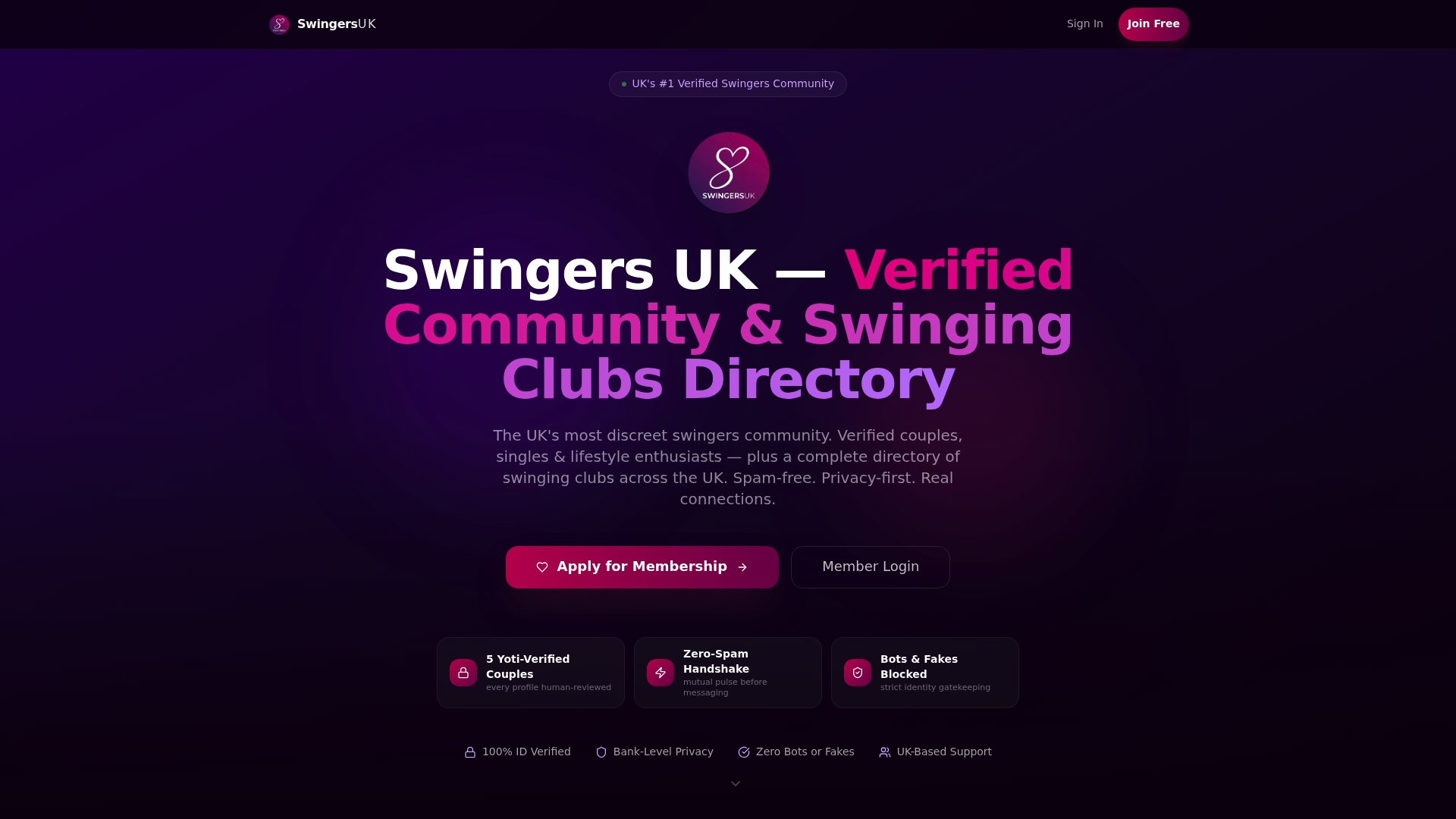
This is a platform for adults 18+ who want verified, consensual interactions in a community that takes privacy seriously. Every profile is ID-verified. Every message requires a mutual pulse. Incognito controls, private cam rooms, and a live events directory give members real ways to connect beyond the screen. There are no open free-tier loopholes for bot farms to exploit.
Check Swingersuk’s identity verification process to see exactly how the multi-layered system works, then view membership options to find the tier that fits you.