
Consent-Based Dating Apps: What Privacy-First Daters Need to Know
Consent-Based Dating Apps: What Privacy-First Daters Need to Know
Consent-based dating apps require mutual, explicit opt-in before any contact or profile reveal. Rather than letting anyone message anyone after a one-sided swipe, these platforms encode consent directly into their product architecture: you only receive a message or see a full profile after both parties have signaled genuine interest. For UK users, that design choice carries real weight. The EFF has argued that consent must be built into product flows, not left to user education alone. Under UK GDPR, platforms also carry legal obligations around how they collect and process your personal data. Swingersuk is one UK provider that has built this mutual opt-in model into its core feature set.
Three immediate benefits for you as a user:
- Clearer boundaries: contact only happens when both people have actively chosen it
- Less unwanted messaging: the architecture blocks unsolicited outreach by design, not by policy
- Improved safety: verified identities and reversible consent reduce the risk of harassment and catfishing
Key Takeaways
Consent-first design is the most structurally sound approach to dating app safety: mutual opt-in, identity verification, and reversible consent work together to protect you at every stage of an interaction.
| Point | Details |
|---|---|
| Consent is architecture, not policy | Platforms that encode mutual opt-in into the product flow offer stronger protection than those that rely on user education or policy alone. |
| Verification is non-negotiable | AI or human-reviewed ID verification, not just a phone number, is the baseline standard for any genuinely safeguarded dating app. |
| UK GDPR adds legal weight | UK users have statutory rights to data deletion, explicit consent for sensitive data processing, and transparent data-retention policies. |
| Trade-offs are real but manageable | Consent-first apps typically have smaller user bases and slower match rates; local events and verified communities offset the discovery-scale limitation. |
| Swingersuk is built for this | Swingersuk’s Pulse Handshake System, ID verification, and freemium subscription model align platform incentives with member safety and genuine connection. |
Table of Contents
- What are consent-based dating apps, and how do they actually work?
- How do consent-based apps differ from traditional dating apps?
- What features should you expect from a consent-based dating app?
- What should UK users know about safety, privacy, and the law?
- How do you choose the right consent-based dating app?
- How does Swingersuk implement consent-first design?
- What are the real limitations of consent-first apps?
- Why Swingersuk recommends consent-first design
- Ready to join Swingersuk? Here is what to expect
- Sources
What are consent-based dating apps, and how do they actually work?
A consent-based dating app is a platform where the product flow itself enforces mutual agreement at every stage. The term “consent-first design” is the recognized industry framing: consent is not a checkbox in the terms of service but a structural gate that controls who can see your profile, who can contact you, and when.
Here is the canonical flow most consent-first platforms follow:
- Discover: you browse anonymized or partial profiles. Full photos, names, and contact details remain hidden.
- Signal interest: you send a soft signal (a like, a pulse, a green-light indicator) without it being visible to the other person unless they reciprocate.
- Mutual reveal: only when both parties have signaled interest does the platform unlock fuller profile information for both of them simultaneously.
- Verified contact: messaging opens only after mutual reveal. On platforms with identity verification, you know the person you are contacting is real.
- Withdrawable consent: either party can revoke access at any time, immediately closing the messaging thread and re-hiding profile details.
MeetPartner illustrates step 3 directly: full profiles and photos are only shown after both users consent, so neither person is exposed to the other without reciprocal agreement. Nudge takes a real-time approach to step 2, using a traffic-light signal (green, yellow, red) so users can express in-the-moment willingness to be approached during local discovery. WeConsent adds encrypted consent records and a discreet SafeWord feature, creating an auditable trail of mutual agreement.
A quick example of the flow in practice: You browse partial profiles, signal interest in someone, and nothing happens on their end until they signal back. Once both signals are in, profiles unlock, messaging opens, and you can arrange to meet. If at any point you change your mind, you withdraw consent and the connection closes. No lingering access, no stored contact details on their side.
How do consent-based apps differ from traditional dating apps?
The structural gap between consent-first and swipe-first platforms runs deeper than a single feature. It shows up in the business model, the matching flow, and the incentives the platform has to keep you engaged.
| Dimension | Consent-first apps | Traditional swipe apps |
|---|---|---|
| Matching flow | Mutual opt-in required before any profile reveal or contact | One-sided swipe opens messaging; full profiles visible immediately |
| Messaging model | Messages only possible after both parties consent | Either party can message after a one-sided match; often anyone can message on free tiers |
| Identity verification | ID verification or AI-reviewed profiles standard | Verification optional or limited to phone number |
| Privacy and data sharing | Minimal data exposure; location often hidden or approximate | Precise location frequently shared; data used for ad targeting |
| Business model | Freemium with premium safety and privacy features; revenue from subscriptions | Revenue often tied to engagement metrics and ad impressions, incentivizing more swiping |
| Safety and reporting | Built-in reporting, reversible consent, moderation-first design | Reporting available but often reactive; safety features may sit behind a paywall |
The business-model row matters more than it looks. A platform that earns revenue from ad impressions has a financial reason to maximize the time you spend swiping, which does not align with helping you find a match quickly and safely. A subscription model, by contrast, earns its revenue from members who find the platform worth paying for, which aligns better with genuine connection and safety.
A 2025 TechCrunch investigation found that some dating apps exposed users’ precise location data and personal information, a risk that consent-first platforms address by design through approximate location, opt-in visibility, and minimal data collection. Mainstream apps have also begun experimenting with AI icebreaker tools, as TechCrunch reported on Bumble’s AI features, which creates a tension: AI-generated openers can bypass the authentic mutual interest that consent-first design is meant to protect.
The honest trade-off: consent-first architecture produces fewer but more intentional connections. If you want volume and speed, a swipe-first app delivers that. If you want verified, mutual, boundaried contact, a consent-first platform is the structurally sounder choice.
What features should you expect from a consent-based dating app?
Not every app that claims to be “safe” or “respectful” has actually built consent into its product flow. Use this checklist when evaluating any ethical dating platform:
Mutual opt-in reveal
- Full profiles and photos are hidden until both parties signal interest
- Neither person can see who has viewed them without a reciprocal signal
Tiered consent signals
- More than a binary like/dislike: look for traffic-light systems (green/yellow/red as Nudge uses), super-likes, or pulse signals that let you express degrees of interest
- Signals should be private until matched, not broadcast to the whole community
Identity verification
- AI-reviewed or human-reviewed ID verification, not just a phone number
- Verified badge visible on profiles so you know who you are dealing with
Privacy controls
- Approximate or opt-in location sharing, never precise real-time coordinates
- Incognito or invisible browsing mode so you can look without being seen
- Granular visibility settings (who can see your profile, your photos, your status)
Reversible consent
- You can close a connection at any time, immediately revoking the other person’s access to your profile and messages
- Data deletion on request, with a clear timeline
Safety tools
- In-app reporting with a fast moderation response
- Encrypted consent records (as WeConsent provides) for situations where a record of mutual agreement matters
- A discreet safety trigger or SafeWord feature for in-person meetups
Questions to ask customer support or check in the privacy policy:
- How long do you retain my data after I delete my account?
- Is my location data shared with third parties or used for advertising?
- Are safety features (reporting, blocking, incognito mode) available on the free tier or paywalled?
- What is your verification process, and how do you handle fake profiles?
Pro Tip: Check the privacy policy’s data-retention section before you sign up, not after. A platform that retains your data indefinitely after account deletion is not genuinely consent-first, regardless of what its marketing says.
What should UK users know about safety, privacy, and the law?
UK users operate under two overlapping frameworks: UK GDPR (the retained EU regulation, now administered by the Information Commissioner’s Office) and the Online Safety Act, which places new duties on platforms to protect users from harm.
Under UK GDPR, a dating app must have a lawful basis for processing your personal data. For sensitive categories like sexual orientation or relationship preferences, the bar is higher: explicit consent is required. That means the platform must ask clearly, record your agreement, and let you withdraw it. This is distinct from in-person consent for contact, but the principle is the same: your agreement must be freely given, specific, informed, and revocable.
Safety features UK users should expect as standard:
- ID verification: platforms operating in the UK lifestyle space should verify member identity, not just email addresses
- Reporting and moderation: a clear, accessible reporting pathway with a committed response time
- Data-deletion controls: a straightforward account-deletion process that removes your data within a defined period
- Incident response: a named contact or process for safety incidents, not just a generic support email
The EFF’s analysis frames this precisely: consent must be encoded in product flows, not left to user education. A platform that publishes a consent policy but still lets anyone message anyone has not actually implemented consent-first design. UK users should look for platforms where the product itself enforces the policy.
Location data deserves special attention. The TechCrunch investigation into dating app data exposures showed that precise location sharing creates real risks. A consent-first platform should offer approximate location (city or region level) for discovery, with exact location never shared without your explicit, per-session opt-in.
How do you choose the right consent-based dating app?
Work through these priorities in order before you create an account:
- Verify the verification: does the platform use AI-reviewed or human-reviewed ID checks? A phone number is not verification.
- Test the mutual opt-in flow: can you browse without being seen? Does messaging require both parties to signal interest first?
- Read the privacy policy for data retention and third-party sharing: if the policy is vague or the retention period is indefinite, treat that as a red flag.
- Check the membership model: are safety features (blocking, reporting, incognito mode) available on the free tier, or are they paywalled? Safety should not be a premium add-on.
- Assess the local community: a consent-first platform with no members in your area delivers the architecture without the connections. Check for active regional communities or local events.
- Look for reversible consent: can you close a connection instantly and have your profile re-hidden? If not, the consent model is incomplete.
Questions to ask before joining:
- “What happens to my data if I delete my account, and how long does deletion take?”
- “Are your verification badges visible to other members?”
- “Can I use incognito mode on a free membership?”
Red flags to watch for:
- No visible verification process or badge system
- Safety features locked behind a paid tier
- Vague or non-existent data-deletion policy
- Precise real-time location shared by default
- No published community guidelines or moderation policy
Check the Swingersuk pricing page to understand which features are available at each membership level before committing.
How does Swingersuk implement consent-first design?
Swingersuk maps its platform features directly to consent-first principles across every dimension that matters. The table below shows how each platform element aligns with the consent-first architecture described in this guide.
The Pulse Handshake System in practice: you browse member profiles with visibility controls active. When you find someone interesting, you send a Pulse. They receive a notification that someone is interested, but your identity is not revealed. If they send a Pulse back, the system registers a mutual match, unlocks both profiles to each other, and opens a private messaging thread. Neither person can contact the other until that mutual signal is confirmed. You can withdraw at any time, which closes the thread and re-hides your profile from that member.
Trust signals you can verify directly:
- ID verification process: explains the AI and human-review steps
- Admin notifications: details how the Pulse Handshake and notification flows work
- Community guidelines: published safety expectations and reporting pathways
- Local events and business listings: verified venue and event directory for in-person meetups
What are the real limitations of consent-first apps?
Consent-first design is structurally sounder than swipe-first, but it comes with genuine trade-offs. Knowing them upfront helps you set realistic expectations.
Myth vs. reality:
- Myth: “Consent-first apps eliminate all risk.” Reality: they reduce structural risk significantly, but no platform eliminates human behavior. Verification reduces fake profiles; it does not guarantee every verified member behaves well.
- Myth: “Mutual opt-in means slower matching.” Reality: it means fewer but more intentional connections. Most users on consent-first platforms report higher-quality interactions, even if the volume is lower.
- Myth: “These apps are only for niche communities.” Reality: consent-first architecture is increasingly recognized as best practice across the dating sector. Platforms like MeetPartner and WeConsent serve mainstream audiences with this model.
- Myth: “If both people consented to connect, the platform’s job is done.” Reality: consent is ongoing and withdrawable. A well-designed platform makes it easy to revoke access at any stage, not just at the initial match.
Operational limitations to plan for:
- Smaller active user bases than mainstream swipe apps, particularly outside major UK cities
- Slower initial match rates due to the mutual-signal requirement
- Verification processes add onboarding time (typically a few minutes for AI review, longer for human review)
- Some platforms restrict discovery features to paid tiers, which can limit free-tier users’ ability to find matches
Pro Tip: If you are on a consent-first platform with a smaller local user base, activate event notifications and check the local events directory. In-person community events are often where the most active verified members connect, and they sidestep the discovery-scale limitation entirely.
Why Swingersuk recommends consent-first design
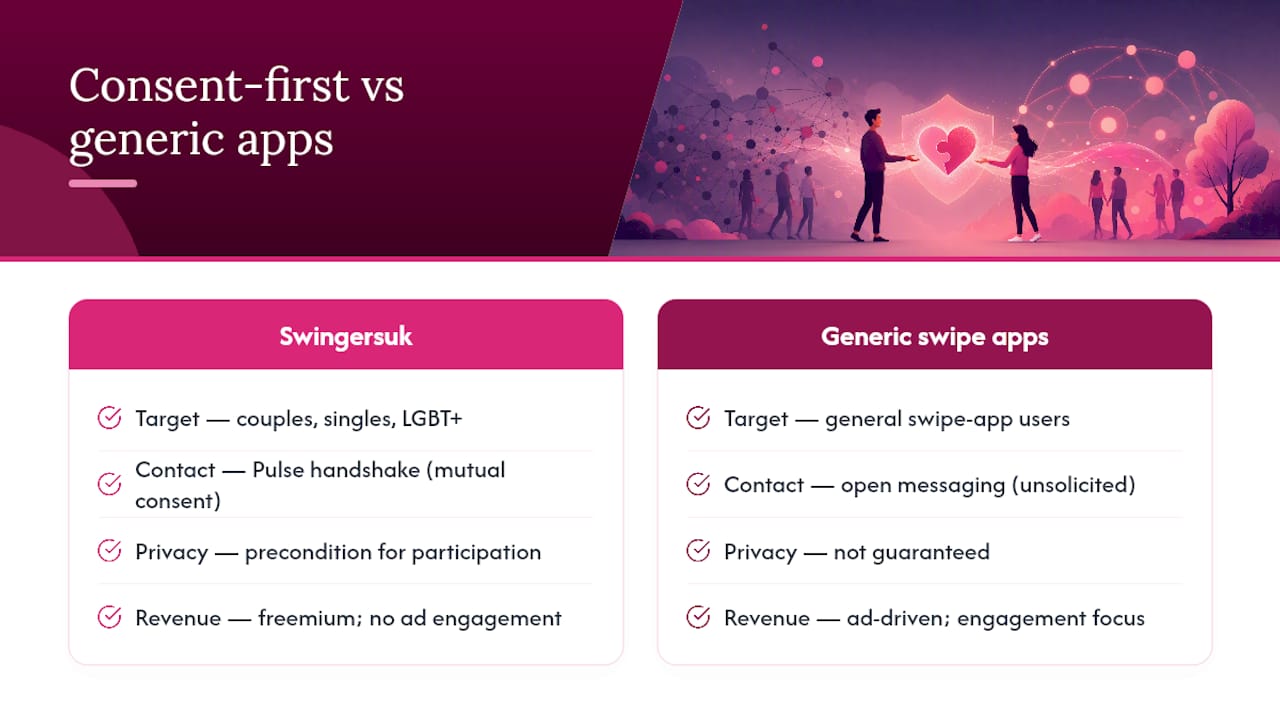
Swingersuk is transparent about its position: this platform was built for the UK lifestyle community, and that community has specific needs that generic swipe apps do not meet. Members are couples, singles, and LGBT+ users who are exploring consensual non-monogamy. Privacy is not a nice feature for them; it is a precondition for participation.
The Pulse Handshake System exists because the alternative, open messaging, creates the exact environment that drives members away: unsolicited contact, fake profiles, and the anxiety of not knowing who has seen your information. By requiring mutual interest before any contact, Swingersuk aligns its product incentives with its members’ actual needs.
The platform’s freemium model reinforces this. Revenue comes from members who find the platform worth paying for, and from verified businesses and event organizers listing on the platform. There is no advertising revenue tied to engagement metrics, so there is no financial pressure to maximize unsolicited contact or keep you swiping indefinitely.
For UK members specifically, the combination of UK GDPR compliance, ID verification, and regional (not precise) location for events means you can participate with a level of privacy that mainstream apps structurally cannot offer.
Ready to join Swingersuk? Here is what to expect
Swingersuk gives UK lifestyle members something most dating platforms do not: a verified, consent-first community where the product itself enforces mutual agreement, not just the terms of service.
When you sign up, the onboarding process walks you through ID verification first. AI and human reviewers check your identity, and your verified badge goes live on your profile. From there, you set your visibility preferences: who can see your profile, whether you appear in searches, and whether incognito mode is active. The Pulse Handshake System is on by default, so no one can message you without a mutual signal already in place.
Three things to do immediately after joining:
- Set your visibility controls before you start browsing, so your profile is only as visible as you want it to be
- Complete ID verification to unlock full messaging and to signal to other members that you are a verified, trustworthy contact
- Review the community guidelines so you know exactly what the platform’s zero-tolerance standards cover and how to report anything that falls short
Check membership options and premium features to see what is available at each tier before you decide.
Sources
These are the primary sources used in this guide, each worth reading directly for deeper context:
- Dating Apps Need to Learn How Consent Works
- Techcrunch
- WeConsent
- Nudge - Meet People IRL, On Your Terms
- MeetPartner - Privacy-First Dating App | Match on Values, Not Just Photos