
UK Age Verification Online: What Sites and Users Must Know
UK Age Verification Online: What Sites and Users Must Know
Yes, age verification online in the UK is now a legal requirement. The Online Safety Act 2023 mandates that specified services implement “highly effective” age assurance, with duties enforceable from July 2025. Ofcom oversees compliance, and Gov confirms that platforms must use secure methods — facial scans, photo ID, credit-card checks — while avoiding unnecessary data collection.
The practical consequences are immediate.
- For platforms: Any service in scope must implement a compliant age-assurance system or face Ofcom enforcement, including fines and remedial directions.
- For users: Expect to complete a verification step before accessing age-restricted content, with the type of check varying by platform.
- For everyone: Privacy trade-offs are real. Stronger verification typically means more personal data changes hands, which is why method selection and data-minimization practices matter.
Pro Tip: If you run a dating app, social discovery service, or any platform where users can share explicit content, assume you are in scope. The duty extends well beyond dedicated pornography sites.
Key Takeaways
The Online Safety Act requires “highly effective” age assurance for all in-scope UK services from July 2025, with Ofcom holding enforcement powers and no single technical method guaranteed to satisfy the standard alone.
| Point | Details |
|---|---|
| Legal duty is live | Age-assurance duties under the Online Safety Act became enforceable in July 2025 for all in-scope services. |
| Scope is wider than pornography | Dating apps, social discovery platforms, and any service permitting explicit UGC in profiles or messages must comply. |
| No method is automatically sufficient | “Highly effective” requires a system that is robust against circumvention; self-declaration alone does not qualify. |
| Privacy obligations are binding | DPIAs, data minimization, and limited retention are required under UK GDPR; collect only what confirms age, nothing more. |
| Layered approaches reduce risk | Combining a low-friction first check with a stronger fallback satisfies Ofcom while minimizing user exclusion and data exposure. |
Table of Contents
- How UK law on online age checks developed
- Which online services are in scope for age assurance duties
- Age verification vs. age estimation: what Ofcom’s standard actually means
- Common methods platforms use for age assurance
- What you should expect when verifying your age online
- ICO expectations, data minimization, and avoiding verification-as-surveillance
- A practical compliance checklist for UK platforms
- How Ofcom enforces age-assurance duties
- How a verified UK community platform puts age assurance into practice
- The privacy trade-off that regulators aren’t fully resolving
- Sources
How UK law on online age checks developed
The UK’s path to mandatory age verification online has been anything but direct. Understanding the timeline helps you anchor your compliance obligations to concrete legal events rather than vague regulatory signals.
| Year | Event | Significance |
|---|---|---|
| — | Digital Economy Act passed | First attempt to mandate age verification for pornographic websites in the UK |
| — | DEA Part 3 implementation delayed repeatedly | Technical and political obstacles stalled rollout |
| — | Government abandons DEA age-verification provisions | Cited concerns about scope and enforcement gaps |
| 2023 | Online Safety Act receives Royal Assent | Replaces DEA approach with broader, risk-based duties under Ofcom |
| — | Ofcom consults on Children’s Safety Codes | Draft codes published for industry comment |
| July 2025 | Age-assurance duties become enforceable | Platforms must demonstrate compliance or face regulatory action |
The Digital Economy Act’s failure was instructive. It targeted pornographic sites narrowly and relied on a single regulator (the British Board of Film Classification) with limited enforcement reach. The Online Safety Act takes a fundamentally different approach: it places duties on a broader category of services, gives Ofcom substantial enforcement powers, and requires “highly effective” age assurance rather than prescribing a single technical method.
Pro Tip: Bookmark legislation.gov.uk and Ofcom’s Children’s Safety Codes page. These are the primary legal texts — not summaries or press releases — and they are what regulators will reference during an investigation.
Which online services are in scope for age assurance duties
The scope of the Online Safety Act’s age-assurance duties is broader than most operators initially assume. Dedicated pornography sites are the obvious case, but the highly effective age assurance requirement extends to dating and social discovery services that permit pornographic or other age-restricted user-generated content in profiles or private messages.
Use this sequence to determine whether your service is in scope:
- Identify your primary content type. Does your platform host, distribute, or facilitate access to pornographic content as a core function? If yes, you are in scope.
- Assess user-generated content. Can users upload, share, or send sexually explicit images or videos — even in private messages? If yes, the duty likely applies regardless of whether explicit content is your platform’s primary purpose.
- Check public vs. private spaces. The duty covers both public profiles and private messaging where explicit content is shared. A “private” channel does not exempt you.
- Consider your service category. Dating apps, social discovery platforms, and lifestyle community sites that permit explicit UGC fall within scope under Ofcom’s guidance.
- Review your terms of service. If your terms prohibit explicit content but your moderation does not enforce that prohibition effectively, regulators may still treat you as in scope.
Pro Tip: Edge cases include platforms where explicit content is technically prohibited but routinely shared in private messages. Ofcom’s guidance suggests that the practical reality of what users do on your platform matters more than what your terms say. If explicit content flows through your service, plan for compliance.
Age verification vs. age estimation: what Ofcom’s standard actually means
The Online Safety Act draws a precise statutory distinction between two concepts that are often conflated.
Age verification confirms a user’s age against a reliable, external reference — typically a government-issued ID, a financial record, or a mobile network operator’s data. The result is a definitive confirmation that the user is above a threshold age.
Age estimation uses observable signals — most commonly facial analysis — to infer a probable age range. It does not confirm identity; it produces a probabilistic output. A facial estimation system might conclude that a user is “likely over 25” without knowing who they are.
Both methods can contribute to a compliant system, but neither is automatically sufficient on its own. What Ofcom requires is that the overall age-assurance process is “highly effective” at preventing under-18s from accessing in-scope content. Critically, bare self-declaration — a user ticking a box to confirm they are 18 — is explicitly excluded from counting as verification under the Act.
In practice, “highly effective” means your system must be difficult for a determined minor to bypass, not merely inconvenient. A single, low-friction check that a teenager could circumvent with a parent’s credit card number is unlikely to satisfy the standard alone.
Common methods platforms use for age assurance
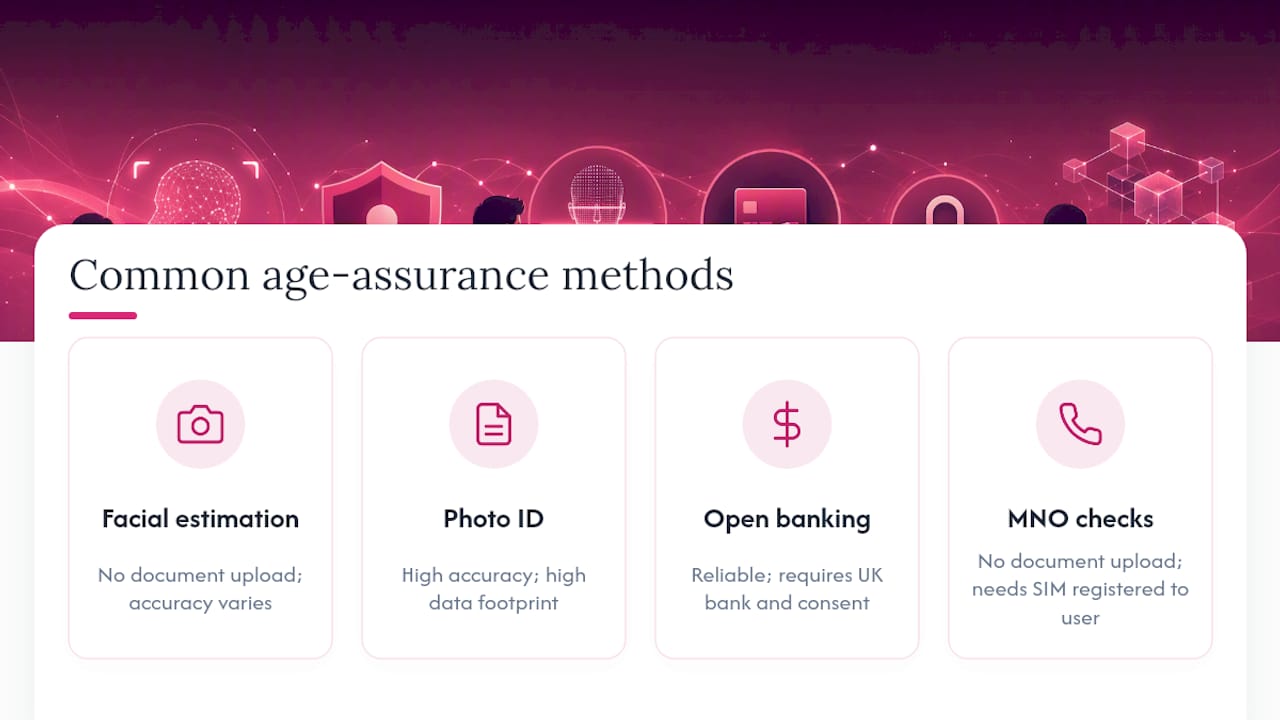
Platforms commonly use open banking, credit card checks, mobile operator checks, and facial estimation, with Ofcom confirming that platforms may choose their method provided the overall process is highly effective. Each approach carries distinct trade-offs.
Facial age estimation analyzes a live or uploaded image to infer age. It is low-friction and requires no document upload, but accuracy varies across skin tones and lighting conditions, raising accessibility and bias concerns. Privacy risk is moderate to high: the image itself is sensitive biometric data.
Photo ID upload with selfie match cross-references a government document against a live facial image. Accuracy is high when implemented well, but it creates a significant data footprint. As the EFF notes, even with deletion promises, the initial upload and vendor processing create high-risk data targets. Accessibility is a concern for users without valid photo ID.
Credit-card checks use a card transaction or lookup to infer that the account holder is an adult. They are widely understood and low-friction, but a minor with access to a parent’s card can bypass them. Privacy risk is relatively low compared to biometric methods.
Open banking verifies age through a user’s bank account data, typically via a regulated open-banking provider. It is more reliable than a card check alone and avoids biometric data, but requires the user to have a UK bank account and consent to data sharing.
Mobile network operator (MNO) checks use the subscriber’s account data held by their mobile carrier to confirm age. They are privacy-preserving in that no document is uploaded, but coverage depends on the user having a UK SIM registered in their name.
Zero-knowledge proof (ZKP) and credential-based approaches allow a user to prove they are over 18 without disclosing their actual birthdate or identity. These are the most privacy-preserving option in theory. In practice, ZKPs do not eliminate verifier-side risks such as repeated queries, phoning home to identity issuers, or cross-site linkage. Technical and economic barriers also limit their current deployment at scale.
Device and behavioral signals use device-level data, browsing patterns, or account history as soft indicators of age. These are useful as a first-pass filter but are not sufficient alone for a “highly effective” standard.
Pro Tip: Academic analysis confirms there is no single, fully privacy-protective and universally accurate age-verification method. The strongest compliance posture combines a low-friction first check with a stronger fallback — for example, MNO or open banking as the default, with ID upload triggered only when the soft check is inconclusive.
What you should expect when verifying your age online
If you are a user on a UK platform that falls within the Online Safety Act’s scope, the verification experience will depend on which method the platform has chosen. Here is what a typical flow looks like.
- First visit or signup. You land on the platform and are presented with an age gate before accessing any restricted content. The platform must explain what verification it requires and why.
- Method selection (where offered). Some platforms offer a choice — for example, open banking, MNO check, or ID upload. Others use a single method. You choose or are directed to the platform’s preferred provider.
- Completing the check. Depending on the method, you may be redirected to a third-party verification service, asked to upload a document, take a selfie, or authorize a bank or mobile account lookup. The check typically takes under two minutes.
- Confirmation and access. Once verified, you receive confirmation and gain access. The platform should tell you what data was collected, how long it is retained, and how to request deletion.
- Repeat checks. Some platforms re-verify periodically or when account behavior triggers a review. You should be notified before any re-verification is required.
When handing over personal data, look for these privacy signals in the platform’s policy: no long-term storage of ID images, a clear deletion timeline, no sharing of verification data with third parties beyond the verification provider, and a named data controller you can contact.
If a verification system fails or produces an incorrect result, contact the platform’s support team directly. For suspected misuse of your personal data, you can report to the Information Commissioner’s Office or raise a concern with Ofcom.
Pro Tip: Before completing any ID upload, check the platform’s privacy policy for the verification provider’s name. If the policy does not name the provider or explain how your data is handled, that is a red flag worth acting on before you submit any document.
ICO expectations, data minimization, and avoiding verification-as-surveillance
The ICO’s position on age assurance is grounded in standard UK GDPR principles, but the EDPB’s Statement 1/2025 on Age Assurance makes the stakes explicit: age assurance is high-risk processing, DPIAs are often required, and proportionality is non-negotiable.
Key data-protection obligations for platforms implementing age assurance:
- Lawful basis. Identify and document your lawful basis for processing verification data before you go live. Legitimate interests is rarely sufficient for biometric data; explicit consent or legal obligation is more defensible.
- Data minimization. Collect only what is necessary to confirm the user is over 18. An age-only assertion (“over 18: yes/no”) is preferable to storing a full date of birth or ID document image.
- Limited retention. Do not retain ID images or biometric data beyond the point of verification. Set automated deletion schedules and document them.
- DPIA. Conduct a Data Protection Impact Assessment before deploying any age-assurance system. This is not optional when processing biometric or identity data at scale.
- Transparency. Publish a clear, plain-language age-assurance policy that explains what data is collected, why, how long it is kept, and who processes it.
- Third-party processor due diligence. If you use a third-party verification provider, you must have a Data Processing Agreement in place and conduct due diligence on their security practices.
The EFF’s analysis highlights a risk that many operators underestimate: even well-intentioned verification systems can become surveillance infrastructure if data is retained, aggregated, or shared beyond its original purpose. An ID+selfie flow that creates a permanent record of who accessed what content, and when, is a qualitatively different privacy risk than a transient MNO check that returns only a yes/no result.
Pro Tip: Prefer privacy-enhancing technologies where they are functionally viable. ZKP-based approaches that return only an “over 18” assertion reduce your data liability significantly, even if they require more integration work upfront. The EFF notes that ZKPs are not a complete solution, but they are meaningfully better than storing full identity documents.
A practical compliance checklist for UK platforms
Converting Ofcom’s guidance into a concrete implementation plan requires sequencing your actions correctly. The table below maps each step to a realistic timeframe.
| Action | Timeframe | Owner |
|---|---|---|
| Scope review: confirm whether your service is in scope | 1–2 weeks | Legal / Product |
| Risk assessment: identify content types and user base | 1–2 weeks | Legal / Compliance |
| DPIA: complete before any system deployment | 2–4 weeks | Data Protection Officer |
| Method selection: evaluate and shortlist age-assurance providers | 2–3 weeks | Product / Legal |
| Vendor due diligence: review DPAs, security certifications, ICO registration | 2–3 weeks | Legal / Procurement |
| Technical integration: build and test the verification flow | 4 weeks | Engineering |
| Accessibility testing: verify the flow works for users without standard ID | 1–2 weeks | Product / QA |
| Policy updates: publish age-assurance, retention, and appeal policies | 1–2 weeks | Legal / Content |
| Transparency notices: update privacy policy and cookie notice | 1 week | Legal |
| Staff training: brief support and moderation teams | 1 week | HR / Compliance |
Three policy documents every in-scope platform should publish:
- Age-assurance policy. Describes which method(s) you use, why you chose them, and how they meet the “highly effective” standard. Include the name of any third-party provider.
- Retention and deletion policy. States exactly how long verification data is held, when it is deleted, and who is responsible for executing deletion.
- User appeal process. Explains how a user who believes they have been incorrectly denied access can challenge the decision and what evidence they need to provide.
Pro Tip: Run your verification flow through an accessibility audit before launch. Users without a passport or driving license — including some older adults, people with disabilities, and those without a UK bank account — must have a viable alternative route. Excluding a significant user group creates both legal risk and reputational exposure.
How Ofcom enforces age-assurance duties
Ofcom’s enforcement toolkit under the Online Safety Act is substantial. The regulator can open investigations on its own initiative or in response to complaints, issue information notices requiring platforms to produce evidence, impose remedial directions ordering specific changes, and levy fines. For the largest platforms, fines can reach up to £18 million or 10% of global annual turnover, whichever is higher, per the Online Safety Act explainer on GOV.UK.
What triggers regulatory action? Ofcom is most likely to act when:
- A platform has no age-assurance system in place for in-scope content.
- A system exists but is demonstrably easy to bypass (e.g., self-declaration only).
- A platform fails to respond to an information notice or provides misleading evidence.
- A significant incident — such as a data breach involving verification data — draws regulatory attention.
Evidence to retain for compliance purposes:
- Scope review and risk assessment documentation.
- DPIA records, including any mitigations applied.
- Vendor contracts and Data Processing Agreements.
- Technical test results demonstrating the effectiveness of your age-assurance system.
- Audit trails showing when the system was deployed, updated, and tested.
- User appeal records and outcomes.
Retain compliance evidence for a minimum of three years, or longer if Ofcom has opened an investigation. Beyond regulatory fines, non-compliance carries reputational risk — press coverage of a platform that failed to protect minors can be more damaging than a fine — and contractual risk if your payment processor or app store partner requires compliance as a condition of service.
| Evidence type | Recommended retention |
|---|---|
| Scope review and risk assessment | 3 years minimum |
| DPIA records | 3 years minimum, or duration of processing |
| Vendor contracts and DPAs | Duration of contract plus 3 years |
| Technical test results | 3 years minimum |
| User appeal records | 2 years minimum |
How a verified UK community platform puts age assurance into practice
Swingersuk operates as a verified community for UK adults, and its approach to age assurance reflects the layered, privacy-conscious model that Ofcom’s guidance points toward. The platform combines AI-assisted checks, human review, and ID fallback — a sequence that mirrors industry-wide adoption patterns ahead of the Online Safety Act taking effect.

The verification flow works in stages. A new member’s account is first assessed using automated behavioral and profile signals. If those signals are inconclusive or raise a flag, the system escalates to a facial estimation check. Members who cannot be confirmed through estimation are prompted to complete an ID verification step, which is reviewed by a human moderator before access to restricted features, including cam rooms, is granted.
The lessons from this implementation are practical. UX friction is real: the ID upload step causes some drop-off, and the platform mitigates this by making the lower-friction checks the default and reserving the ID step for cases where it is genuinely necessary. False positives — real adults flagged incorrectly — are handled through a clear appeal route, with human review as the backstop. The measurable benefit is a community with significantly fewer fake accounts and a higher baseline of trust among members.
Pro Tip: The layered approach — soft check first, stronger check only when needed — reduces both friction and exclusion. It also produces a cleaner audit trail: you can demonstrate to Ofcom that your system escalates proportionately rather than applying maximum friction to every user.
The privacy trade-off that regulators aren’t fully resolving
Age verification is a genuine child-safety tool. That is not in dispute. What deserves more honest discussion is the gap between what regulators describe as “privacy-preserving” and what most deployed systems actually do.
Ofcom’s guidance correctly points toward data minimization and proportionate methods. The EDPB’s 2025 statement reinforces this. But the practical reality is that the methods most operators can deploy at scale — ID upload with selfie, credit-card checks, MNO lookups — all create data relationships between a user, a platform, and a third-party verification provider. Even when the platform itself sees only a yes/no result, the verification provider holds the underlying data. That data is a target.
ZKP-based approaches genuinely reduce this risk, but they require infrastructure that most smaller platforms cannot build or procure easily. The result is a compliance market where the most privacy-protective methods are the least accessible, and the most accessible methods carry the highest surveillance risk.
The honest position for any platform operator is this: you cannot fully eliminate the privacy cost of age assurance with current technology. You can minimize it by choosing the least-invasive method that meets the “highly effective” standard, conducting a rigorous DPIA, and being transparent with users about what you collect and why. That is not a perfect answer, but it is the right one.
Sources
The sources below are the primary legal texts and regulator guidance that govern UK online age verification. Reading summaries is useful; reading the primary materials is what compliance actually requires.
- Dating and social discovery: know the online safety risks, rules and how to comply
- Keeping children safe online: changes to the Online Safety Act explained
- Online Safety Act 2023 (section on “age verification” and “age estimation”)
- Age Verification Systems Are Surveillance Systems | EFF
This article is general information, not a substitute for advice from a qualified lawyer. Consult a qualified legal professional about your own circumstances before acting on anything here.